TorrentFreak

The place where breaking news, BitTorrent and copyright collide

Artists Make More Money in File-Sharing Age Than Before It

An extensive study into the effect of digitalization on the music industry in Norway has shed an interesting light on the position of artists today, compared to 1999. While the music industry often talks about artists being on the brink of bankruptcy due to illicit file-sharing, the study found that the number of artists as well as their average income has seen a major increase in the last decade.

Every other month a new study addressing the link between music piracy and music revenues surfaces, but only a few really stand out. One of the most elaborate and complete studies conducted in recent times is the master thesis of Norwegian School of Management students Anders Sørbo and Richard Bjerkøe.

In their thesis, the students take a detailed look at the different revenue streams of the music industry between 1999 and 2009. By doing so, they aim to answer the question of how the digitization of music – and the most common side-effect, piracy – have changed the economic position of the Norwegian music industry and Norwegian artists. The results are striking.

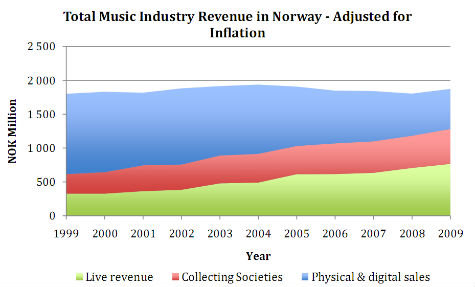
After crunching the music industry’s numbers the researchers found that total industry revenue grew from 1.4 billion Norwegian kronor in 1999 to 1.9 billion in 2009. After adjusting this figure for inflation this comes down to a 4% increase in revenues for the music industry in this time period. Admittedly, this is not much of a growth, but things get more interesting when the research zooms in on artist revenue.

Music industry revenue corrected for inflation
norway music industry

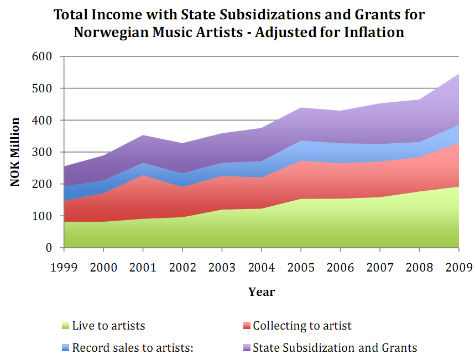
In the same period when the overall revenues of the industry grew by only 4%, the revenue for artists alone more than doubled with an increase of 114%. After an inflation adjustment, artist revenue went up from 255 million in 1999 to 545 million kronor in 2009.

Some of the growth can be attributed to the fact that the number of artists increased by 28% in the same time period. However, per artist the yearly income still saw a 66% increase from 80,000 to 133,000 kronor between 1999 and 2009. In conclusion, one could say that artists are far better off now than they were before the digitization of music started.

Artist revenue corrected for inflation
norway music industry

Aside from looking at the reported revenue, the researchers also polled the artists themselves to find out what their income sources are. Here, it was found that record sales have never been a large part of the annual revenue of artists. In 1999, 70% of the artists made less than 9% of their total income from record sales, and in 2009 this went down to 50%.

Live performances are the major source of income for most artists. 37% of Norwegian artists made more than 50% of their income from live performances in 2009, up from 25% in 1999. That said, it has to be noted that only a few artists make a full living off their music, as most have other jobs aside.

In conclusion, the study refutes some of the most common misconceptions about the music industry in the digital age. Musicians are making more money than ever before. It is true that the revenues from record sales are dwindling, but that can be just as easily attributed to iTunes as The Pirate Bay.

The bottom line is that the music industry as a whole is thriving. Record labels may report a dip in their income from record sales, but more money is going to artists at the same time. Is that really such a bad outcome? Well, that depends on who you’re listening to.


Related Posts

Previous Post | Next Post

  • yeahright

    anibody notice ticket prices increase with 400 percent at least??? as well as the associated merchandising and food and beverages at the concerts

  • TerribleTony

    @1 It’s called “captive audience.” Movie theatres have been doing it for years. You can legally rip off your customers because they can’t go anywhere else for their sugar and alocohol fixes. Damn druggies. :D

    Best way to avoid excessive ticket prices is to not buy them. Personally I prefer to spend £3-4 on a ticket to see local bands who have more talent in their little fingers than these so-called mega-stars.

    But your post is completely off-topic, and I have just compounded the error.

  • Anonymous

    @yeahright

    Well at least it’s a good experience which can’t be copied.

  • yawn

    Still, stealing is stealing.

  • Mike

    Do you have a link to the original study? I’d like to see if they’ve looked at stuff like the distribution of money among artists.

    This is all conjecture, but I’d imagine we’d have a fairly skewed distribution, with a lot of the revenue concentrated to a few bands/individuals. Particularly in the 20th century.

    However, I’d be willing to bet it’s less skewed now – thanks to the internet.

  • An0nYm0uS

    Were do you guys live… so i can go steal from you directly.

  • yawn harder

    @4

    It seems nothing was stolen.

  • The Rust Belt

    @6

    You mean – make copies of what we already posses. I have no problem with that, just pay the cost of copying.

  • hyperlexic

    a live experience was always the ‘real’ product these artists sold. yeah it sucks that cool new bands like The Black Keys don’t see a dime from record sales, but that doesn’t mean they can’t market themselves right and set up a big dope tour with the White Stripes and become millionaires.

    sorry, musicians have been living ‘godlike ‘lives’ for too long. if you’re lucky enough to make a really good lump of money simply through your art – that’s enough blessing.

  • sarantis

    there is no theft. it steal something is to cause someone financial harm by taking what is not yours. if the music is not for me to enjoy then keep it off the web and under your mattress. if how ever you want make money then set it free and let the market decide what your talents are worth.

  • hyperlexic

    @TerribleTony i don’t think enough scrutiny is put into who actually owns the major theater chains that seem to dominate the U.S. at least. I did a little digging, and found some major ones owned by the studios right out. anyone asking if there enough competing screens in the same area with the same access to the movie as the theaters owned by the studio to give the consumer a fair choice?

  • GrX

    @6 you are the type of person i bet who if you see someone else driving the same model make of car as yourself you phone the police and report how angry you are your car has been stolen.

    last week my mobile phone was stolen from my van it’s gone i dont have it no more i cannot use it no more thus it’s harmed me because i pysically do not have it

    that is stealing

    now if they pop’d the door open took a copy and cloned the phone and left the original there then hell i wouldn’t care less nothing lost and someone benefited from something i had which i made someone else happy and still managed to keep my original

    that is not stealing

  • lilars

    @#10
    Good comment.In every other aspect of the internet we are told not to expect any kind of privacy,once we put it out there.

  • Antonio

    The headling is a bit misleading. It could’ve read “Artists Make More Money in Three-Eyed Fish Age Than Before It” and it’d still be accurate.

    Things other than file sharing have changed. Perhaps people are buying music or the same people are paying for their music (live and on cd/mp3) but that still doesn’t disprove that illegal sharing, be it copying or handing over your cd, is still illegal and still hurts many industries (I’m a visual artist and we get stung by this too)

  • The Rust Belt

    @14

    It is hard to disprove that “illegal sharing is illegal”, don’t you think? Besides, copyright is not about “industries”, although “industries” seem to think so.

  • Jhon Pridgelton

    well, interesting fact. I thought it was the other way round. Well, check here and see more amazing things you did not know! http://ow.ly/2B3qm

  • Anonymous

    obvious troll is obvious

  • Anonymous

    Artists benefit while record companies suffer. This is EXACTLY why I pirate (and because I’m a dirt poor college student).

    #14 has a good point though. The only thing this proves is that the record companies are wrong when they say piracy hurts the industry. We can’t say that piracy helps it, but it definitely does not hurt.

  • yawn even more

    @4

    seriously dude, don’t ever say something stupid like that again, just don’t…

  • yawn even more

    also

    #14

    wrong answer, next!

  • The United Hackers Association

    @6 oh
    what will the actors do when avatar technology means we dont need any actors at all

    what will musicians do when we create software to make tunes too

    YOU WILL BE ASSIMILATED
    and robots took GM factory jobs NOW WERE COMING FOR YOU

  • Pingback: Artists Make More Money in File-Sharing Age Than Before It - Holdem Poker Forum

  • Pingback: Innovations that Thrive without IP

  • eni

    This doesn’t surprise me in the least. The entire ‘anti-piracy’ campaign is developed to keep the record companies and their movie brethren in the money, not to get the money to the artists.

    I just wonder when the baying mob will realise this…

  • To Your Sucess

    @18 “Dirt poor college student and to others” Make your $ dreams a reality. Sign up 5 serious people and profit. 50 Reasons why to join this on http://is.gd/faoJC .

  • Pingback: Studien: Künstler verdienen im Filesharing-Zeitalter mehr als zuvor

  • anonymous

    agree entirely with ‘by eni’. just think that it is the world’s governments that need to realise what is actually happening, not ‘the baying mob’, and it applies to every aspect of the entertainment industry, whether it be music, movie or game. i dont think anyone here wants to deprive artists. it is the ‘moguls’ at the top of the trees, doing the least and gaining the most, under the pretence that those artists are losing out hand over fist, that is so objectionable

  • Anonymous

    @6 An0nYm0uS

    “Were do you guys live… so i can go steal from you directly.”

    No. You got it wrong.

    We can now steal from you directly, from you and your boss after you stealed from us and the artists for so many years.

    We can and we will.

    We will also torch your houses, jack your cars, bulldoze your backyard sink your boats and crash your planes.

    Say bye bye to your Bentley music parasites. The party is over.

  • Anonymous

    “In 1999, 70% of the artists made less than 9% of their total income from record sales, and in 2009 this went down to 50%.”

    erm, so in 1999, 30% had 10%+ from records
    in 2009 50% has 10%+ from record sales.

    So more artists made money from record sales in 2009? i dont think this stat is correct?

  • Pingback: Artists Make More Money in File-Sharing Age Than Before It | Systema

  • Carefully watching

    The Music and Movie industries in general make so much money it makes me sick. The issue is that I work hard to make 50k a year and when I have to spend on average $150-$200 for 2 people to go to a concert or $50-$60 for 2 people to go to the movies is nuts. There is no real reason any 1 person needs to make millions of dollars. If anything history should teach us all when 3% of the people own 80% of the economy war/revolutions happen. The music and movie industry will crumble on its own greed it will take time. Robin Hood may be called a thief but most agree what he did isn’t theft.

  • Anonymous

    Come on, Ernesto, this article is totally biased: First, the total music industry revenue has not progressed at all for 10 years according to the first graph (0.4%/year), then the study does not differentiate between physical and digital sales, and then of course, most of the revenue goes to a minority of artists. A distribution chart as mentioned by @5 would have been nice.
    @26 I am confused by the phrasing too, but since physical records sales have been declining, I think it means “in 1999, only 70% of the artists had a revenue from records sales, amounting to less than 9% of their income.” It would seem that the digital sales are not able to compensate for physical sales decline, therefore probably giving an argument to the anti-piracy advocates. But again, the useless study does not differentiate between physical and digital, which is really a let down as a missing key information.

  • http://torrentfreak.com Ernesto

    @30

    I wouldn’t call it biased. The bottom line is that artist’s revenues overall have increased. That’s hard to dispute since the numbers speak for themselves.

    If you read the last two paragraphs you’ll see that we point to http://torrentfreak.com/is-piracy-really-killing-the-music-industry-no-100418/ for the digital / physical issue and piracy. In that article we argue that changes in consumption habits are more likely to be the cause of stagnating revenues rather than piracy.

    The difference between digital and physical doesn’t matter really for the question that was asked by the authors. I have to agree that it’s merely correlational (so it’s hard to attribute anything to piracy), but based on the data it would be hard to argue that the financial position of artists has worsened in the last 10 years.

    The study is by no means perfect, but it gives some great insights in my opinion. If you read the full thesis you’ll get a more complete picture than I could possible give in an article, but the title of the article is true no matter how you try to spin it.

  • Pingback: Dear readers, im sorry that I have ignored you all « The Blog Of Kieran Shalloo

  • disbelieved

    i knew that the torrenting of music would lead to INCREASE of profit. those people who download the music usually go out and buy the albums after listening to them . no more buying crap and and wondering if its good. you can make sure you like the stuff you get :)

  • Booger Bender

    Work it Ernesto
    :)

  • neostyles

    Ernesto, isn’t this just for norway? How about another country, where the piracy levels are higher like Russia or western europe?

    Plus, this is just for the music industry overall. The number of artists has increased immensely since 1999, hasn’t it?

  • RippOff

    “…Greed is good.”
    Michael Douglas in The GodFather.

  • Anonymous

    @RippOff: ? 2 out of 3 aint bad ?

  • p_c

    Another intelligent article, thanks TF!

  • awesome

    and they are talking about millions of losses from a single torrent site

    like if I would have bought their stuff If I had never downloaded it in the first place

    I think the problem behind this whole logic that these industries and especially artists have created through out all these years is the lack of education, most artists can play or sing, but CAN’T use their fucking mind for simple things like this.

  • Dan

    Well we know its never been about helping artists, just taking a cut of their hard earned cash.

    Im glad that piracy has occurred on a massive scale and now i’m actually started making my own music which i intent to sell once i get my production skills up to an acceptable standard.

    Without this new digital market we’ve created, i would never be able to make money out of music. Plus i wouldn’t even been able to afford the software i need so there would be no chance.

    God bless piracy!!

  • Chimel

    @Ernesto Sure, any countering to the usual music industry argument is good, but that’s not the part I was contesting.
    Mostly, to which artists goes the revenue. I am finally able to view the thesis, so I could find a partial answer there: The majority of artists earn only 10-20% of their income from music, and only 37% make more than 50% from music. Global statistics hide a lot of disparities, which is the kind of data that interest me more. I ackowledge you can’t and shouldn’t write a summary containing all the personal interests of all your readers, thanks for the thesis link that allowed me to dig further.

    Same about the frustrating lack of physical/digital sales data, I can now see this data was included.
    Among other findings, CD sales have been more or less stable from 1999 to 2004, and on a sharp decline since then, half of what they used to be in 2000.
    Digital sales have increased since the introduction if iTunes, but at a rate over 500% less than the CD decline, so there is no real switch, although it seems to be making up for it fast: Digital sales increased 15% from December 2009 to July 2010, reaching 34% of all albums sales!
    Digital albums sold more than single tracks in 2009, it used to be the reverse with over 50% more revenue from single tracks since the first published digital sales data.

    Fun fact: Thanks to Alexander Rybak, Norwegian artists album sales now rank first (used to be international artists.)

    All in all, pretty good for “just” a thesis.

  • Pingback: La faute au P2P ou la théorie du complot ? «

  • Anonymous

    @8

    could I come and “copy” your credit card number and bank account details?

  • Anonymous

    Can we clarify what Collecting Societies means please?

  • Gordon Gekko

    @ 34 RippOff

    Actually, he said that in the movie Wall Street:

    “The point is ladies and gentlemen that greed, for lack of a better word, is good.”

  • Gordon Gekko

    Actually, make that @ 32

  • Pingback: [TF] Artists Make More Money in File-Sharing Age Than Before It - Overclock.net - Overclocking.net

  • Ninja

    Why I’m not surprised by these figures? Labels revenues might be stagnant (or rather they ARE stagnant) because of their response to the evolution. They lost the train of evolution. And guess what, even with this they are STILL DOING WELL.

    You need very little effort to break arguments based on fake and biased researches =D

  • look again

    @26

    Okay, so let’s start from the beginning. This study was trying to prove that things like “piracy” were not hurting the artists.

    “In 1999, 70% of the artists made less than 9% of their total income from record sales, and in 2009 this went down to 50%.”

    What this means is that in 1999 70% of artists made 9% of their total income from record sales (ie, through the record COMPANY). Now there was a 20% decrease in artists who made their money from records. This simply means that more of their money is coming from live performances and things such as that. Artists are making money from showing themselves, not being on a disk.

    Everyone complained that file sharing was taking money from the people who created the music, when in fact is had only made it better.

    File sharing has taken money from record sales, but that is only from the company, not the artist. File sharing has allowed for more people to find new music more easily (and free) and explore music without having to purchase a crappy cd that only has two or three good songs on it, but people can still enjoy the artist for what they have.

    So, I would venture to say that those artists who have complained about file sharing are those who own a record company, and have deviated from their artistry and moved into capitalism.

  • Pingback: Artists make more money since file sharing |

  • whatev69

    “they’ve been living like gods for too long” yeah let’s just become a socialist country and take the money of those who are successful and distribute it to all of those who aren’t good enough to make it…that seems fair…

  • Iustitius

    The RIAA’s whole thrust is to use their power to intimidate anyone or anything that they claim threatens their purported representees’ (the artists) earnings. The key word is “purported”.
    When I ran sound at a small club several years ago, a rep from the RIAA came around and tried to pressure the manager into paying into their scheme through fear of legal liability. That was based on the assumption that we would be playing music registered with the RIAA on a jukebox or over the PA system, or that the musicians performed such. We said that we had no jukebox, that during business hours, we played music from CDs the local artists that our club featured themselves recorded and gave us, and that we weren’t privy to their set lists, nor were we able to know if they covered any tunes by RIAA-registered artists. We said the rep would have to talk to the bands himself to determine that.
    You can see — the RIAA uses fear to squeeze money from their targets however they can. Every coin they take from local clubs is money that can’t go into a working musician’s pocket. I’d like to see results of studies showing how much of the RIAA’s money trickles down to their “clients”; also, how fairly it is distributed to them, i.e., does the small-timer recieve monies proportional to the mega-sellers, and is that amount fair?
    I suspect the RIAA’s existence is based on false premises — that they don’t really exist to serve the artists who need their protection, but to insure status quo income for the record labels’ executives and their cash-cow stars. Their continually flogging the dead red herring of “piracy/illegal sharing/stealing” illustrates how little they care about statistics, logic, facts, or ethics. Someone needs to put them on the defensive through exposing their inner workings. Let’s keep showing how obsolete those scurvy parasites are in the 21st century!

  • Anonymous

    @40 – “Collecting Societies” are agencies that take money from those convicted of illegal activities in the courts, such as SACEM and SDRM. (I wouldn’t try going to their websites, though — they will get your IP address. PeerBlock has them blacklisted… ;) )

  • Pingback: Michael Alan Miller » Loads of links

  • NeuRoBot

    Sharing isn’t stealing…

    Good artists will make their living from live shows. The music moguls days are numbered!

  • Kyle

    Thing is, you all wouldnt know an estimate of 96% of the music you listen to, if it wasnt for record companies.

  • guilty conscience

    Well, my conscience feels a bit better now. True, I’m still stealing when I pirate music, but at least it’s not _really_ hurting the musicians… just the thieving music labels. It’s okay to steal from those thieves.

  • Anonymous

    @Kyle

    Don’t you mean, “you all wouldn’t know an estimated 96% of the music you listen to if it wasnt for filesharing”…?

    @guilty conscience

    Well, since filesharing isn’t stealing by any definition of the word except for the MAFIAA’s entirely fictional definition, your conscience can feel even better.

  • Copymachine

    @4: But it is not stealing, it is COPYING!

  • walt235

    The joo parasites who control the media don’t like it because it takes away their control. Taking money out of a kike’s pocket is like putting a stake thru the heart of a vampire.

  • Pingback: “Artists Make More Money in File-Sharing Age Than Before It” « Geek Drivel

  • Pingback: Kalingeling-Schulterblick: 14.09. und 15.09.2010 « Kalingeling – Verdienstkonzepte im Netz

  • Whatever

    @32 neocommunist
    “he number of artists has increased immensely since 1999, hasn’t it?”

    It helps to have all those “everybody has talent or look stupid on TV shows”.

    Lets count: If the number of artists increase to 1 billion then the rest of the world need give a million times more to the MAFIAA just to keep every single artist away from work (thanks to MAFIAA “tax” collecting foundations). No wait, strike that, it would be 2 million because of inflation and piracy to compensate for their feeling of being robbed while waiting for the next check in the mail.

    Where can i register as an artist ?

    (In this regard the only real communist system left is the music industry)

  • betterPropaganda

    I’m surprised by two things that have been overlooked in this discussion:
    (1.) It’s already been methodically demonstrated that file sharing did not cause sales declines in the record industry. Harvard Business School Associate Professor Felix Oberholzer-Gee and Professor Koleman Strumpf of the University of North Carolina demonstrated this back in 2004: http://tinyurl.com/22rs6ch
    (2.) Most people above have missed a second salient point. The student research above was completed for the “music industry in Norway”, a rounding error percentage of the overall music market. There’s no indication that anything garnered from Norway’s experience is relevant to the overall market, especially given the Norwegian government’s indicated subsidies to musicians.

  • Pingback: Interesting Reading #578 – Miniature nuclear reactors, Immersion Cooled computers, Convertible Netbook/Tablet, Largest Lithium battery factory and much more… – The Blogs at HowStuffWorks

  • Kyle

    @51 Anonymous.

    No i don;t mean that, try and read it again. If it wasnt for record companies you wouldnt have a clue what to look for, admit it. The majority of the bands or acts you download or search has been signed to a label of some sort.

  • Pingback: Artists make more in the file-sharing age - B-sting.com

  • Iustitius

    @56 – The bands that sign to labels do it for a variety of reasons, but they mostly boil down to the fact that they don’t have enough up-front money to pay for recording and putting out CDs, nor are they well-versed in the non-musical parts of the business, such as promotion. Also, they have day jobs in order to keep afloat, and lack the time and energy to do all that themselves. Plus – they need to have their egos massaged and their dreams of fame & fortune re-inforced by “pros in the know”. (Some even get their wallets massaged with advance money.) Let’s be realistic: many artists are young people with dreams, aspirations, energy, and inexperience with the hard realities of “music biz” that have little to do with the **AAs. That works both in their favor and against them. I know – I’m no big star – maybe just a meteor LOL, and I’ve been playing for 44 years, and singing for 50 as a student/amateur, a full-time pro, and a sound tech/audio electronics boffin, and now, I’m mainly a student/amateur again.
    Record companies aren’t necessarily bad; some are superb. It’s the MPAA and their allies that make up “The Music Industry” that suck. (See 46.)

  • Pingback: Musicians Revenue Higher than before the File Sharing Phenomenon, Says Study

  • Pingback: Gli Artisti guadagnano di più grazie al File Sharing

  • Pingback: Online Global Week in Review 17 September 2010 from IP Think Tank

  • MM

    Artists make their money via live shows, recording companies make all their money by stealing most of the physical and digital sales and they have the gull to call file sharers pirates and thieves…

  • Kyle

    @58 LOL, the ignorance, its more than entertaining..

  • Pingback: Musicians Revenue Higher than before the File Sharing Phenomenon, Says Study | Piracy Network

  • heywudjablowme

    Labels are a good old boy club that finesses the right people to get a hot video on MTV, regular rotations in the National radio stations, Promos in all the record stores, etc. etc.

    In return, they take nearly 100% of the profit.

    Hopefully we are only a few more years away from them being redudant. If you look at high schools now, there aren’t the “cool kids” anymore. Every clique from punks to ravers thinks they are the cool kids. More are getting music on there own or underground scenes.

    CD’s have been redundant for over 10 years now, but as more kids grow up without technical ignorance it will be harder to convince people to buy them.

    The only thing left is promotions. I believe we are just on the cusp where new artists will find a better cost/benefit analysis distributing there music direct and foregoing record labels completely.

  • Pingback: Television Archiving » Blog Archive » Artists Make More Money in File-Sharing Age Than Before It | TorrentFreak

  • EM

    idotic. The only thing that has increased is the amount of artists releasing music- much of it only through the internet.

    Wow. I can’t believe people avoid looking at the obvious- file sharing or not. You are talking about “collective revenue” and misconstruing that as applying to “the whole business” or “individual artists”. By and large those making a lot of money before the crash are still doing OK. Those lower on the totem pole that were active before the crash are doing much worse, if barely surviving at all (I am talking about niche music that used to sell 500-50,000 copies). The artists that started releasing music after the crash- most of them at least can’t see the forest from the trees because they haven’t been involved in both eras (pre-high speed internet and post).

    The growth of the internet has brought out of the woodwork many a hobbyist that is fine with file-sharing, but not terribly interested or adept at creating timeless art- those that are making it today are good business people, not generally interesting artists (which is why so many complain about all the sh*t music that is released these days- major and indie).

    Patently false assertion that always seems to crop up in pro-file sharing arguments.

    -E

  • E

    I’d love to see a study like this for Canada (or the United States). Does anyone know of one?

  • E

    Hmm, EM (comment 61) could be correct.

    I see the study mentioning the AVERAGE (“mean”) income, but no word on the MEDIAN, which is the one that’s actually of significance to most artists.

    On pg.35, one of their interviewees says that most artists making a decent living from concerts today had established themselves back when CD sales were still good. That suggests that a gap may have opened up, with most new entrants doing worse than they would have under the old system and a few doing much better.

  • Mike

    @9

    Godlike lives!! You apparently are NOT a musician. The live shows are always to sell CD’s, not the other way around. Touring is usually a money-losing proposition.

  • Anonymous

    You think touring is the way to make money? Well, why not hear from an actual musician http://www.metalsucks.net/2010/07/19/trap-thems-ryan-mckenney-responds-to-sacha-dunables-metalsucks-column/

  • Plain and simple

    Upload music and Ads -> Money
    Upload music -> Promotion
    Promotion -> Concerts
    Concerts -> Money

  • Obama supports ACTA :(

    I’m not really into compartmentalizing liberalism (appeal to novelty) and conservatism (appeal to tradition) but I thought that Obama, a liberal would be more inclined to new technology aka the Internet, but just like Joe Biden and all other politicians, they can be bought by those who exploit capitalism.

  • Damn Obama for supporting TEH anti counterfeit trade agreement

    Some people I know hate Obama because he’s a socialist. Well, I hate him because he isn’t. I can’t believe he supports the ACTA. I thought he was cool. As a voter, I have the right to complain and complain I shall!

  • Pingback: Film Director Helps Finance Busted File-Sharer’s Legal Battle | TorrentFreak « WorldWright's …

  • thedudeabides

    > those people who download the music usually go out and buy the albums after listening to them .

    Ha-ha!!!!

    Funny one, please tell us another good joke!

  • thedudeabides

    >You think touring is the way to make money? Well, why not hear from an actual musician http://www.metalsucks.net/2010/07/19/trap-thems-ryan-mckenney-responds-to-sacha-dunables-metalsucks-column/

    Totally. Anybody who wants a realistic look at what touring is like for most bands should see the “Anvil” movie.

  • Pingback: Artists Make More Money in File-Sharing Age Than Before It « Christian Engström, Pirate MEP

  • Pingback: Bryce Corkins – Design » Artists Make More Money in the File-Sharing Age

  • Pingback: Quora

  • BTGuard - BitTorrent Anonymously

NewsBits

Even more news...

  • The Pirate Bay Isn’t Down Completely, Just Having a Few Issues

    Twitter and Facebook, not to mention the TorrentFreak inbox, are currently alive with complaints that The...

  • Pirate Bay Founder Gottfrid Svartholm on Freedom of Speech

    Freedom of speech is a highly valued commodity, but should people be allowed to say whatever...

  • Blu-ray Anti-Piracy Tech Stops Discs and Promotes Purchases

    An anti-piracy system present in all official Blu-ray players since 2012 has received a fresh update...

  • Foxtel Breeds Pirates by Locking Up Game of Thrones

    One of the main reasons why people turn to piracy is the lack of legal alternatives....

  • UK Student Admits Breaching Sony Copyrights With Leak of PS3 SDK

    Last year an Internet user known as El Nomeo leaked version 3.70 of Sony’s Playstation3 SDK...

MostDiscussed

Below are TorrentFreak's most discussed articles of the past month. Join the discussion if you like.

CopyQuote

Left Quote

“The Pirate Bay has been one of the most important movements in Sweden for freedom of speech, working against corruption and censorship.

Peter Sunde Left Quote

PopularArticles

A selection of some TorrentFreak's classics dug up from our archives.