Study Reveals Reckless Anti-Piracy Antics

Written by Ben Jones on June 05, 2008 

A new paper from the University of Washington department of Computer Science and Engineering, has investigated a problem with current DMCA notices and the methods used in dealing with them. It puts further pressure on anti-p2p groups like BayTSP to validate their claims.

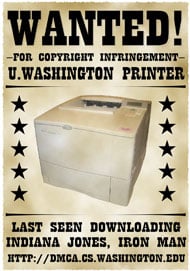
wanted printerCalled “Challenges and Directions for Monitoring P2P File Sharing Networks –or– Why My Printer Received a DMCA Takedown Notice”, the paper is a look into methods used to collect IP addresses for the sending of DMCA notices, and focuses on two main methods called ‘direct’ and ‘indirect’.

The paper shows that the tracking methods used by anti-piracy enforcement companies are not watertight, to say the least. Indeed, last year we already reported that it is possible to trap people into being reported to the MPAA or RIAA, by simply letting them click on the announce url of a BitTorrent tracker. The research from the University of Washington confirm these vulnerabilities, as they managed to receive hundreds of infringement notices addressed to a networked printer.

In August of 2007, data was being collected for a study of BitTorrent activity. During the experiment, the research team received over 200 DMCA complaints, despite never having violated any copyright. This alone should, and does, strike at the basic credibility of the organizations issuing such notices, and will be a big question if the content industries attempt to push for another ‘3 strikes’ approach.

Then, in May 2008, the team decided to repeat the tests, first to see if things had changed, and to discover if they could later implicate other IP’s, ’spoofing’ their presence. This time, there were almost 40% more DMCA notices, despite still not actually infringing copyright as claimed in the notices.

However, not only did the number of notices rise between the two monitored periods, the actual number of swarms monitored by the research team decreased. In August 2007 they had one notice for every 270 swarms. In April, that was up to less than one per hundred. However, without better knowledge of the torrents they were on each time, it’s hard to say if the difference was down to the choice of targets, or if anti-piracy efforts had been stepped up. For example, it could be that the increase was down to picking ‘hotter’ torrents, rather than an increase in enforcement.

Michael Piatek, one of the researchers involved in the project told TorrentFreak that they have contacted BayTSP and other enforcement agencies about the vulnerabilities in their tracking methods, but nothing has changed so far. A spokesman of BayTSP said he could not give a comment yet, but he assured us that their technical team will look into the research.

In addition, the researchers also checked to see if they could detect anti-p2p efforts, such as loggers. Whilst the paper gives one potential way to identify things, and later a method for using that to automatically create blocklists, the end result is that even with these major assumptions in favor of the blocklists (by eliminating residential IP addresses from consideration, for instance) at best, out of the 17 suspicious IPs found, only 10 were in such blocklists, 8 of them at colo facilities, tagged as ‘Mediasentry ‘or ‘Mediadefender’ (note that MediaDefender does not do enforcement)

In summary, the paper says that “potentially any Internet user is at risk for receiving DMCA takedown notices today. Whether a false positive sent to a user that has never even used BitTorrent or a truly infringing user that relies on incomplete IP blacklists, there is currently no way for anyone to wholly avoid the risk of complaints.” More dishearteningly for groups like Bluetack, however, is that it’s yet another kick at their claims of protection.

The last paragraph sums things up better than I can, however: “We have further demonstrated that IP blacklists, a standard method for avoiding systematic monitoring, are wholly ineffective given current identification techniques and provide only limited coverage of likely monitoring agents.”

We will give a more detailed breakdown of the study and its implications, soon.

Previously: Warner Confesses: Pirate Bay Cop Compromised

Next: BPI and Virgin Media Agree to Start Warning Uploaders

34 Responses

Pages: [1] 2 » Show All

1 Jun 05, 2008 at 23:08 by Retard

LOL, THAT IS JUST LOL.

2 Jun 05, 2008 at 23:13 by Anonymous

How many years is your printer going to get in the County slammer? :o

ROFL

3 Jun 05, 2008 at 23:28 by Anon

Haven’t yet read the paper, but do they also tell for what things they go t DMCA notices?

For example, who’s copyright were they supposedly breaking, or maybe even more detail information like certain files or something.

4 Jun 06, 2008 at 00:32 by Anonymous

they can take my printer away, it’s out of ink, and it’s cheaper to buy another than refill, ahahahahaaaaaa

5 Jun 06, 2008 at 00:35 by jimc

this is exactly why I use btguard

6 Jun 06, 2008 at 01:25 by Jag

Useful information, i hope they can use it in some cases to get some of the poor souls who got caught up with the sue-the-world approach that the gangsters are using.
Maybe doing a setup of exactly what they did in the judges quarters and then wait while his printer gets these automated messages… after which take the same printer and bash the shit out of them the sniveling low down bastards for their lies.

Cheers!

http://www.ezee.se/ copyright is copywrong.

7 Jun 06, 2008 at 01:35 by no brainer

No post on Mark Cuban’s anti-torrent rant?

8 Jun 06, 2008 at 01:47 by Iraeif

Perhaps a cue could be taken from Doctorow’s novel Little Brother, and some jamming could be done? Get a spoofer, find a honeytrap torrent, and make it look like the whole world is downloading.

9 Jun 06, 2008 at 01:49 by zomg

“We have further demonstrated that IP blacklists, a standard method for avoiding systematic monitoring, are wholly ineffective given current identification techniques and provide only limited coverage of likely monitoring agents”

they’ve shows us shit cos every1 knows p2p blocklists aren’t fully effective and tbh i feel sad for the folks in the usa being sued for such shit at least its peaceful in eastern europe

10 Jun 06, 2008 at 02:23 by Anonymous

I want to do these spoofs and have Cox shut off my internet for nothing, they would get hell and finally learn that some random person saying I downloaded something doesn’t mean anything.

11 Jun 06, 2008 at 02:48 by Mr Roboto

Yeah well BlueTack never said Blocklist manager was an all in one solution. It’s only effective at blocking IPs that are already identified. Like Anti-Virus programs aren’t a blanket protection against Virus and maleware.

12 Jun 06, 2008 at 03:09 by Putin 08

“The research from the University of Washington confirm these vulnerabilities, as they got hundreds of infringement notices addressed to a printer.”

HAHAHAHAHAHAHAHAHHA… hah… AHHAAHAH!

And the funniest part is, that printer has a higher chance of getting convicted than The Pirate Bay does.

Let us all join hands now and give our thanks that the MAFIAA and its hired thugs have the IQ of plankton.

BTW, this should make it much more difficult for the MAFIAA to abuse the court system in their persuit of criminally punishing the innocent. All a lawyer has to do is cite this study. The judge doesn’t have to have a clue about technology to know that something is seriously fucking wrong with their IP-collection method.

“You were sending DMCA complaints to a WHAT!?”

(I’m getting really fucking weary of this ‘awaiting moderation’ BS)

13 Jun 06, 2008 at 03:38 by nevermind1534

i’m in the US and I’ve been ok. I should really try something like TorrentFreedom. Actually, I’d probably be using it now, if it supported x64…

14 Jun 06, 2008 at 06:14 by Sheriff John Bunnell

THIS PRINTER THOUGHT HE COULD DOWNLOAD THE LATEST MOVIES FROM A TORRENT TRACKER

BUT LITTLE DID HE KNOW HE WAS BEING ‘TRACKED’ BY THE FEDS

AND NOW HE’S ON THE ‘FAST TRACK’ … STRAIGHT TO JAIL

15 Jun 06, 2008 at 06:20 by Jack

I think the media companies idea of a “three strikes and you’re out” policy is FANTASTIC!

When can we have the same policy introduced for the people sending the DMCA notices?

If their methods for tracking infringers is so great I’m sure they won’t mind being held to the same standard. :D

16 Jun 06, 2008 at 07:40 by Hulk

Well,

again I might add that the Opentracker software (run on TPB’s trackers) has a build in feature against these “indirect-evidence” (a.k.a. bullshit) collecting, inserting random IP’s in the tracker answer. Obviously BayTSP et al. are either to stupid to reckon the effect of this feature on their “evidence” collection, or they are ignorand about it, which might open the way for ligitation against them. Just in case a interested laywer needs more info to kick some MAFIAA-enforcers rectum:

http://opentracker.blog.h3q.com/?p=22

17 Jun 06, 2008 at 08:29 by Ezzy Elliott

What does it mean to be law abiding?

Is it that you don’t break any law?

Can you break silly laws which harm no one?

Most people only come into contact with the law through traffic offences. There at least it is easy to see the point.

But sending legal notices to kids and young people to introduce them to the legal system is undernining the law.

Copyright laws are bogus to young people.

Dargens
http://www.Dargens.com
Web UI Ad-Hoc Network

18 Jun 06, 2008 at 08:49 by Monster_mack

This study clearly shows, that anti-piracy groups are trying to manipulate people’s minds by using truly deceitful ways of collecting data on copyright infringers.
I am really glad, that there are people who can see through this bullshit and are not silent.

19 Jun 06, 2008 at 09:20 by lol

ezzy, i keep thinking about trying dargens, but your website looks like a 4 year old designed it with some crayons. It doesn’t inspire confidence.

20 Jun 06, 2008 at 09:44 by Ezzy Elliott

lol, point taken. Have a look at the code (100% open source) at http://code.google.com/p/kerjodando/ .

Post specific points to blog http://kerjodando.blogspot.com/ .

BTW I don’t think anonymous p2p is the total answer to sham DCMA notices. It is a work round for now.

The solution is to change the law so that like the UK BBC licence fee is used to compensate TV companies in UK, a similar fee is collected to compensate IP owners on the internet.

Governments to promote development should be promoting the free flow of information not aiding ludites to keep the status quo.

21 Jun 06, 2008 at 12:13 by ^o^

Although it’s well known that IP blocklists do not provide 100% protection, there are secondary benefits to using them.

It is because of the widespread use of blocklists that anti-P2P firms are forced to spend a lot more money, because effectively defeating blocklists requires the anti-P2P to set up a dynamic series of colocation servers all over the world.

The financial burden of this substantial expense may have contributed greatly to bankrupting MediaDefender.

For that alone, blocklists are a P2P’s best friend.

22 Jun 06, 2008 at 13:00 by AnarchyNow

DMCA = obvious ass-wiping of the 1st amendment, fuck the law

23 Jun 06, 2008 at 13:01 by lolllll

@5 . lol.

anyway, hopefully the anti-p2p comitees will do their usual job of being useless and not actually create a better way to track people uploading/downloading with less flaws. Or most peoples defence goes out the widnow ^_^

24 Jun 06, 2008 at 13:31 by Reacto

That printer has himself in a jam! ooooohhhh yes i went there. lol

25 Jun 06, 2008 at 13:35 by Anonymous

mafiAA warning > /dev/null
continue downloading…

Pages: [1] 2 » Show All

Responses are closed

All remaining responses will continue to be archived. Use the TorrentFreak forums if you want to discuss something.