
TorrentFreak

The place where breaking news, BitTorrent and copyright collide

New Report Accuses Google and Yahoo of Funding ‘Pirate Sites’

A new report has linked two of the world’s largest search engines to the funding of piracy-related sites. In the University of Southern California’s Advertising Transparency Report both Google and Yahoo stand accused of funneling cash to the sites, which were picked due to their placement in Google’s own Transparency Report. Also admonished in the report is torrent index SumoTorrent for their alleged operation of an advertising network.

adtransreportOne of the anti-piracy complaints of the entertainment companies that appears to be raising its head more frequently is how so-called ‘pirate’ sites are funded by “legitimate” business.

There are many ways that sites can generate revenue in order to keep going, but far and away the most obvious is by the placement of advertising. Most public facing sites carry adverts of some kind and it is the goal of entities such as the MPAA and RIAA to have these removed, either by placing direct pressure on advertisers themselves or through the agencies that handle them.

It will come as no surprise that due to them operating some of the Internet’s largest ad networks, search engines are high on the list for berating.

The latest pressure comes via new study carried out by the Annenberg Innovation Lab at the University of Southern California. Released today, the report aims to identify the online ad networks offering the most support to the “major pirate movie and music sites around the world.”

The top 10 list produced by USC notably features Google in the number two position and Yahoo at number six. Topping the chart is OpenX, a Pasadena company described by CrunchBase as “one of the world’s leading providers of digital and mobile advertising technology.” Web analytics and advertising company Quancast appears at position seven.

In order to compile the list of piracy-related sites, USC mined Google’s own Transparency Report for the sites that received the most DMCA takedown notices during the previous month.

In third position on Google’s report for most takedown requests is SumoTorrent. This torrent index also features at position four in USC’s report, with the university claiming that the site operates its own advertising network.

USC’s full list appears as follows:

1. Openx
2. Google (including Double Click)
3. Exoclick
4. Sumotorrent
5. Propellerads
6. Yahoo (including Right Media)
7. Quantcast
8. Media Shakers
9. Yesads
10. Infolinks

The university says that it used a bot to scrape Ad Network HTML identifiers from each ad in order to identify the advertising network responsible for its placement. Speaking with CNET, Google suggested the methodology might be flawed.

“The complexity of online advertising has led some to conclude incorrectly that the mere presence of any Google code on a site means financial support from Google,” the company said.

The report, which notes that it will continue to list the “top advertising offenders” on a monthly basis, states that major brands are not aware that their money is being spent financing the “piracy industry”.
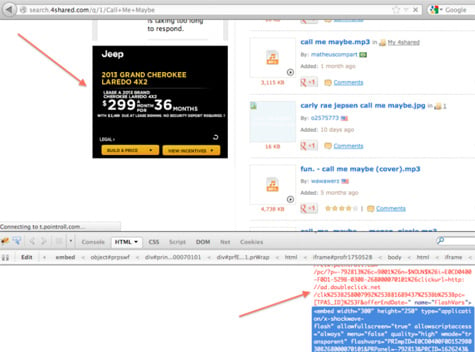
Google4shared

USC says the aim of the report is to help these innocent companies “steer their ad dollars away from sites that exploit film, TV and music artists for what appears to be criminal gain.”

“Whenever we talk to a brand about the fact that their ads are all over the pirate sites, they’re like, ‘Oh, how did that happen?’” said Jonathan Taplin, Director of the USC Annenberg Innovation Lab. “We thought it would be easier if they knew what ad networks were putting ads on pirate sites — so they could avoid them.”

“We do not believe that government regulation alone is the answer to the Piracy problem, but rather that the self-regulation of major sectors like the online advertising industry could make it harder for the Kim Dotcom`s of the world to unfairly exploit artists,” Taplin continued. “We look forward to working with advertising agencies and networks in the coming months to address this issue.”

The report can be downloaded here (pdf).

Related Posts

Previous Post | Next Post

  • ken147

    Cry me a river.

    • Anonymous

      Except for Yahoo and Google, the others advertisers will go offshore (and some already are) , to get out of trouble.
      They seems to forget that the internet business is World Wide, and noy US -Based

    • Kalcania

      “make it harder for the Kim Dotcom`s of the world to unfairly exploit artists”

      ROFL, WTF??

  • Guest

    just blame somebody else!

  • Haha

    I have adblock addon active at all times so no ads for me.
    I only enable them on the sites I whish to support myself.

    • Hogspace

      Yeah, Ads? what’s that all about then. Adblock and Flashblock. And I keep mostly away from Google too.

      • IHaveNoBalls

        Don’t forget to get No-script as well.. You’d be surprised how much facebook and twitter try to track you (Or maybe no surprise at all)

        Back on topic, i find the comment they made about Kim dot com a little out of place when you have you-tube using everyone’s work and taking advertising venue from that. Why do they conveniently forget you-tube is a “piracy site”. So is google for that matter. These people are up their own asses.

        • Guest321

          Just get rid of your facebook and twitter account. Problem solved. I never made an account on FB and I’m better for it. Why cripple the Internet with no-script for just a couple of lousy websites that should be boycotted anyway?

        • Danny

          Just use TACO.

          It blocks the vast majority of tracking and allows you to configure sites you wish to get ad revenue without the hassle of blocking all scripts.

        • Hogspace

          I wouldn’t use twitter or facebook. Simples.
          YouTube isn’t really a piracy site, the owners are right up the ass of the copytheft industry.

      • Jimmy671

        Don’t forget Ghostery if you use Firefox.

        • Anon

          And RequestPolicy, another add-on that blocks unwanted tracking.

    • xpmule

      i use adblock to but i will NOT support ANY web sites by enabling ad’s i will simply go else where..

  • Guest

    “the Kim Dotcom`s of the world to unfairly exploit artists”

    Says who? Hollywood? RIAA/MPAA? Tssssssssssk.

    • That’s libel Jon!

      Yeah, that was a wtf moment for me too when I read that.

      Watch out Jon, when Kim Dotcom is finished with the DOJ maybe he’ll set his sights on your ass for libel…

      Anyone care to send Jon a comment or two may do so here http://jontaplin.com/about-2/

    • Hogspace

      Fuck them RIGHT between the eyes.
      It’s a shame Breivik wasn’t so upset about the copyright lobby. Right tactics, wrong targets.

      • 7th_Guest

        For the dozenth time, guys, you do not defeat (copyright) extremism by advocating your opposite brand of extremism – not if you wish to come out as any kind of moral victor in the end anyway. The three first boxes can still afford Pirates a lot of options before even beginning to consider the ammo box. Let’s chill a bit and stick to the plan for now.

        • Hogspace

          I prefer the Irish Perspective.

    • MadAsASnake

      So, an impartial and objective report then? Not.

    • Scary_Devil_Monastery

      “Says who? Hollywood? RIAA/MPAA? Tssssssssssk.”

      Actually, yes.

      Apparently the author of the report is listed as being employed as a “public relations consultant”.

      This is not a study. It’s an inverted commercial.

      • MadAsASnake

        Ummm. It is three pages long, makes a few prejudicial and totally unsupported statements, and has no academic content whatsoever… haha

  • Who

    Who cares……its ALL corrupted any way.

  • sammyman

    who the hell is the USC Anneberg Innovation Lab, lol … who’s paying them … i bet i know

    • DB

      Well it comes as no surprise that Warner Brothers is a major sponsor.

      http://www.annenberglab.com/sponsorship

      • SoundnuoS

        Please explain what difference it makes in this particular case who sponsored the report?

        Go to any torrent site, watch ads appear. Does anyone really think this isn’t a for profit business?

        • MadAsASnake

          “make it harder for the Kim Dotcom`s of the world” …

          These are not the words of an impartial or objective comentator. If they start with that sort of bias…

          BTW, If no-one except hollywood is aloud to profit from this stuff, why is HMV allowed to profit? iTunes? and so on.

        • MadAsASnake

          BTW, how does this differ from the actions of animal-rights activists going after Huntingdon Life Scientists customers?

        • SoundnuoS

          @ MadAsASnake

          >BTW, If no-one except hollywood is aloud to profit from this stuff, why is HMV allowed to profit? iTunes? and so on.

          Because they are one of the distribution channels through which the creators can get a share.

          Torrent sites give nothing to creators.

        • MadAsASnake

          Wasn’t it just two days ago that you were bemoaning how little you get from those channels? It was not enough for your business interests?

        • Guest

          “Please explain what difference it makes in this particular case who sponsored the report?”

          Are you actually this stupid?

          From the copyright industry-fellating nature of the report, to the dishonest cheap shot at Kim Dotcom who ran possibly the most rights-holder friendly file locker on the planet, to calling something “criminal gain” when it isn’t.

          It reads like it was fucking written by Warner Brothers. And you ask what the significance of their sponsorship is?

          Get the fuck out.

        • Guest

          “Torrent sites give nothing to creators”

          Except for shitloads of money.

          http://www.google dot com/search?hl=en&source=hp&q=filesharers+%22buy+more%22

        • SoundnuoS

          Whoa, polite forum here.

          Anyway, the point I was getting at is that it doesn’t matter if the CEO of Warner Brothers himself wrote this report. It doesn’t change the fact that ads are on these sites and money is being made from them.

          None of this money is going from these sites to any of the creators whose work is the reason for the existance of these same sites.
          In other words torrent sites give nothing to creators.

          This has nothing to do with if the visitors to these sites decide to buy a record now and then. Running a torrent site is mostly about making money through making the works of others easily available. A for profit business in other words.

          @MadAsASnake
          I bemoaned no such ting, check the thread.
          http://torrentfreak.com/copyright-monopoly-trends-and-predictions-for-2013-121230/#comment-753380590

          @Guest right below
          It might be that some filesharers also spend a lot on media, but it’s reasonable to assume that many use it as a way of avoiding spending any money on the stuff they want.

          The chart here for instance:
          http://www.businessinsider.com/chart-of-the-day-music-industry-sales-2011-2
          implies that it might be quite a bit of money that is avoiding being spent.

          Straight drop since 1999 / 2000, all formats included. The chart ends in 2009 but every year after has showed continued decline.

        • MadAsASnake

          @SoundnouS

          “A secondary problem is that, since the competition is free, legal services have to offer the product at prices that are too low to actually pay out very much to the artists, the people who are putting the stuff we want out there.”

          You said this? right?

        • MadAsASnake

          @SoundnouS

          Just how much money do you think you have lost to piracy?

        • SPEIS

          - “Torrent sites give nothing to creators”

          - “Except for shitloads of money.”

          He was referring to those admins who run a torrent site, not about uploaders,
          who some of them need to buy the product
          in order to get the audio and/or video source.

        • SoundnuoS

          @MadAsASnake below (both posts)

          As a disclosure: I myself have lost nothing to piracy since I have nothing out there to lose.
          I do make a living from music, but the income is 99% related to my teaching gig atm.
          I am writing as someone who might at one point decide to put something out there that could lose something to piracy, so I can’t claim being unbiased however.

          Based on the available facts I’m also convinced atm that piracy presents a significant problem for musicians and other producers of creative works the world over, both for those associated with large companies as well as smaller independent self-financing producers.

          This isn’t just because piracy removes sales, but also because piracy causes a heavy general price drop in legal alternatives since the competition (piracy) offers the same product for free.

          This is the secondary problem I was talking about in your other post below. I was specifically thinking about streaming services like Spotify who are offering access to a large part of music history for only 9.99 / month.

          Spotify’s compensation model means that for one buyer having as much effect incomewise for the creator as the sale of one album, that buyer has to dedicate an insane amount of time spinning only music from that one artist on Spotify.

          Since few people do this it means that, spread across all available artists the share gets way smaller and won’t be of much help sustaining a career.
          (See the story about Lady Gaga’s 1000000 plays making her 108£)

          Spotify is however paying out something like 70% gross to rights holders so in order to improve this they’d need to both get a lot more subscribers as well as raise prices.
          My guess is that this will be very hard to do as long as the competition offers the same things for free.

        • Scary_Devil_Monastery

          “Please explain what difference it makes in this particular case who sponsored the report?”

          Because quite a lot of reports sponsored by the MPAA and RIAA have come out with claims which by extension mean they are “losing” more money due to piracy than exists on the entire planet. 46 times over.

          Other such reports by extension turn out to be fundamentally flawed – as in manually correcting the math by inserting an extra minus sign. Or moving a decimal in place here and there.

          Hence it becomes very damn important when looking at a study to find out not only who sponsored the study but also on whether it will pass a peer review. As a hint, no published report sponsored by the MPAA has EVER passed a peer review.

          The reports stating emphatically that the “lost sale” does not exist however, have quite often passed that hurdle and so been declared scientifically sound.

          [EDIT] As some eagle-eyed poster commented below…

          “Erik Nyquist 16 hours ago
          The woman who is listed as the author of the report on the linked website is a representative of a Las Angeles PR firm.

          Go figure.”

          I think you’ll agree that finding a “report” to actually have been issued by a Public relations Company would rightly invite a sharper investigation, hmm?

        • SoundnuoS

          @ Scary_Devil_Monastery below

          >Hence it becomes very damn important when looking at a study to find out not only who sponsored the study but also on whether it will pass a peer review.

          No one is denying this. What I’m saying is that no report is needed for anyone to see for themselves what’s going on with torrent sites.

          Visit any site, watch the ads. The only thing anyone can claim to doubt in this report is exactly what specific ad agencies are responsible.
          That ads are there and making money for the site is beyond doubt.

          About peer reviewed reports:

          One claim that’s often made in discussions like these is that there would be no reports showing “the lost sale” and that reports claiming the opposite would be unproblematic and numerous.This is not true.

          http://papers.ssrn.com/sol3/papers.cfm?abstract_id=1932518&rec=1&srcabs=2025071&alg=1&pos=2

          In the report linked above the author summarises the available research and apparently the majority of research claims that piracy is responsible for loss of sales.
          He also presents some arguments for why the conclusions made in the relatively few reports that appear to show no loss of sales might be problematic.

          In the specific report linked above the author is in fact making the case that ALL of the sales drop is attributable to piracy.

        • Danny

          You realise of course that the Advertising revenue has nothing to do with the artists and they are not entitled to a cut.

          The torrent sites in question host no copyrighted materials and nor do they distribute any copyrighted works. They offer a service, like google, that provide links that allow people to connect with one another, like google allows you to connect to a web server.

        • MadAsASnake

          OK, You are describing a situation where you don’t see enough profit in the business model. Don’t do it. I think you will find that Spotify struggles to get subscribers at 9.99. That is demand and supply. It is certainly true that the new business models mean that being a recording artist only you would need to reach a lot of people – that is what “going viral” is all about. Piracy is not the problem, and people download for all sorts of reasons:
          1.) it’s really convenient (note that the MPAA and RIAA have been totally hostile to this)
          2.) People want to “try before they buy” – a role radio has usually offered for music. However, Radio and the “official charts” have always been rigged by the RIAA and various spinoffs.
          3.) Many people download to timeshift (rather than recording it locally)
          4.) And many people download stuff because it has not been made available in their location (or like Game of Thrones, requires you to take out a major subscription to do so)
          5.) A lot of people can’t afford to spend a lot on this (uni students, for example) hence uni’s being download hotspots.
          None of these are a “lost sale”. Most of them are so what. Some of them are fair use.

        • Scary_Devil_Monastery

          “One claim that’s often made in discussions like these is that there would be no reports showing “the lost sale” and that reports claiming the opposite would be unproblematic and numerous.This is not true.

          http://papers.ssrn.com/sol3/pa

          In the report linked above the author summarises the available research and apparently the majority of research claims that piracy is responsible for loss of sales.”

          I hope you downloaded and read that article. The author references, as sources, IFPI and RIAA’s own numbers(!).

          Similarly he makes the claim that “the majority of studies claim record sales decline due to filesharing” – and conveniently fails to mention even one study in his source list to make that claim. Indeed, the one and only source claim he makes at all appears to be on the papers he tries to dissect.

          Notably he fails to mention any of the government-sponsored studies on filesharing. Including the Hargreaves report, the study commissioned by the dutch government, and very curiously the report published by the US Government Accountability Office.

          “The U.S. Government Accountability Office published a report in April 2010, as directed by the Prioritizing Resources and Organization for Intellectual Property Act of 2008 (PRO-IP Act), about the quantification of the impacts of counterfeit and pirated goods. This report shows that “some experts and literature also identified some potential positive effects of counterfeiting and piracy” and that “three widely cited U.S. government estimates of economic losses resulting from counterfeiting cannot be substantiated due to the absence of underlying studies.”

          If we are to believe the US accountability office there are no studies substantiating any loss of sales worthy of credibility.

          If we are to believe the Dutch studies, the Oslo studies, or the reports used by the swiss governments, then science can not corroborate any form of “lost sale” at all.
          Find a few good links here:

          http://www.laquadrature.net/wiki/Studies_on_file_sharing

          And market studies for which empirical data actually exists in abundance all indicate that media spending has increased, not decreased.

          Logically speaking if people spend the same proportionate amount on media now as then it simply follows that sound recording is simply being outcompeted by video, movies and games. It’s that simple because it isn’t as if people magically have proportionally more money to spend.

          If you want to refute science in a scientific manner, don’t do it by putting up a paper which begins by making an unbacked and unsourced assumption.

          However, for the sake of argument let us play Devil’s Advocate:
          Assume that we have rock-solid proof that filesharing accounts for 100% of diminished revenue. Let us similarly assume that revenue itself has diminished to 5%, making filesharing reponsible for a 95% loss.

          That would make the result just about the same as when the automobile was invented and suddenly 95% of everyone involved with horses no longer had a living. Or similar to blacksmiths, similar to purveyors of ice, and hand calligraphy.

          What is your suggestion? That we abolish every civil right related to communication and privacy in existence in order to prevent people from communicating certain files? At extreme expense, mind.

          Or should we abolish the digital revolution because technology will not conform to the demands of copyright enforcement? Even as a thought experiment the result becomes gruesome – you are trying to alter human nature and the urge to communicate more fundamentally than the Sovjet union or China ever attempted.

          You are speaking like a fundamentalist churchman when faced with Galileo’s telescope. Enough harsh measures of sufficient severity may postpone the inevitable a year or two. That’s all. Like king Canute trying to order the tides to stop

          A last link for reflection – based on what the internet looked like in 1993, 20 years ago.
          http://www.chemie.fu-berlin.de/outerspace/internet-article.html

          20 years of trying to curb the internet hasn’t worked. At all. There is no silver bullet for copyright enforcement to find. Learn to live with a paradigm where anyone can communicate anything, to anyone. Or fight to stop everyone from communicating. It’s that simple.

        • Whatever

          @SoundnuoS
          Seeing your comments here, i would guess you are a renamed troll, not a musician.

          It’s weird how you are worried about something that you haven’t created yet and may never create. Teaching how to read/play notes/music doesn’t make you an artist. If you’re not creative or even if you are creative but nobody wants/needs what you try to sell (in future) you will probably need the MAFIAA to force people to pay for the (possible) shit you create (in future). As you must know, as you are on this site, a lot of artists that actually did create something advertise for example through TPB. So you must also know they don’t worry about pirating at all.

          You as a wannabee musician want to make a career of something you like todo as a hobby (instead of teaching which actually doesn’t seem a bad job at all). A few billion people would like to have another easier, better and lazier job (hobby) than their current job but will always have to stick to hobby as their hobby services are not required by a large part of the population.

          This leaves one big question to be answered.
          If you’re against sharing and you’re not a troll then what the hell would you be doing (even commenting) on a torrent/filesharing news site ? It makes completely no sense at all because you would be wasting you’re time as there are already more than enough trolls moaning “thieves”.

          About the issue if it matters who made the report, i bet that if it were about any other issue then it would matter to you who made the report. Like the tobacco, alcohol or medical industry on the safety of their products. Then you would be paying attention. I can only view your remark as hypocritism. The worst thing though is that they are destroying the way people look at real scientists that actually do real research.

        • SoundnuoS

          @Scary_Devil_Monastery below

          I hope YOU downloaded and read the entire article. In section III he lists twelve studies he considers to be claiming lost sales (see section III, table 2 for summary)

          The actual point in the article is to estimate the actual loss in sales comparing different studies using a specific metric, which according to the author shows that piracy is 100% responsible. Some of the other studies using different metrics have varying estimations.

          >The author references, as sources, IFPI and RIAA’s own numbers(!).

          First of all what he does is examines existing studies applying a consistent metric on them.

          Secondly: you do realize that if this source (IFPI and RIAA) is considered a problem, then no research on the matter will ever be possible to do?
          Where should the numbers for declines in sales come from? Who else would be able to compile them?

          And since the paper is published it must have passed peer review. Here’s your chance to do more of it.

          >And market studies for which empirical data actually exists in abundance all indicate that media spending has increased, not decreased.

          Link actual studies please. All data I’ve ever seen is that media spending is down across all forms.
          As a side note: even if spending is up on every other form of entertainment it’s very easy to argue that it’s because music is so easy to pirate that it leaves consumers more discretionary spending for those other forms.

          Another interesting study on the effects of HADOPI (french 3 strikes law): http://papers.ssrn.com/sol3/papers.cfm?abstract_id=1989240&rec=1&srcabs=1932518&alg=1&pos=1

          It’s also listed at the very top in the link you gave, however the summary under that link is imo NOT an accurate description of the conclusions in the study so I’m inclined to distrust the validity of the data in your link (the laqudrature one).

          The study shows that digital album sales on iTunes are up 25% compared to a control group of countries having no similar law. (Not potentially up, actually up)

          An interesting result is that sales started diverging already before the law was passed, and at the conclusion of the study no one had actually yet had their internet connection cut.
          The authors attribute this to awareness of the law and the potential consequences.

          If piracy doesn’t account for lost sales, why do sales increase when new measures against piracy are introduced?

          About your devil’s advocate bit:

          The automobile analogy always annoys me some, because as a description of the situation it is flawed.

          The purpose of both automobile and horse is to get around. One way is better than another.

          Using that analogy implies that someone would have come up with a new and revolutionary way of making music, making composers and musicians obsolete.
          Algorhitmically composed music is however not very interesting atm and does not represent a major market share.

          The only thing that has changed is the mode of delivery, the medium. And as I’ve argued for, the value of the medium is and has always been practically nothing compared to the message on it. Hence copyright.

          We all still want the same old horse and cart (the music). The difference is it’s being taken for free and no one wants to pay the cartmaker.

        • Scary_Devil_Monastery

          “I hope YOU downloaded and read the entire article. In section III he lists twelve studies he considers to be claiming lost sales (see section III, table 2 for summary)”

          Yes, I noticed. Those are not sources he’s using to claim there is a lost sale – Those are exclusively sources which DO claim there is a lost sale to begin with and try to quantify it. In short, out of the studies which exist he’s cherry-picked only ones which claimed a set percentage on the lost sale.

          The actual source reference is found on the final pages, where a scientist in order to pass peer review must be able to show that everything he claims has been written elsewhere or be prepared to back his claim up with proof.

          Several of those sources are his own. Given that the author of that paper is the same Stan Liebowitz who along with Stephen Margolis fought tooth and claw for the Bono Act (extension of copyright retroactively from 50 to 70 years), I think I may have to read exactly what sources THOSE works reference.

          Call me a sceptic but when I see lawyer whose career has been solidly entrenched in the pro-copyright maximalist camp put forth a paper detailing how to measure lost sales without ever overturning the falsification of “the lost sale”, I’m beginning to wonder what he wants to say.

          There is no regulation on publishing a paper using self-referencing as the main source, of course, but when you make a bold claim which has been conclusively disproven by government-funded studies elsewhere it is certainly not wise to do so.

          And of course the paper is realistic enough for a peer-review. If there does indeed turn out to be a lost sale, then his metric may indeed be useful for measuring it. In this case peer-review quite correctly judges it worth publishing. I am quite similarly convinced every word he writes is backed up by the sources he cites.

          But as for his paper’s actual assumption on the lost sale, it’s a bit like reading a refutal of Einstein’s general relativity theory which never once actually dares to reference Einstein.
          If I were ill-intentioned I would suggest that this looks like he cherry-picked his sources very carefully in order to prevent such a conflict from taking place.

          “If piracy doesn’t account for lost sales, why do sales increase when new measures against piracy are introduced?”

          Well, gee, you don’t suppose the ginormous information campaign had anything to do with it? Any marketing graduate should be able to tell you the effects of any concurrent advertising. Especially when the government itself was eager to help out by pointing at alternatives.

          Interestingly enough, piracy remained relatively stable under HADOPI, suffering one short dip and then a backswing. If piracy and sales were linked what so ever, this should have been followed by a concurrent dip in sales. It did not.

          Same as in Sweden when the statistical data of the IPRED directive implementation came in.

          “We all still want the same old horse and cart (the music). The difference is it’s being taken for free and no one wants to pay the cartmaker.”

          False. The cartmaker gets money for every cart he sells. He doesn’t get a penny for the photos people take of his cart. Not even when such a snapshot can amazingly transport people just as well.

          The solution in that specific example is that the cartmaker has to establish a brand so that people would actually want to buy his carts.

          Just like Evian does, despite the existence of soda streamers and tap water which in many places is fully comparable.

        • SoundnuoS

          @Scary_Devil_Monastery

          What’s your opinion on section IV where he claims there are only two papers who attempt to show no harm? If that is true then the majority of available research would still be tilted towards showing harm from filesharing.

          Specifically footnotes 13 where he brings the Andersen and Frenz paper into doubt and 14 where he claims that the Oberhelzer-Gee and Strumpf paper included iPod sales (!) as income for the music industry.

          > The actual source reference is found on the final pages, where a scientist in >order to pass peer review must be able to show that everything he claims has >been written elsewhere or be prepared to back his claim up with proof.
          >
          >Several of those sources are his own.

          Common practice when writing scientific papers as far as i know. Any author always lists all of his prior work he feels is relevant.

          >There is no regulation on publishing a paper using self-referencing as the main >source, of course, but when you make a bold claim which has been >conclusively disproven by government-funded studies elsewhere it is certainly >not wise to do so.

          I’d really need to see the original studies here, before I can completely take your word on it.

          >Well, gee, you don’t suppose the ginormous information campaign had >anything to do with it?

          Well yes, that’s exactly what I suppose. The law worked just because people knew about it, no punishments even had to be administered.
          This wouldn’t have happened if there had been no law however.

          >Interestingly enough, piracy remained relatively stable under HADOPI, suffering >one short dip and then a backswing. If piracy and sales were linked what so >ever, this should have been followed by a concurrent dip in sales. It did not.

          If you can link the original source for the above I’d appreciate it.

          Meanwhile, some more info on the results from France between 2009 and 2012:

          http://www.digitalmusicnews.com/permalink/2013/20130102warnings#pREs1CpAMsXnEelEMa4I7g

          Digital income is up 62,7%
          The part of that which is income from subscriptions is up a massive 159,4%
          Physical sales are down 29,4%
          Total sales (digital and physical) are still down 14,7% however, despite the massive rise in subscription popularity.

          I’ll have to do a copy-paste job on my points about the cartmaker and why filesharing is not like taking a photograph of the cart. I think it can warrant a separate discussion.

        • MadAsASnake

          The claim that HADOPI increased iTunes sales by 25% is fanciful at best. Have a look at http://torrentfreak.com/anti-piracy-no-effect-on-itunes-sales-120124/

          Notice that the uplift started well before HADPOPI went live and acknowledges there was no effect at all when it did. There are a range of other factors about the French situation which the report makes no attempt to address. The conclusion that these differences are solely due to HADOPI is unjustified.

          The other thing to note is that far more taxpayer Euros were spent on this exercise than was supposedly gained by iTunes. Taxpayers are being stolen from for a very questionable and much smaller gain by a corporate interest. A sensible set of laws would be a natural fit and not require this sort of expensive, invasive and ultimately ineffective agency.

          And then of course, in the first of the very few prosecutions they targeted someone that had not downloaded material and that they knew had not downloaded material, but had found out how it had happened on his connection [ie, all the HADOPI people cared about was a successful prosecution, not justice]. As we know, an IP cannot identify the user responsible.

          A final point on HADOPI, the French Government did not anticipate HADOPI in isolation to be a solution. It expected rightsholders to put in place genuine online alternatives to piracy. This they have NOT done, and this is a major factor to HADOPI getting downgraded. It should be killed off because it is an expensive white elephant. It’s a waste of taxpayer money.

          Even the French Government recognises that the music industry is not itself doing the right things to combat Piracy.

        • Scary_Devil_Monastery

          “What’s your opinion on section IV where he claims there are only two papers who attempt to show no harm? If that is true then the majority of available research would still be tilted towards showing harm from filesharing.”

          Hence my choice of words – cherry-picking.

          http://www.laquadrature.net/wiki/Studies_on_file_sharing

          However, I believe I know what he references:

          “A literature review by Professor Peter Tschmuck found 22 independent studies on the effects of music file sharing. “Of these 22 studies, 14 – roughly two-thirds – conclude that unauthorized downloads have a ‘negative or even highly negative impact’ on recorded music sales. Three of the studies found no significant impact while the remaining five found a positive impact.”

          Lifted directly from wikipedia, unfortunately. I would dearly love to see which studies are referenced there, since quite a lot of the early work performed by “independents”, released in the napster days, were haphazard guesswork.

          Now, if he claims there are only two works showing no harm, then he has indeed been cherry-picking his sources with an assumed paradigm in mind. For a practical model to use as a hypothesis in an experiment this can be encouraged, but for a paper on theory it’s as close to a mortal sin as you can get.

          Peter Tschmuck is another professor whose career hinges on copyright, and it’s interesting to note that he and Liebowitz can’t even agree on the number of studies showing no harm.

          “Specifically footnotes 13 where he brings the Andersen and Frenz paper into doubt and 14 where he claims that the Oberhelzer-Gee and Strumpf paper included iPod sales (!) as income for the music industry.”

          I’m certainly not defending very many of the people who try to write papers on economy studies. If I had handed over a thesis like most I’ve seen written about the entertainment industry to my own professor, I’d have spent the next few months scrubbing lab floors as punishment.

          To begin with, many of these clowns – pro or against copyright – already have difficulty separating the entertainment and the software/hardware industry. That’s where you get the iPod sale idea, i guess. Then again, If they’d been examining Sony instead, they would have been dead right. I suppose this follows suit when many of these so-called professors in 2000 had a dim idea of a computer as being a typewriter loosely connected to a series of tubes.

          I am far more inclined to reference the studies written as part of a university research program or as a government-commissioned study. They are likelier to come under heavy fire.

          “Well yes, that’s exactly what I suppose. The law worked just because people knew about it, no punishments even had to be administered.
          This wouldn’t have happened if there had been no law however.”

          Hmm, no. Not exactly what I meant. Any marketing campaign which points out you can get X from Y will have people flocking to Y even if they’ve never even heard of X before.

          However, negative marketing is proven not to work. Take piracy for instance. Every time there’s negative headlines about us Pirates we get a massive surge of curious bypassers asking friendly questions, wanting to know what the fuss is about.
          I have never received so many questions about what a “Pirate” is, what we believe in, and “…erm, so…how do you download, exactly?” as I have under the times when IPRED, the TPB trial, and the ePhone case as current here in Sweden.

          I should google “streisand effect” if I were you. You can not show people a sign of a product and say “Don’t use this”. That’s very common psychology.

          “If you can link the original source for the above I’d appreciate it.”

          Someone seems to have removed the actual page I wanted – you’ll have to settle for the swedish IPRED comparison while I try to find one which isn’t in french. I’ll recommend the entire book here, but the netnod graph in itself on page 31 is quite telling.
          http://falkvinge.net/wp-content/uploads/large/The%20Case%20For%20Copyright%20Reform%20(2012)%20Engstrom-Falkvinge.pdf

          Incidentally, I’d be wary of claiming actual piracy is down due to increased sales, in france.
          http://www.techdirt.com/articles/20120402/12145518337/hadopi-accused-massaging-numbers-to-make-anti-piracy-activity-look-better.shtml

          Combined to the explosive surge in VPN services in europe…I’d be inclined to say people are downloading more than ever before.

        • SoundnuoS

          I do find it slightly ironic that you point out the importance of source criticism and then give a torrentfreak analysis as support for your argument.

          >Notice that the uplift started well before HADPOPI went live and acknowledges there was no effect at all when it did.

          The sales curve mirrors the control group’s, but remains at a statistically different margin during the whole graph which imo indicates that HADOPI keeps working.

          As to why it starts working before the introduction we discussed that in the two last posts:

          [>Well, gee, you don't suppose the ginormous information campaign had >anything to do with it?

          Well yes, that's exactly what I suppose. The law worked just because people knew about it, no punishments even had to be administered.
          This wouldn't have happened if there had been no law however.]

          And imo genuine online alternatives to piracy has been online a long time already.
          iTunes, Spotify, Deezer, who knows how many others?

        • SoundnuoS

          Must have posted at the same time, the below post is more a reply to MasdAsASnakes post two below, this one is @ Scary_Devil_Monastery

          I’ll have to point out that sources such as Falkvinge and Techdirt suffer from a similar (but opposite) bias that you accuse the RIAA of and that considering that i found the LaQuadrature summary misleading as well I’m a bit vary of anything written on that site.

          Given that, about the techdirt article. It seems very inconclusive. The source they give for claiming that the numbers could be unreliable goes to iptegrity, a site which at first look at least seems very pro-filesharing biased.

          Iptegrity in turn gives absolutely no proof for it’s claim that p2p is constant on a relative basis. What they present is just a claim that the info has been given to them by a France Telecom representative. No other source, the name of the employee or actual data is given.

          The only bit of actual data in the article is the graph from Figaro which indeed seems to show that p2p and legal streaming are inversely related. Exactly as you might expect if HADOPI was working.

          Concerning IPRED in Sweden, it doesn’t surprise me if that’s a failure. If I understand correctly from a quick googling, the only thing it does is give the rights holders the right to contact and possibly sue anyone doing downloading.

          This really makes no statement that this is something society would be willing to enforce and, as has been pointed out, is something of a pr-disaster for the creative industries. (Although the hadopi-paper I linked has a footnote where it’s claimed that highly publicized piracy-trials cause a temporary downspike in piracy)

          The reason, imo, something like HADOPI is likely to work better is because it moves the responsibility of enforcement from the rights holders to the state.
          Pr-vise it’s a much better solution, and since it has to go through judicial review and it’s punishment is equal for all, it has a much better sense of legality.

          This is a bit like shoplifting. You can argue that any shoplifting should be a case between the perpetrator and the shopkeeper, yet society has decided that it’s a criminal offence.

          The system for punishment (having your net cut for a month) is also probably a far better deterrent for a hardcore net-user than the random chance of getting sued.

          One point I have to point out to anyone suspecting rights holders organisations of falsifying the results of various research on enforcement methods against piracy, is that it would not be in their best interest.

          Rights holders organisations have absolutely nothing to gain in holding on to enforcement methods proven not to work. They only gain something when the methods actually work.

        • MadAsASnake

          @SoundnouS

          A note on the source or these various reports. There are three major sources: those sponsored by industry (of which not one, including this one, has had a peer review), technology pundits, and finally university studies (which are usually peer reviewed). The industry ones typically read as if they have started with the conclusion and then cherry picked only that information that might support it (this one reads that way, and as its been prepared by a PR company, well, what a surprise). All the rest are generally very cautious about drawing any conclusions and are generally forthright about the difficulty of studying the phenomenon with any accuracy, or drawing any straightforward conclusions because the truth is exceedingly complex.

          While I’m on the subject of accuracy, let us look at the way they “track” accused offenders – using IP. Generally, they simply scrape IP’s from trackers – it’s rather error prone, and the attempt to match these through the ISP’s is as well. If you look at those used by ACS Law and GEIL, the ISP’s can’t match fully half of them at all. Given this level of inaccuracy, how many false-positives do you think are in the remainder? It is difficult to believe this is better than 50%. So around 50% of those accused will be so without basis at all. At this point, we are usually at the router in the home, and it is at this point that the most egregious assumption is made: that the ISP account holder is responsible for the infringement (in the UK, only the infringer can be prosecuted). Let us assume that the average household has 4 people in it, any one of which could be the infringer, or indeed none – it could be a guest, or someone else may have accessed a wireless connection. A simplistic calculation on this would be a little less than 25% of infringers will actually be account holders (for some categories, it will be likely somewhat less) – let us say 20%. 20% of 50% is around 10% (or 5% of those “detected”)

          Now, are you really happy with a system that accuses people that is systematically wrong about 90% of the time? Why are rightsholders not using the courts (except the pr0n extortion scammers – who always drop defended cases) but pushing for all these “x strikes” schemes? This is really simple. The rightsholders have no chance at all in succeeding with a prosecution on IP alone. Further, to put this through the courts, the tracking technology would need to be made available to both the courts and the accused – not one has ever been, or ever will be. These “x strikes” schemes have been devised to avoid the problem that they have no usable evidence at all, and it obfuscates the appalling quality of what evidence there is. In these x-strikes schemes, there is inevitably an assumption of guilt and a reversal of the burden of proof. This is blatantly unfair as it is impossible to prove you did not do as accused. If this was not so, then a simple denial would defeat it, as it does in a properly formulated court case.

          I’m sorry, when industry bodies claim they are loosing several multiples of Global GDP to piracy, you know there is no chance that they are right.

        • bobmail

          @Sounduos: I would like to say that I agree with you very much on the issues of both Rick and Techdirt. Both of them are incredibly biased sources with their own interests (and careers as “gurus” at stake), and are very likely to take extremely flimsy supporting evidence and run with it.

          On the other hand, they hold everything up to the other side up for micro analyses, often discrediting it by vague suggestion of impropriety that cannot be easily shown. Techdirt in particular is the home of taken opinion pieces and treating them as fact, which is (to quote Perez Hilton) HIGH-larious.

          Any time I read some junior twerp on a site like this making evil noises about the “MAFIAA” I can’t help but laugh, as they don’t realize their own stuff is so weak as to be transparent. The arguments made in support of piracy are generally so self-serving and self-supporting as to be easily dismissed by anyone not actively profiting from them. Yet they will hold opposing views to such a high standard as to be impossible to satisfy their needs. It’s sad really.

          A series of good posts from you, congrats for adding at least a little balance to this extremely one sided site.

    • OneEyedWillie

      LOL I was thinking the same shit. At best this is a setup by the Recording industry to milk the Google cow in court. Lawsuit in 3…2…1

  • theonlyone

    I hope they are funding piracy directly or indirectly.

    • Sean

      it’s indirectly. trust me

  • dondilly

    The flaw in all this is that advertisers couldn’t care two hoots about the media industries. What interests them is placing ads on sites that their target demographic frequents. There is no getting away from the fact that p2p related sites are popular with the vast majority of young people.

    While it has been shown that sharers tend to spend more on media than non sharers, this does not seem to be a widely held view. Indeed, if sharers are perceived to refuse to be ripped off by the media companies’ high prices, they may be considered cash rich and a more attractive target for non media product advertising.

    On or offline, the targetting of advertising is nothing new and where do you draw the line.

    Torrentfreak is a case in point. No one would suggest that (currently) TF is anything other than a perfectly legal blog reporting and discussing P2P and copyright related issues. The advertising on the site reflects the interests of it’s readers hence wall to wall VPN ads.

    • Adblock FTW

      Theres advertising on this and torrent sites? Wow, Adblock is good! Blocking all the way, its like a 1999 internet…

  • TerribleTony

    Just throw Dotcom under the bus why don’t you. Thing is, if you read the news, you’ll discover that Dotcom was mostly harmless. Some academics aren’t worthy of the name.

    • MadAsASnake

      I suspect this document might fail a peer reveiw. The language in it makes it look like the answer was a prerequisite.

      • Pelham123

        They’re counting rainbows and pots of gold to prove the existence of leprechauns.

    • Guess

      Dotcom is not done in court, the people involved are cowering under some blankets praying lol.

    • xpmule

      He’s still in court AND we what know from court info released is “they” are in a LOT of trouble for lying about US FBI involvement etc and the commonly known fact that Kim had his site setup to stream line dmca requests for copyright holders (which he shouldn;t have had to do in the first place) and to top it off he was even contacted by the fbi and did what they said so they could use what he did in court later. He made every effort to play ball with them openly and honestly to do things right by th law so they cooked up illegal bs in a non USA country to jail him and then lied that they had any involvement.

      “they” fucked up bad and will pay for this in the long run.
      The kimdotcom PR blunder for “them” will publicize this ongoing problem and show it in the light it really truly is.. lies and corruption and $$$

  • TerribleTony

    Also, Google is right, their methodology is flawed. And it does stink of special interests funded “research”.

  • Sean

    i thought everyone knew about this already?

  • http://profile.yahoo.com/3WK3JNCWUEZMPMP3YVNK4XZDHY Harpreet

    we r all paying the sites indirectly based upon money circulation :P

  • http://profiles.google.com/pianogamer Knut Harald

    Not sure what the actual practises are, but I assume you are allowed to specify certain sites where you don’t want your advertisement to appear, to the ad network? In any case, wanting the ad network to play moral police on your behalf is ridiculous.

    • IHaveNoBalls

      Why is it immoral to see a for example Nike advert on a torrent site? That’s what i don’t get. These people seem to be suggesting that its wrong to supply advertising to torrent sites, file lockers etc… The rules and regulations of internet advertising actually has nothing to do with the people making this study, its none of their business. So why do they think it is?

  • DannyUfonek

    I think they went too far on this one.
    To demand regulating somebody’s business to your advantage is one thing, but to demand them to take away their own revenue is a step too far.
    I hope the search engines show them the middle finger.

  • Erik Nyquist

    The woman who is listed as the author of the report on the linked website is a representative of a Las Angeles PR firm.

    Go figure.

    • MadAsASnake

      So it’s PR, not reseach. Figures. Isn’t this misrepresentation?

      • 7th_Guest

        Wearing multiple hats (businessman, industry spokesman, academic) and carrying commissioned work over from one field to another a misrepresentation? Nonsense; it’s multi-tasking! Mr. Jonathan Taplin is a true renaissance man, the world (of copyright parody) needs more of his kind!

  • Nastyutopia

    this is the worst kind of excuse for censorship, really indexing sites can’t do their job?

  • Ray186

    Ok. You have your proof. Now go sue Google. Lets see what happens then.

    • Nastyutopia

      google might do
      harm…but they don’t want this fight

      • Nastyutopia

        and will fight it… i hope

        • Guest

          What are you lot smoking? Google has more than enough monies to severely cripple the RIAA and the MPAA, and that’s if Google spares them. Google could obliterate them completely if they wanted, or just buy them out. Either one will do.

        • Guest

          Yeah, they have more than enough money and power to take down the RIAA and MPAA(especially in their weakened states), but Google seems to be suffering from an extreme case of no-balls.

          They can’t even be bothered to defend their own Android partners from lawsuits. I don’t think they’ll be going up against the MAFIAA anytime soon.

        • Anonymous1

          Ironic Guest on Guest action right here! :P

        • Nastyutopia

          i’m smoking ganja….and yeah maybe right

  • Anonymous

    ‘“We do not believe that government regulation alone is the answer to the Piracy problem’

    if the entertainment industries themselves were to listen to customers and give what is asked for, do you think that might help?

    ‘self-regulation of major sectors like the online advertising industry could make it harder for the Kim Dotcom`s of the world to unfairly exploit artists, Taplin continued’

    i would like Kim to sue him personally for slander and deformation of character!

    ‘We look forward to working with advertising agencies and networks in the coming months to address this issue.”

    and the best way to start that ball rolling, is to accuse companies of doing God knows what against the ‘lying, cheating entertainment industries.

    i assume that Jonathan Taplin thinks he is untouchable because he is in the USA? given that the USA has introduced the procedure of getting people extradited to the USA for crimes it says have been committed under it’s laws, but not under the laws of the country where the accused person lives now or maybe has always lived, i would be a bit more selective with what i said and did, if i were him. karma is a wonderful thing! funny how anyone that is accusing someone of copyright infringement, file sharing or breaking patents seems to think they can say what they like, to who they like about anyone they like.

  • Anonymous

    “We do not believe that government regulation alone is the answer to the Piracy problem, but rather that the self-regulation of major sectors like the online advertising industry could make it harder for the Kim Dotcom`s of the world to unfairly exploit artists,”
    Let me fix that for you
    “We do not believe that government regulation alone is the answer to the Piracy problem, but rather that the self-regulation of major sectors like the online advertising industry could make it easier for the major labels of the world to unfairly exploit artists,”

  • Pelham123

    The skeevy ads on torrent and cyberlocker sites drive people away from them. Those ads HELP rightsholders by reinforcing the idea that the sites are not legitimate.

    I guess the important thing here is that USC gets paid by Warner et al to confirm their ignorance.

    One more “anti-piracy” effort that does not help artists get paid.

  • Guest

    Warning, If this link is anything like his other link it’s an ad for how to make money online webpage that you can’t escape from. Flagged

    • What if Guy

      What if… the scammers paid for bandwidth and data transfer and lot’s of people went and used it all, on the 1st day of the month.
      Wouldn’t it be a shame that every GB thereafter would cost them money.

      Host and plan dependent of course.

    • ScrewEwe2

      Just flag them. Don’t respond to let others know it’s an Ad.

    • Guest

      @ScrewEwe2

      Don’t respond to let others know it’s an Ad.

      The problem with that, is that there are some dumb users who don’t know what an ad is.

    • ScrewEwe2

      @Guest, I Think I should have used the word spam instead of Ad, but I was barely awake @ the time.

  • icec0ld

    Lol, I’m sure all they need to do to fuck up their entire business model is to fire it’s legal cannons at Google. Watch Hollywood weep as it’s funds and time are dragged into a costly and embarrassing lawsuit. It’s like watching a small animal piss off a lion.

    I’m more interested in the comment “Harder for more Kim Dotcoms”. Yeah… harder for legitimate businesses you mean. Frankly, this sham of a place has no real value to society given the hypocritical nature of their work.

  • ProGrasTiNation

    Real artists don’t care about their work being appreciated by people that don’t have the money to buy.
    Real artists don’t flaunt their wealth in the public domain & then cry poverty.
    Real artists get shunned by the publishers for profit.
    Fuck you MPAA your time is coming to an end,we don’t need money on this planet anymore & your kind will be the first to burn in my fire.

    • frozar

      Exactly. Just look at Psy, his video is free and look how he’s cashed in on that cow.

    • Guess

      Dear mpaa/riaa.

      All you motherfuckers are gonna pay. You are the ones who are the ball-lickers. We’re gonna fuck your mothers while you watch and cry like little, whiny bitches. Once we get to Hollywood and find those Miramax fucks who is makin’ the movie… we’re gonna make them eat our shit, then shit out our shit, and then eat their shit that’s made up of our shit that we made ‘em eat. Then you’re all you motherfucks are next.
      Love- Jay and Silent Bob.

    • SoundnuoS

      You do realise that what you’re saying is that anyone who tries to make a living from music isn’t an artist?

      Mozart, Beethoven; Bach and who knows how many others aren’t artists because they chose to work for money instead of just giving their music away to the poor?

      And sadly, the current state of the world means that we still need money. Food and shelter aren’t free and this goes for artists as well as everyone else.

      • Scary_Devil_Monastery

        “You do realise that what you’re saying is that anyone who tries to make a living from music isn’t an artist?”

        Mozart, Beethoven and Bach all lived in a world without copyright – and did just fine. Do you even realize what you are saying here?

        You do realize that what you are arguing for is also that any person who is bad at what they want to do should still be artificially supported in whatever job they chose?

        Down that road lies madness. The Sovjet Union tried it and had to give it up since someone who can’t read makes a piss-poor scientist no matter how much they want to wear the white coat.

        If you are crap as an artist or can not amass a base of fans then no, you should not be able to support yourself as such. That’s how a “job” works, see?

        For a more relevant example on how to make a living of “free music” see Psy. Or for that matter, are you telling me even Rebecca Black has you beaten as an “artist”, managing to make a decent profit out of what every one agreed was puerile crap?

        • SoundnuoS

          What I’m saying in that specific line is that IMO “artistry” can’t be defined by wether or not someone tries to make a living of it or not.

          >You do realize that what you are arguing for is also that any person who is bad at what they want to do should still be artificially supported in whatever job they chose?

          How you infer this from what I said, I’m not quite sure.

          What I’m arguing for is that anyone who demonstrably can produce a popular enough product should have the right to benefit from it.

          Mozart, Beethoven and Bach all had patronage. In todays world patronage has been replaced by sales to fans. If those sales are removed, what is left?

          I replied to the points about copyright in another thread, but I’ll do a copy-paste job and get them in here as well:
          —-
          Rebecca Black gets her money because copyright enables her to. Without copyright someone else would have sold her song on iTunes earning practically infinity roi on an investment of near zero.

          Trent Reznor (like Radiohead when they did the same thing) has the recognition needed to pull off a stunt like that (i.e. give away music for free and still sell it)
          That recognition (for both) was created during their time in the major label system. That system with the significant investments made in them enabled them to build the name needed for this.
          During their time in that system copyright was the only thing they had to protect them from total exploitation.

          Without copyright someone else would be selling their records.

          Note that neither Reznor nor Radiohead have chosen to repeat the experiment.

          And last I heard Reznor is back with a major label for distribution. They must be of some use after all.
          http://www.hypebot.com/hypebot

          Without copyright someone else would have sold Paulo Coelho’s book instead of him.
          ——
          Same goes for Psy.

          None of them were discovered through piracy.

          Without piracy it’s also very likely all of them would have made even more.

          The fact is that Rebecca Black and Psy are outliers, the exception.
          It’s the music worlds equivalent of winning the lottery after getting hit by lightning and survive.

          The interesting question is what piracy means for the “middle-class” musicians, the ones who through the internet might have sold 10-20000 copies of a selfproduced record but now have to face the likelihood of a large part of that being removed by unauthorized distribution.

        • Scary_Devil_Monastery

          @SoundnuoS

          You are beginning to make a very confused argument here. Let me put a few of your claims in order and answer:

          “Mozart, Beethoven and Bach all had patronage. In todays world patronage has been replaced by sales to fans. If those sales are removed, what is left?”"

          “Rebecca Black gets her money because copyright enables her to. Without copyright someone else would have sold her song on iTunes earning practically infinity roi on an investment of near zero.”

          “[Re: Trent]…Without copyright someone else would be selling their records.

          “Without copyright someone else would have sold Paulo Coelho’s book instead of him.”

          First of all, commercial copying – such as bootlegging or the large-scale variant of it the CRIA did – is bad. If you came to argue against that we can close up shop right here because you’ll find no one to argue with. At least the Pirate Party and the politically active pirates are fully in accordance with you there.

          And if the MPAA and RIAA hadn’t been so hell-bent on removing the distinction of non-commercial copying and commercial-scale one the prior wouldn’t be catching pirate flak aimed at the latter either.

          If that’s your position – commercial-aspect only – then we are in many aspects on one and the same page. Brand fraud, counterfeiting and bootlegging are bad and should not be allowed. It’s the one valid use of “copyright” I can envision. Though the view on necessary protection term needs clarifying. 5 years with sought extensions a set number of times possible perhaps.

          I’m going to assume that IS your position and move on:

          “The fact is that Rebecca Black and Psy are outliers, the exception.
          It’s the music worlds equivalent of winning the lottery after getting hit by lightning and survive.”

          That was the case for Mozart, Beethoven and Bach as well. Indeed, the way it is for any artist we today call “great”.

          “The interesting question is what piracy means for the “middle-class” musicians, the ones who through the internet might have sold 10-20000 copies of a selfproduced record but now have to face the likelihood of a large part of that being removed by unauthorized distribution.”

          The ones who aren’t Mozart? They teach the next young Mozart. They get a job in an orchestra. They perform in gigs, may make a small tour, or perform as freelancers wherever a decent instrument is needed. Much like dancers, acrobats, or sport athletes.

          The point you are missing here is in your assumption. You may be able to, as a “decent” artist to pull a small crowd to a pub, generating a job for you and some extra revenue for the pub owner who pays you for the gig. The people listening to you? Those people are the guys downloading 10-20,000 copies. The people stopping in the street to give an ear? More of the same. The people filming the birthday reception at one of the tables? More of the same.

          How many of those casual listeners would be willing to buy a concert ticket? One? Two?

          But when you have played enough pubs and gotten yourself 1 or 2 fans in each you have a willing concert audience. Assuming you have good music.

          Those 10-20,000 downloads for an “average joe” artist – a “professional musician” rather than a “star” is pure advertising. For free at that. Without playing in 5000 pubs either. What that gets you is jobs, a reputation, and possibly fans. And fame, if you’re into that sort of thing.

          What really boggles my mind is that a few decades ago, artists like the “professional musician” would have killed for the opportunity to be played on the radio – for free.

          Either you get heard enough and get better and more gigs/job opportunities – or you get heard by everyone in which case you just became the next Psy.

          The real threat is not being heard enough. And I’m very surprised to see any artist having forgotten that most basic rule of artistry.

        • SoundnuoS

          @Scary_Devil_Monastery

          I, of course, don’t think it’s confused at all :)

          Re: the copyright bit, let’s move all of that to the above thread^

          The other point is that for actual working musicians the alternatives you mention don’t seem to work as offsetting the loss from record sales.

          http://thetrichordist.com/2012/05/22/why-arent-more-musicians-working-professionally/

          The link goes to David Lowery’s page so it will of course be biased against piracy. The part I’m drawing attention to however is the graph around midway down.

          The data on employment comes from the US department of labor and is overlayed on RIAA:s numbers for recording shipments.

          Employment for musicians show a fairly even 43% decline since 2000, correlating with the decline in music shipments.

          These won’t be superstars, but the “average joe” musicians.

          I think this strongly implies that what piracy is doing is creating a situation where musicians are more and more divided into being either complete hobbyists or then through some lightning strike being propelled into stardom, or at least strong reknown.

          This is ironic considering that the internet has been touted as “the great empowerer” enabling thousands of small indie artists to make a living selling their stuff through it. This however doesn’t seem to be the case.

        • Scary_Devil_Monastery

          @SoundnuoS

          No need to move the thread. Disqus is screwy, but reloading the page does send replies in the same last foldout to a proper sequence.

          “I think this strongly implies that what piracy is doing is creating a situation where musicians are more and more divided into being either complete hobbyists or then through some lightning strike being propelled into stardom, or at least strong reknown.”

          If that is true, then one wonders if any sustainable business model will ever offer itself as an alternative.

          I would like to point out that the open-source sector faces a similar challenge but has adapted wonderfully.
          However, it can certainly be acknowledged that job niches swell and decline based on quite a lot of things. Piracy is unlikely to be one factor there. If it were, then the cassette tape would already have shown this effect.

          When the dotcom bubble burst in 94 an entire generation of hopeful new computer scientists and networking techs who had been told it was the surefire road to fast-track employment opportunities and careers found themselves without any job hope whatsoever and it took a sceptical market 10 years to recover fully – resulting in a market scarcity of techs today.
          Almost every company working with data went bankrupt – literally overnight.

          The big scapegoat, ostensibly toted, was piracy. the real reason was simply that the market was glutted. There was no more room and people had forgotten completely that not every computer program, irrespective of how good it was, would have a buyer.

          In 2000 however, the trend changed. Suddenly you couldn’t hire programmers fast enough. The reason being that what had been launched at the time was this:

          http://www.ign.com/decade/best-games-2000.html

          In the years from 97 and onwards, the first MMO’s were launched, followed closely by titles spoken of in reverence even today. Counterstrike and Diablo II. Once online gaming hit keyboards, recovery came fast.

          And ever since, not one year has passed without yet one more must-have title hitting shelves for any susceptible market target. One year the preferred christmas gift is the latest CD, the next no matter who you turn to it’s games, games, games.

          In addition Microsoft releases windows XP and the xbox. Intel had released the pentiums, RAM costs were dropping like rocks. Sony released the playstation 2.

          No matter who you were or what you did, your entertainment budget would shift.

          You want to know why music sales are down since 2000? Take one wild guess. You have three major competitors in console manufacturers, game developers and service providers alone. But the average joe still has the same proportional budget to spend on entertainment.

          At the same time artists are still being launched at the same rate but now with a far smaller cake to share.

          At that point the survivors may very well be the lightning strikes and the hobbyists.

          I think your problem is that both in where people spend their money and in the time they allocate on their entertainment, music now comes in dead last. Especially when where we find it tends to be on the easiest available way. Radio, webcasts, occasionally youtube – and spotify.

        • SoundnuoS

          >You want to know why music sales are down since 2000? Take one wild guess. You have three major competitors in console manufacturers, game developers and service providers alone. But the average joe still has the same proportional budget to spend on entertainment.

          I don’t deny this. What I’m saying is that the average joe has a choice to not spend any of his budget on music while still getting all of it he wants.

          The thing that makes me suspicious of the argument that demand for music would somehow be “organically down” is that in that case you should see some correlations with the 50% drop the music industry has experienced.

          Leaving aside my personal bias that it’s unlikely that an artform that has been a part of human expression for tens of thosands of years and has been considered powerful enough to constitute a threat to social stability by Plato (and others at other times) would suddenly within a space of twelve years become totally passé.

          It’s possible of course, the problem, as I said, is that I can’t really see the correlations.

          People in general still seem interested in music, it’s all around us.
          As far as i know, piracy of music isn’t down. If the popularity of music would be down 50%, who the hell would bother torrenting such an antiquated form of entertainment?
          The iPod was a big hit, instead of flopping.
          Sites for lyrics and tabs still exist. Why, if no one is interested?
          Hits on Youtube for music videos are enormous.1 billion hits for Psy, as you’ve pointed out.
          Musical apps for smartphones are being made all the time.
          You can walk into any home electronis store and find huge speakers with a tiny docking bay for an iPhone. How does the music get on those phones?
          Whenever someone suggests that maybe some laws should be made against the free downloading of music everyone has a fit. Why, if no one wants it?

          This leads me inevitably to the conclusion that if it was harder for the average joe to download all his music for free, then his allocation of the entertainment budget would be different.

          Which imo is corroborated by the results of HADOPI in France.

        • ArtistRights

          Mozart, etc did fine??? LOL You’re an idiot. Copyright came about precisely because creators like these were exploited- just as you exploit artists today.

          Please, go die in a fire, you sicko.

        • MadAsASnake

          @SoundnouS

          Ah – yes they do. Non-Commercial copyright infringement is in every jurisdiction I’m aware of a civil matter. The Copyright Holder has every right to enforce his rights in a court of law against an infringer, to the standards set forth in civil procedures. This is no more or less than I have if you were to breach civil law against me. Shoplifting is a criminal offense, so not comparable.

          Generally, law enforcement will only prosecute criminal matters. Aside from Mega, I dare you to find a case where the police are prosecuting on a civil matter. They don’t. It is up to the plaintiff to make the case, in a court of law. You have to prove your case on balance of probabilites. This is nothing new – it’s existed for centuries, and works pretty well.

          Now, in many cases, you can suspect, or even know that a civil offense has occurred against you but have no way of knowing by whom. This is not unique to copyright infringement. Accusing and prosecuting third parties is not an acceptable option. Reversing the burden of proof is not an acceptable option (this means you don’t care who did it, you just want a payout). Removing the right to a genuine court hearing is not an acceptable option. HADOPI does all of these things. You did not answer my question BTW – please tell, why is it OK to accuse people using a technique you know is about 10% accurate?

          Copyright is not there to compensate artists. It is there to encourage the creation and distribution of creative works. 80-90 years is ridiculous. How does that encourage anyone? 14 years is plenty of time to be “discovered”. Few, if any works are still producing significant returns after that. If the creator dies, what possible incentive can he have to create more. Dead = end of copyright. While it may be a tragedy that Cobain died leaving young children, nobody else expects there kids to be endowed in this way. The kids are not encourged to be creative by this (if they are, great, they create their own stuff). If you haven’t made enough in 14 years, it is unlikely you ever will. If it’s not worth renewing after 7, well, argument made. Why should Tolkein’s work still be in copyright for instance? What possible incentive is that except for someone that is rent seeking? Long copyright reduces the impulse to create and also puts barriers up against derivitive works.

          Tech is a little different. A year old idea is old hat. A big problem tech faces also is IP squatters – companies that buy up patents but do not paticipate – literally these creeps just rent-seek. Note what I said – you need to be active in the area. A really short patent period here would also get rid of a lot of the destructive patent battles – Samsung v Apple for instance, and lead to better standards-based designs – but this is getting off topic. Note that I said one year from release, not on year from invention. Same for movies etc. So if you discover some unreleased work and release it, copyright starts then.

        • SoundnuoS

          >Shoplifting is a criminal offense, so not comparable.

          That’s the point I was getting at. Why should that be criminal while copyright infringement is civil?
          The fact that copyright infirngment is a civil offence makes small indie producers disadvantaged when it comes to protecting their rights.

          HADOPI solved that by making infringement a new petty criminal offence.

          Considering the relatively few convictions of HADOPI while still showing effect makes it a relatively unoppressing law. Seems to me more than 10% of those first warnings have to reach the right adress.

          They attempt to solve the burden of proof problem with making everyone responsible for their router. The warnings serve to alert the owner of the router that something is going on.
          The conviction everyone writes about was in fact made with the man’s router.

          I’m not 100% content with that solution, but it is admittedly somewhat like holding the owner of a car responsible if he knowingly gives use of his car to someone DUI.
          Maybe it’s time to accept that the internet isn’t necessarily a harmless toy.

          Anyway, if it’s so easy to circumvent, then it really doesn’t matter. The only difference will be that people are committing a petty criminal offence instead of a civil one. The effect of HADOPI will then also over time be possible to show as converging with the control group.

          If it isn’t, and the method will lead to numerous innocent people (from the pov of router responsibility) being convicted (which so far doesn’t seem to be the case), what technical alternatives do you suggest?

          Re: copyright

          The only mechanism copyright uses to encourage creation is the financial incentive.
          It’s not only about getting the existing creators to keep creating but also to give new creators an incentive.
          Few things more motivating (apart from the ego aspect) than the fact that if you’d create a very popular product you could be seeing an income stream for the rest of your life.

          And imo everyone expects their kids to have the rights to the stuff they leave behind.
          The value of it might be taxed, but few argue that a kid shouldn’t be allowed to inherit their parent’s house for instance.

      • MadAsASnake

        He has a point. Real Artists generally want people to see / hear their work and appreciate it. If you want to work as a freelance musician, you need to sell your work. Many of the classical masters sought sponsorship, often from local leaders and some did very well out of, some less so. Making a living out of this is very hard and most that try fail or die paupers. This is nothin new. We all have the same responsibility to earn and provide for our households – I personally would love to go freelance (SW design) but so far have not found a model that pays anywhere near what my employer does. I am not asking for a government mandated income.

        • Scary_Devil_Monastery

          ” I personally would love to go freelance (SW design) but so far have not found a model that pays anywhere near what my employer does. I am not asking for a government mandated income.”

          And I certainly didn’t imagine I’d be working as a database admin – or that i’d be very good at it either.

          How come for the last few thousand years of human history, the vocation of “artist” is the only one which hasn’t understood either the “Many are called but few chosen” part or the “Try as you may, maybe you won’t be able to be a policeman/astronaut/action hero/researcher when you grow up” bit?

          There are tens of thousands of people who have spent numerous years getting themselves M.Sc’s, PhD’s, and bachelors while racking up monumental debts doing so who ended up flipping burgers. Too many by far for me to give any sympathy at all to self-proclaimed “artists” who think somehow, they should be treated differently.

          Culture is important? Yea, and so is the potential nobel prize winner who didn’t get out of his dull clerk job and go on to discover general relativity at Princeton. It’s one lucky break we even got Einstein.

          Five hundred years down the line we may all live in a Star Trek-esque world where basic existential needs have all been covered by technology, but in this world, in the here and now, you can still spend years educating yourself – or writing music/books – and still end up having to pull of a very menial 9-5 job or a career radically different than the one envisioned just to put food on your plate and money in your wallet.

        • SoundnuoS

          @MadAsASnake and Scary_Devil_Monastery both.

          But then we kind of agree that “artistry” is not determined by wether or not the artist in question tries to make living of it?

          Everyone knows it’s a hard business. It has been made harder still in recent years and this for unjustifiable reasons.

          Asking for money for your work is not government mandated income, everyone is free to not buy. If they choose that, it should also mean they can’t get the product.

          >Five hundred years down the line we may all live in a Star Trek-esque world where basic existential needs have all been covered by technology, but in this world, in the here and now, you can still spend years educating yourself – or writing music/books – and still end up having to pull of a very menial 9-5 job or a career radically different than the one envisioned just to put food on your plate and money in your wallet.

          And this IMO is a pretty good reason to not destroy the possibilities for those few who do reach the position of having the chance of making a living from it.
          Both for their sake and for the sake of having them continue producing, since them reaching that position means that whatever they offer is perceived as valuable by quite a few people.

          Posted the below in another thread, but might as well throw it in here as well:

          Food and shelter are some of the basic necessities of life. If you can achieve the complete social revolution of making those free, then the case can be made that culture should be too.

          Until we live in that utopia however, the situation is that the creators of scientific and artistic knowledge need to eat and pay the rent too.

          Distribution of their work without compensation leads to everyone benefiting except the actual creators.
          This would create a situation where we deem it acceptable to demand that a small group of people work for free to produce things we desire.

          From a basic human rights perspective this would be a staggering move backwards and just another form of oppression.

          Oppression by the majority is still oppression.

        • Scary_Devil_Monastery

          @SoundNuoS

          “Distribution of their work without compensation leads to everyone benefiting except the actual creators.
          This would create a situation where we deem it acceptable to demand that a small group of people work for free to produce things we desire.

          From a basic human rights perspective this would be a staggering move backwards and just another form of oppression.

          Oppression by the majority is still oppression.”

          As has been demonstrated by the aforementioned classical artists as well as by a few new ones – Psy, Trent, Rebecca black, Paulo Coelho, etc – it is quite possible for a good artist to make a living – even a great one – without relying on copyright what so ever.

          http://en.wikipedia.org/wiki/Ghosts_I%E2%80%93IV
          http://en.wikipedia.org/wiki/Friday_(Rebecca_Black_song)
          (This one’s slightly tragic as Rebecca had to fight the studio she paid to record it in for the song she owned all the rights to).
          http://paulocoelhoblog.com/2008/02/03/pirate-coelho/

          However, if you are to implement copyright enforcement which works at all we will certainly live in a paradigm where no one may communicate anything without first having it vetted for “suitability” by a third party. Worse still, encryption must be outlawed which means the methods to enact and hide encryption must be outlawed. At the end of this, unavoidably, owning a personal computer can no longer be legal.

          That’s why China, even after trying it’s hardest, still has to suffer dissidents saying whatever they like to whoever they like.

          If we are talking about human rights, then I would have to say this:

          Article 27.

          (1) Everyone has the right freely to participate in the cultural life of the community, to enjoy the arts and to share in scientific advancement and its benefits.
          (2) Everyone has the right to the protection of the moral and material interests resulting from any scientific, literary or artistic production of which he is the author.

          Note that partaking of culture freely is actually a human right. Commercial claims are also covered of course, the “moral” rights are usually represented as the claim of being the author – paternity right.

          If someone outright sells a copy of your work then you are entitled to remuneration. No pirate – at least no political pirate – will argue that. It’s counterfeiting and brand name fraud; a bad thing.

          On a torrent site it gets more tricky. No one is doing any selling and as far as can be determined the only “service” being bartered at all is “eyeball time” for the ads. If a torrent file can be said to be copyrighted (and it is, actually) then it’s the copyright of the one creating the torrent hash in the first place. And that will NOT be the artist who created the song whose digital signature the hash file is a check sum of.

          This is the problem as far as making monetary claims go: Making that claim on a torrent site, for instance, makes as little sense as if a car manufacturer wanted a road manufacturer to pay for every car which traversed their road and had specs similar or identical to their own models. There is no link at all.

          Whatever link between the copying and communication there is only exists when person A using a filesharing client communicates with person B, C and D in a way which results in all having a copy of what person A had on his hard drive. And no money at all changes hands here.

          Filesharers practice their sharing in full accordance with the UN human rights. 3 or 4 of them in fact. No filesharer or torrent site violates or infringes upon article 27 – the other way around, rather.

          That said, individuals and private entities can not violate human rights, not even the majority. Governments can do that and only in a negative way – by trying to block their use.

          Copyright in itself is a problem in that it effectively tries to limit the exchange of undesired information. On the net however, information gets anywhere and everywhere in every form – fast.
          Hence the knotty problem that any attempt by government to effectively render copyright enforcement ends up breaking against article 27. Not to mention article 28, 20, 19, 18, 17, 12, and 11. They would all have to be curtailed or abolished in order to accommodate copyright even partially in a non-commercial sense.

          No individual can violate your human rights. But government can, by trying to prevent person A from communicating privately and freely with person B. You may feel differently but in that case we are talking about your personal sense of entitlement – not human rights.

          And from where I stand, the only way to “own” information is by not revealing it. Once you do you force similar “ownership” on anyone who listened (or had the misfortune to listen which is why there is an expression such as “TMI”).
          The basis of that philosophy here, written by a certain Thomas jeffersson:
          http://press-pubs.uchicago.edu/founders/documents/a1_8_8s12.html

          Now, given history both past and recent any creator of culture, art, or innovative ideas does get rewarded. Linus Torvald created Linux and gave it away for free. Or did he? Every computer major knows his name in reverence and he can write his own paycheck.

          The Open Source sector is today the biggest repository of functionality apps and tools on the planet. All of that work made for free. Do you think the people who created Gimp, VLC, or Open Office came to regret it? Or figure their efforts wasted?

          You think they aren’t being paid? Does any artist sufficiently known eat today irrespective of how much or little people exchange copies of his/her work?

        • SoundnuoS

          @Scary_Devil_Monastery

          I feel you’re contradicting yourself in some of your opinions.

          If no individual can harm another individuals human rights, then I guess slavery wasn’t (isn’t) much of a human rights problem?

          I think the point about oppression still stands (exploitation of a minority by the majority)

          I made a specific reply somewhere below about copyright being the only way the (modern) artists you list have of defending their rights. (Artists before copyright had no protection at all and were completely reliant on good will. This was NOT a better situation for them)

          It seems your opinion on copyright seems to separate between global distribution made for commercial gain and global distribution made by private individuals for free?

          I don’t think the distinction can be made, because in both cases the end result is removal of the chance for the original creator to benefit from their work.

          This is where UN article 27 comes in:

          Clause 1: Everyone has the right freely to participate in the cultural life of the community, to enjoy the arts and to share in scientific advancement and its benefits.

          Thats freely as in unhindered, not as in “for free”, without paying.

          To further clarify:

          Clause 2: Everyone has the right to the protection of the moral and material interests resulting from any (note the ANY) scientific, literary or artistic production of which he is the author.

          This means the authors right to compensation supersedes your right to take part, when payment is asked for.
          You are still freely allowed to take part, if you are willing to pay.

          Without that interpretation clause 2 becomes totally pointless.

          Edit: Adding a point since reading your post below:

          If you’re against commercial exploitation of artists, what is your stand on torrent sites making money from advertising without compensating the people whose work they are helping distribute?

        • Scary_Devil_Monastery

          @SoundNuoS

          “If no individual can harm another individuals human rights, then I guess slavery wasn’t (isn’t) much of a human rights problem?”

          Actually, yes. Pay attention here, because this is how fundamentally flawed your understanding is:

          1) Person A “sells” person B to person C.
          2) When person C tries to haul off person B, person B calls for help.
          3) Police (the government) arrives.

          Example 1: In a nation where human rights are abided by, person C is arrested by the government for attempted kidnapping because the human rights declare person B in full ownership of his own body.
          Example 2: In a nation where human rights are not abided by, person C may be assisted by the police in capturing his property (person B).

          In either case the stance on whether human rights are violated or not does not rely on person A, B or C. It rests solely on the shoulders of the Government.

          And the reason for this distinction is because the government has a monopoly on violence.

          “Clause 1: Everyone has the right freely to participate in the cultural life of the community, to enjoy the arts and to share in scientific advancement and its benefits.

          Thats freely as in unhindered, not as in “for free”, without paying.”

          Read again. There is no limitation in that clause, nor will one magically appear because you insist it should be so. “Freely” by it’s very definition means without any restraint. Unless you are arguing that i have to pay in order to breathe freely as well. The only limitation on the UN articles are the ones described within the articles themselves – and the collission with other UN articles, as detailed in article 30.

          “To further clarify:”

          To further obfuscate, you mean, because the re-definition you made above is complete nonsense.

          “Clause 2: Everyone has the right to the protection of the moral and material interests resulting from any (note the ANY) scientific, literary or artistic production of which he is the author.

          This means the authors right to compensation supersedes your right to take part, when payment is asked for.
          You are still freely allowed to take part, if you are willing to pay.

          Without that interpretation clause 2 becomes totally pointless.”

          You seem to understand, then.
          I am certainly asking for no payment in allowing someone else to make a copy, nor has ever anyone asked me for compensation when allowing me to make a copy.
          The material interests of said exchange are always 0. Of which you can have as big a cut as you like.

          Which is why bootlegging is a bad thing as it deprives the creator of the “material interests resulting” and non-commercial filesharing is a good thing as it adheres fully with article 27.

          Allow me to afford you a hint. Semantic shell games are useless and will only keep making you look bad here. We’ve seen it all before. From the desperate attempts at redefining what the english language means to the “starving artist in the street”-argument.

        • SoundnuoS

          @Scary_Devil_Monastery

          I see. You’re argumenting from the position that law makes right and I’m argumenting from the complete opposite position that any law has to be justified through examining the ethical foundations for it.

          These are pretty different positions so we might have a hard time coming to an agreement.

          >In either case the stance on whether human rights are violated or not does not rely on person A, B or C. It rests solely on the shoulders of the Government.

          From my point of view human rights precede law. They are philosophical statements on the rights a human should have, and should inform lawmaking.
          That means I consider human rights (in the case of slavery) to have been broken no matter what the governmental stance is.

          If you do mean this (law makes right) then imo you have a very hard time defending your stance on filesharing.

          Concerning my reading of article 27 I still think my reading makes more sense.
          Note that they chose to phrase it “freely to participate” instead of choosing “to participate freely”. This weird wording implies that we have to look at clause 2 for further clarification.

          And clause 2 of course states that the author has the right to protection of the material interests of his production, of which distribution of it is the major one.

          Edit: just saw I forgot to answer this point:

          >The material interests of said exchange are always 0. Of which you can have as big a cut as you like.

          The material interest of the original creator is however not zero in the described exchange.

        • MadAsASnake

          @SoundnouS

          I’ll leave the human rights stuff to Scary – he’s much better informed. I disagree on one point – anyone can violate your human rights. Rights (by definition) are very delicate. The right to life does not stop anyone taking a life. Unless each side respects the rights of the other, rights are lost for all. Your solutions threaten my rights for something quite trivial, and in a manner that is wide open to abuse for less palatable reasons. It should not be made possible for you to spy on me just because it is possible for me to copy your stuff (we’ll forget for the moment that it is not possible because you haven’t released anything).

          The next point is, that if you want to make your living putting stuff in the public domain, you will loose almost all control over it. I am in the same position – when I write a web-page, all the code that is pushed to the browser can be read and copied by anyone that wants it. I couldn’t stop it if I wanted to. I am not clammering for legal restrictions and costly policing. It wouldn’t work anyway. I would note that this situation is by and large accepted by web developers.

          Pre-copyright, a lot of music was created either to order or through patronage. Once released, anyone could obtain the sheet music and play it. No one is suggesting that you should not play music penned by others and profit from it – many bands prosper by playing covers. Copyright becomes really problematic when looking at improvised work. What Beastie Boys did is not possible today because the copyright maximalists are now breaking it down phrase by phrase and charging rents. Improvised Jazz (the most dynamic type) is not possible in this scheme either – so copyright destroys improvisation. There are some really idiotic cases in the courts at the moment. Which brings me to another point, any “new work” is a derivative of what came before. Same with SW. I notice that while you scream for protection for your proposed future “work”, you are making no allowance for what you take from others, or from the public domain. Have a look at what Prince does.

          The answer to your particular set of problems inline with your opinions, is not to release stuff to the public domain. Saying Piracy is unjustifiable misses the point. It’s a natural result of domestic computation and networking. People share stuff. Always have. If you look at any declared reason for an economic system, it is for the maximisation of benefit and minimisation of cost (in social terms). File sharing works in complete accord with these principles. A massive law and enforcement regime will not work – look at “the war against drugs” for all the reasons why.

        • SoundnuoS

          I think the question of how far the right to privacy should stretch might be one where we won’t be able to reach an understanding.

          I think the right to privacy stops at filesharing (like it stops at shoplifting) and that something like HADOPI (if it’s working, which so far I’ve seen no real evidence against) could be a sensible solution.

          The other point I can’t agree with you about is the public domain. Imo stuff has to be out there at least a couple of generations until it’s proven to “deserve” a place in the public domain.

          Bands playing covers actually (at least theorethically) means a composer gets compensated somewhere.It’s the responsibility of the venue where they are playing to pay ASCAP (or similar) licensing fees that then get transfered on to rights holders.

          I agree that sampling is one area where things can become problematic, but it can be worked out through various agreements.

          Improvised jazz however has no problem whatsoever, since jazz (when it follows a structure) is improvised over a chord progression, and progressions can’t be copyrighted. They are considered too general.

          In fact it’s a fairly common thing for a jazzmusician to write a new melody over an existing chord progression and call it a new song. The only things copyrightable are melody, lyrics and arrangement (which covers fairly many elements).

          Every thing made is based on influences, yet we’re constantly hearing variations that are sufficiently different to be called “new”

        • MadAsASnake

          @SoundnouS

          In order to do what you propose, you would need to closely monitor everybody. The costs would dwarf the profits of the industry you are supporting. You would also need military grade logons in everyones homes – or mandatory face recognition etc. I suppose you expect taxpayers to pay for it? You clearly also haven’t considered that such surveillance would no doubt be used for even less valid purposes. If you think I will either pay for that idiocy or accept that invasion you are totally mistaken.

          There isn’t a scrap of evidence HADOPI works. It’s IP based so bound to fail.

          ASCAP, like most MAFFIA creations means MAFFIA gets almost all the money.

        • SoundnuoS

          Since so far the only data presented seems to say that HADOPI is working, I’ll treat that as a fact until someone finds some real world data to falsify it.

          The best part of it is that it seems to work without having to send out very many third warnings and is therefore a relatively punishment-free law.

          The cost of HADOPI is reported to be around 12 million euro. The French music industry is worth close to 400 million (extrapolating from 296 million for the first 9 months of 2012, as reported below). Add the movie, games and book industries to that and it becomes a hefty chunk of change.
          I’d say protecting that for 12 million becomes justifiable from a purely economic standpoint.

          We’re also having society pay the bill of enforcment against various forms of theft, despite the cost of that.

          Considering that one of the primary responsibilities of the state is considered by many (especially in the US) to be the protection of livelihood and property, I’d say that a law against downloading is justifiable from that pov as well.

          What, as an it professional, would be your suggestion for a better yet equally effective law?

          You’ve expressed a strong preference for the right to privacy over other rights, so I’m not expecting you to change your mind on this.
          Imo, however, the right to privacy is lessened when it interferes with someone else’s right to livelihood.
          I.e. free downloading stands in direct opposition to the creators right to benefit from his creation.

          I’ll return to the declaration of human rights, article 27, quickly here as it seems the source of the confusion is indeed the english language.
          The problem is that english doesn’t have a commonly used separate word for “without paying”, so we can take a look at the same passage in some other languages that do have a word for it.

          The passage we’re debating is “Everyone has the right freely to participate [..]” .
          In swedish the same passage is “Var och en har rätt att fritt delta [..]“. There’s still some ambiguity there with the word “fritt”, but the swedish word “gratis” which stands for “without paying”, and is commonly used in such context, is nowhere to be found.
          In finnish the passage goes “Jokaisella on oikeus vapaasti osallistua[..]“. “Vapaasti” being the operational word here. Once again the word “ilmaiseksi” which would be an unambiguos way of saying “for free”, is nowhere to be found.
          In french it becomes “Toute personne a le droit de prendre part librement [..]“. “Librement” is the word here. The word “gratuit” which would mean “for free” is nowhere to be seen.

          In all, this supports my reading of the declaration. The purpose and meaning of clause 2 is to clearly state that the creators right to compensation supersedes anyone’s right to take part, in cases where payment is asked for.

        • MadAsASnake

          @SoundnouS

          The HADOPI data is inconclusive, at best. Oh, if it is so effective and profitable, the Music, Movie and Games industries should pay for it (like in NZ). It is not for the taxpayer to fund civil enforcement.

          I don’t think many here would disagree that content creators should have sole rights to profit from sale of their own works, to the exclusion of all others, and within limits

          In simple terms (largely covers Intellectual Poperty as well)
          - Time limited. For media, that should be x years, extendable by a single x year term on payment of a registration fee. x should be in the region of 5-10 years (7 seems optimal). For tech, this period should be far shorter – 1 year seems about right.
          - Copyright terminates at the death of the creator under any circumstances
          - Copyright begins the first time the work is placed in any public domain.
          - For copyright to apply, the creator must be making it available, at reasonable cost and convenience to the user in question.
          - Private use is subject to fair use and civil law (ie it is not a criminal offense).
          (fair use includes time-shifting, format shifting, derivation, criticism, parody …)
          - Legislation must be clear, unambiguous and enforceable (get rid of all the “encouraging, facilitating, linking” crap)
          - Infringement is the responsibility of the infringer. No one else.

          In terms of enforcement:
          - Enforceable in civil courts. This means “making the plaintiff whole” plus proportionate expenses. Demonstrated losses (ie at most the retail cost of the work)
          - Civil standards of proof apply. No reversal of the burden of proof.
          - Serial offenders at pulling defended cases should be barred from using court processes (as this is vexatious)
          - It is ther responsibilty of the copyright-holder to obtain evidence and prosecute.

          No we should not be creating massive, intrusive, costly taxpayer funded schemes to compensate creators. They alrady get all the protections and rights that everybody else in society has.

        • SoundnuoS

          @MadAsASnake

          >No we should not be creating massive, intrusive, costly taxpayer funded schemes to compensate creators. They alrady get all the protections and rights that everybody else in society has.

          No they don’t. Shoplifting (or any other kind of theft) can be argued to be an economical matter between the perpetrator and the victim, yet this is criminally enforced and we accept the state doing it and society paying the bill.

          How would your suggestions for law be enforced, if the means HADOPI uses are unacceptable to you?
          Without finding a way that works as well as HADOPI does, it won’t be of much use.

          Re: copyright term.
          I counter your offer with life of the creator or 80-90 years, whatever is longer.

          Imo if someone manages to create something that is consistently popular during that time then it’s justifiable that they should be able to benefit from it.
          There’s also the case where something gets “discovered” long after it’s been released.
          And the situation where someone dies very young and leaves kids, Cobain for instance. With your term some of his stuff would have been in the public domain even before his daughter turned 18.

          On tech something different might be justifiable, keeping in mind that not all technological advances move at the speed of IT.
          Also,1 year seems a short time to get production finished and the products sold to me.

  • townie2

    “accuses”? sue for slander. i don’t know how all these so called “antipiracy groups” and reports are allowed to throw out whatever crap the can imagine and get away with it, next it will be that Hitler came to power because of piracy,or Jesus was crucified by pirates.

  • Omnidosiac

    Just so we’re clear, the researcher Jon Taplin in the 80s he “helped Walt Disney fend off a corporate raid,” then went on to join Merrill Lynch Investment Bank where he ” helped re-engineer the media landscape on transactions such as the leveraged buyout of Viacom” and he “is a member of the Academy Of Motion Picture Arts and Sciences.” No wonder this paper looks like it won’t be peer refereed.

    • Realist

      It doesn’t matter that he helped organize it. At all. Mickey Mouse himself could have written it while riding at Space Mountain and it wouldn’t matter. Facts are facts. And this came about using data from Google’s own “transparency” report.

      Ouch for you guys.

      • Omnidosiac

        What facts? This is a POS Ph.D. with a biased background who published a report with no bibliography, no research question, no discussion of other scholarly material, etc. Take it for what it is, a list of ten groups that Taplin’s paymasters don’t like.

  • Guess

    Google needs to hires a real man or woman to stand up and to stop this dmca and other harassment bullshit.

    • xpmule

      Google as a whole is a coward .

      They act like these issues related to piracy is not important ..to them.

      Would be nice if they grew some balls !

      I think they should take search engine down for 24hrs and post a message stating they are being harassed about copyright crap ..to raise awareness.

      All this bullshit just drags on and on.. but for how long can things stay the same ?

  • Guest

    Next thing you know is that the MAFFIA will sue Google and Yahoo for all the money made from advertising that the MAFFIA will state was stolen from them.

  • YesToPP

    “We do not believe that government regulation alone is the answer to the Piracy problem, but rather that the self-regulation of major sectors like the online advertising industry could make it harder for the Kim Dotcom`s of the world to unfairly exploit artists”

    How can this study be taken serious? It starts out with blindly accepting that piracy is a problem, when no such proof has ever been found. This study will never be peer-reviewed accepted. It is so drenched in bias that it is not even funny.

    This is really obvious when you read the line about KDC.

    • Internet_Zen_Master

      No, piracy IS a problem. In the same sense that lung cancer for a chainsmoking cigarette user is a problem (except for Hollywood, the danger of piracy actually being fatal to their health is much lower than the person with lung cancer… unfortunately).

      The RIAA et al wonder why piracy/file-sharing is so wide-spread when they continue to put out products that A) are not worth buying/renting due to quality of product, B) are way overpriced and people can’t afford them/don’t want to deal with the opportunity cost of buying the CD and not having money to buy something else (I seem to recall that the RIAA said the price of CDs would drop down from $20 back in the 90s within a few years. It’s now 2013, and the price hasn’t dropped much, if at all.), and C) treating their customers like criminals.

      I can’t fathom what those respectable gents at Hollywood could ever be doing wrong. Oh wait…

      And “could make it harder for the Kim Dotcom`s of the world to UNFAIRLY EXPLOIT ARTISTS”? Excuse me, but isn’t this a case of the bloated, obsolete pot calling the new, well-polished kettle black?

      The sad truth is, the general population (aka the baby boomers and those in power) has, historically (and currently), accepted the basic assumption made by this joke of a report without batting an eye. How long that will continue remains to be seen.

      The Zen Master says, “We’ll see.”

      • SoundnuoS

        A) Why are they then downloaded and listened to so much? Looking at the top 100 of TPB shows an overweight towards exactly those releases.

        B)Price is based on demand and despite demand being constant or even up, prices have gone down (despite the effects of inflation). 9.99 for an album on iTunes or 9.99 / month for most of music history (and present) on Spotify.

        Music producers have no obligation to practice welfare, thats the job of society, You might as well demand free iPhones for everyone.

        C)You are not a customer if you don’t pay.

        • MadAsASnake

          A.) People can. New reality.
          B.) So price is finally reflecting market value.
          C.) Not so. Many businesses make free offers to attract customers. Try doing that and treating those customers as freeloaders, youv’e lost them. Payment does not determine whether you are a customer or not.

        • SoundnuoS

          @MadAsASnake below

          A) Not denying the reality of the situation. I’m pointing out that Zen_Masters argument above doesn’t work if people actually want the products

          B) No, prices are not reflecting market value. Market value is distorted because there’s a huge amount of unauthorized free distribution going on.

          C) Payment determines wether you are a customer or not in cases where payment is asked for. Which is what we are talking about here.

        • MadAsASnake

          A.) Great. You accept this. Seems to be working pretty well at the moment.
          B.) No, Price is being set by the market (pirating is part of that market, and as it happens a fabulous disincentive to rent seeking). Set it too high people won’t buy it. Piracy is being driven by silly decisions by, among others, the RIAA. Set up sensible cost effective online solutions and watch the money roll in. I’ve been online for 20 years, and only now are these idiots thinking about doing this.
          C.) No-one is asking for money in the torrenting situations we are talking about. You are asking for money from a relationship between others. If you want them to come to you, you need to work out a compelling reason. You are right, these probably aren’t your customer (in this transaction) and, given your attitude, never will be. The way to make this work for you is to take advantage of the promotion it gives. It’s hard, nature of the beast.

        • Internet_Zen_Master

          A) Honestly, I don’t have a solid answer for that. My best guess is that it’s because pop music (for reasons that escape me) is, well, popular, and people want to know what everyone’s talking about. Honestly I find most popular music to be overrated junk pushed onto the airwaves via the record labels, regardless of how crappy the song is (see Rebecca Black’s “Friday”).

          B) I was actually referring to the “brick-and-mortar stores” and physical albums. As you pointed out, an album purchased online is much cheaper than buying the physical CD. There are probably a few fixed costs for making the CD/album cover that the label passes onto the customer instead of absorbing at least part of that cost themselves.

          And last I checked, the supply of physical albums hasn’t declined by much (it’s been awhile since I’ve visited my local electronic store, so I’m not 100% certain on that). And as you pointed out, the demand for music hasn’t changed much. However, the format in which people want their music has changed. More and more people are choosing digital format over physical format when it comes to buying music (you can thank Jobs for that one). So assuming that the supply of physical albums has remained constant (or even declined slightly), it makes economic sense for groups like the RIAA to lower their price in order to meet the lower demand and still be a viable competitor with the web (after all, they seem determined to keep people stuck in the 90s when it comes to buying music).

          C)Actually, you’re statement is correct. You aren’t a customer if you don’t pay for the product. However, you are STILL a consumer of that same product. See, both the customer (someone who buys the product), and the consumer (who doesn’t pay but still uses the same item) both want the product. Shouldn’t a smart company try to reach as many consumers as possible? If they lower the price enough (keeping in mind that they’re still able to generate a profit in the long-run), theoretically speaking, a significant faction of casual downloaders would buy the product instead of just pirating it. ‘course, this also has to account for the folks who just pirate out of convenience and would never pay to begin with.

          Point is, by going on the warpath against the non-paying consumers, the paying customer gets screwed over in the process. And as the Internet has effectively demonstrated, you can’t put that file-sharing genie back in the bottle after its been out for over a decade.

        • Realist

          @MadAsASnake

          No. Piracy occurs because people think they can get away with it, with zero repercussions.

          It’s been like that since day 1.

          Everyone knows this, so please spare us your grandiose economic theories. If they held any water, you wouldn’t be freaking out about the law finally being enforced.

        • xpmule

          Realist
          How do you know what pirates think if your not a pirate ?
          maybe go find out instead of making up stupid claims ?

          no one cares about piracy.. what most of us do care about is file sharing and how are rights are being violated by things that are related to it.

          sharing with each other with always exist. I suggest you get use to it then maybe you won’t have to post ridiculous drivel on comments sections on a filesharing news site.

          there is often more than one way to look at something and it would seem to me that you think what ever you choose is the correct view yet look around 99% of people seem to think otherwise.. i wonder why that is ?
          Where are all the other copyright trolls ?

          Maybe drop the carefully crafted comments designed to antagonize us all and get a life.. you can’t tell me you have nothing better to do than to provoke us all incessantly with unprovable propaganda. Or wait..
          Maybe it’s because your PAID to come and post garbage OPINIONS masquere4d as facts here ?
          Do you also get paid for posting fake files online ? Or virii / malware ?
          Or leaving fake comments on legit torrents etc ?
          All that happens a lot and i wonder WHO would be doing that ;)

          Don’t you god damn dare put that white hat on and trot around on your horse like your that good guy !
          You are condoning evil when you support copyright terrorists.

          The worst people on planet ? Rapists, Pedophiles and Copyright Trolls !
          Your in good company assholes ;)

      • MadAsASnake

        @Zen

        Online digital copies that I have looked at are no cheaper than physical copies. The sellers though want to give you far fewer rights.

        @Realist

        I’m not freaking out about the law being enforced. I’m pissed off by the amount of extra-judicial fudges going on (Megaupload, HADOPI, DEA, 6-strikes), and the amount of illegitimate legislation being foisted on us (SOPA, PIPA, TPP, DEA etc.) precisely because these idiots know they have no case. Even worse, they are attempting subvert hard won liberties for a quick buck.

        Piracy occurs for all sorts of reasons. I suppose you feal the same about people using VCR’s to timeshift?

        • Internet_Zen_Master

          Hmmm… the fact that the digital copies are around the same price, yet the buyer’s given fewer rights than if they were to buy from a real-world store is rather disconcerting. It could mean that the RIAA is trying slowly phase out physical albums in order to go completely digital, narrowing the number of options for consumers and regaining their former role as media gatekeeper to a certain extent (after all, with the advent of the internet, the concept of gatekeeper has been the ISPs than it has for the content industry).

          One has to remember that back when file-sharing and its brother “piracy” were still in their infancy, the files they provided had to come from somewhere. There wasn’t this massive trove of mp3 files on the web at people’s fingertips (provided they know the secret handshake). Those files were originally copied from CDs somebody bought in a store and then uploaded to the web.

          In other words, if/when the CD goes the way of the 8-track and the cassette tape, the RIAA’s going to have a much easier job maintaining control over new releases since they can focus all their energy on the Internet…

          As the Zen Master says, “We’ll see.”

        • SoundnuoS

          As I pointed out in the post above (forum filter on newest first, this goes for direction in all my posts), the main value lies in the content.
          The cost of manufacture of physical media gets spread so thin (especially over large runs) that the difference becomes almost negligible.
          (Leaving out the added (both real and opportunity) cost of the logistics involved with physical media)

          Indeed the situation is so odd atm that you can find the same product offered cheaper on physical media by retailers pressing their margins.
          For this you get the added perks of the (near) archival media the product is stored on and cover art.

          This is, as I’ve pointed out; because the market is distorted from being in constant competition with the distribution for free (piracy) being done through filesharing.
          Piracy in turn can NOT be considered a part of fair market competition since the distribution is done without consent from or compensation to the creator, something all other forms of distribution have to take into account.

          Like the Internet_Zen_Master below I would also be worried at any sign of the cd being phased out.
          Both because that would spell big trouble for the considerable amounts of archived material on cds around the world and because going all digital really is an excellent form of forced obsolescence.

        • MadAsASnake

          Piracy is part of that marketplace whether you like it or not. Why would piracy make physical media cheaper than digital? That makes no sense. That is a simple expression of the simple fact that people want and are moving to digital services. BTW, I have not seen CD or DVD retail prices reduce in the last 20 years, so what are you talking about? There have always been bargain bins… CD’s and DVD’s have always been overpriced – I never pay that.

        • SoundnuoS

          Piracy is not a legitimate part of the market place. Piracy doesn’t operate under the same conditions as every other actor in the marketplace has to (i.e.compensation to creators).

          Prices of physical media are pressed because they compete with digital media and prices of digital products are pressed because they compete with free unauthorized distribution (piracy).
          Basic economics.

          http://www.amazon.com/s/ref=nb_sb_noss_1?url=search-alias%3Daps&field-keywords=radiohead#/ref=nb_sb_ss_c_0_37?url=search-alias%3Dpopular&field-keywords=darren+hayman+and+the+long+parliament+-+the+violence&sprefix=darren+hayman+and+the+long+parliament%2Caps%2C184&rh=n%3A5174%2Ck%3Adarren+hayman+and+the+long+parliament+-+the+violence

          Amazon link to one new release on spotify. 9.99 / month for that and a legion more. 8.99 for a download album. Cheapest physical option is 14.81 (all prices in dollars).
          Cheapest offer for the physical cd in euros is 11.57 on amazon.de

          I’m not sure where you live and what cd pricing has been there, but where I live cds used to cost as much as 19-20 euros in the early to mid 90′s. (Actual prices at the time in finnish marks, with the exchange rate 5.94573)
          Factor in the effects of 20 years of inflation on that and the prices of cds are definitely down.

    • Scary_Devil_Monastery

      “This study will never be peer-reviewed accepted. It is so drenched in bias that it is not even funny.”

      And as some other eagle-eyed poster noted, the person presenting the report is employed in a Public Relations company, not a think tank or research institute.

      You don’t even need to look at bias. This report is “advertising”, not “science”.

      And welcome around, YesToPP. :)

    • MadAsASnake

      Of course that they will conclude that extra-judicial measures are the right answer. All the judicial ones get laughed out of court, and all their corrupt laws get thrown out of parliament.

  • UraPhake

    From the CNET article link:

    “Google, which now sells movies and music as part of Google Play (the successor to the Android Market) and YouTube, has acquiesced in some ways, such as removing millions of URLs to pirated content from its search function. The entertainment sector has applauded the efforts, but they want Google to keep going.”
    -=-=-

    See — that’s the thing right there! The entertainment industry will NEVER be satisfied no matter what Google or any other site does when they try comply with their wishes.

    It will never end — you give them one thing, then they want two, then they want four, then eight, etc. Eventually they just want the whole fucking thing and nothing less.

  • Guess

    Ad sites should simply say, its our business fuck you and fix your damn business and then slam the door in their face. Google then should do the same.

  • Techanon

    pot calls kettle black

  • ScrewEwe2

    Aren’t Ads protected free speech?

    • ddasas

      Free speech doesn’t hold on the Internet unless it’s a publicly owned website, privately owned websites can do whatever they want in regards to speech.

  • xpmule

    This is worthless lies period .

    “received the most DMCA takedown notices”
    This story depends on this info being true but its worthless bullshit simple as that..

    I just finished doing a google search and what i found was as usual a link on the bottom of the search results mentioning DMCA take down notice info so i clicked on it and looked like i have off and on over the years and get what i find ?

    Contact Information
    Name: [redacted]
    Company Name: Morganelli Group LLC
    Copyright holder: Lionsgate
    Country/Region: US

    And the page lists so many specific web site urls i couldn’t count them all.
    they also state under each claim..
    “The work can be seen by visiting their site http://www.lionsgate.com
    BULLSHIT !

    For example.
    http://thepiratebay.se/user/DibyaTPB/22/3
    This link is a TPB user’s page (page three search results)
    Generic vague link address mentioning no one specific at all
    and may or may not show Lionsgate’s work on their web site for proof.

    This is not 1 example.. its a major trend across this DMCA take down and others !

    These copyright trolls have no right to demand Google take down web sites with such mind blowingly vague urls pointing no specific page or release etc

    ..as usual an endless stream of the “good guys” doing BAD things.
    Copyright Trolls are the worst people on the internet hands down.
    The rhetoric that spews from their mouths measures against the activity that they are consistently caught doing is the very definiation of hypocrisy.
    I would safely call all these people internet terrorists.

    I’d sooner burn the internet to the ground than let corrupt piece’s of shit like Lionsgate take over !

    And google has ad’s ? Yeah we know and chances are with some common sense we would find ad’s on web pages.. funny how that works lol
    Yeah some may turn out to be linked to so called “piracy” but according to “them” what isn’t ?
    The people who put that study together can kiss my ass with their Sherlock Holmes detective work lol

    Fed up !
    So sick and tire of these lying cheating cock suckers fucking with everyone and everything in the name of “good” when they are clearly doing VERY BAD things !

  • tmc8080

    The ads on The Pirate Bay were making so much money actual governments either knowingly or unknowingly advertised on TPB at one time or another… Piracy generates money, who knew…
    You can also say that killing it off will destroy more than one kind of revenue stream… the quest for faster interenet speeds at ever higher prices will flatten out if they decide to be too heavy handed on enforcement… Web “clicks”, ads and privacy violations are worth their weight in gold… but ISPs better not try to exchange the real gold for the fools gold the RIAA & MPAA are pushing on isps..

  • SoundnuoS

    I promised to repost my points on copyright and why filesharing is not like taking a picture of the cart (re: the flawed horse and cart argument as a description of the situation), so here it is.

    A lot of the arguments for free downloading here seems to be based on a misunderstanding on what the product a musician, for instance, actually is offering for sale.

    It is not a cd, vinyl or a file. If that would be the actual product then a blank cd would be worth as much as a musical cd.
    These are simply media and the value of the medium is practically nothing compared to the message on it.

    The product the musician is offering are soundwaves stored for the future on one of the existing media and the experience you get when those soundwaves hit your eardrums.

    This is fundamentally an immaterial product and the thought process on how the maker is compensated isn’t as intuititive as when your dealing with physical products.

    The amount you’re paying (9.99 for a digital album) goes nowhere even near to covering even the expenses of production.
    That’s why it’s unreasonable to expect having rights to distribute it for that price.
    .
    The whole “revolution” being claimed by the horse and carriage argument concerns simply the mode of delivery, the medium.
    The actual message, the content, is still the same (music in this example).
    In other words the cart is still being made and desired, the major difference is that it is being distributed for free.

    A digital file has no physical aspect, it is pure content. What you’re giving away / copying for free is the message itself, what the musician has put out there to make a living.
    I.e. you are not “taking a photograph of the cart” and giving it away. It’s the cart itself that is being distributed.

    You’re not creating something new in the process. The message, that which gives it any value has already been created by someone else.
    The only thing being done is removing the chance for the creator to benefit from his creation.

    Copyright was created because it was realised that the physicality, the medium of an immaterial product is practically worthless and it’s value lies in the content.

    That’s why it’s perfectly suited and relevant for a digital world.

  • Abc

    Don’t forget Youtube which is owned by Google. Youtube is THE largest pirate site in the world right now. You can download any song ever recorded from Youtube for free and the RIAA doesn’t do sh*t

  • Robin_masters

    More retarded researchers who haven’t a clue how the internet works. Do they think cancer comes from Moon beams too?

    • MadAsASnake

      It’s not research. It’s PR.

      • SoundnuoS

        But PR based on fact. Torrent sites make money from ads. None of this money go to the creators whose material the sites are helping distribute.

        • MadAsASnake

          No, it’s PR based on unsubstantiated assertions and disregards material that does not support it’s conclusions.

        • SoundnuoS

          @ MadAsASnake

          I’m sorry, what part of there being ads on torrentsites and ad agencies to get the ads placed there is unsubstantiated?

        • Lemon

          And? Here’s some more reading material, note the very first myth addressed is the myth that “The purpose of copyright is to compensate the creator of the content”.

          https://www.eff.org/document/rsc-report-three-myths-about-copyright-law

          Copyright is for “promoting progress of science and the useful arts” (which turns out it basically fails at), and it’s a completely artificial construct. And plain idiotic and now known to be economically harmful anyway, never mind morally what with all the surveillance and privacy invasion and whatnot.

          Anyway, in reality, a creator creates only his copies, not all copies (unless he hasn’t published and thus has all existing copies). Sure, he has a right to his actual physical work results – but that is physical, the copies HE created. If he wants to be paid (not that he’s owed anything, remember, it is his choice to invest resources to create his copies), he can certainly charge for the service of authorship or charge for release. If he doesn’t want a copy he made copied further by others (with their own resources, owing him nothing,), he just shouldn’t publish.

          You have to believe at least two impossibilities to misinterpret the way you do, probably more.

        • SoundnuoS

          @Lemon

          I’m sorry, but please read through some of the posts (even the long ones) in this section where a lot of the points you make are countered.

          The report you linked is basically considered debunked, but i’ll reply to the first myth anyway.

          The only mechanism copyright uses to “promote progress of science and the useful arts” is the financial incentive.

          There, report debunked.

          Copyright, like all our laws and society in general is of course an artifical construct, what is your point?

          Conserning the economic harmfulness of it, I’m sorry but there I can’t take your claim that it’s “known to be economically harmful anyway” seriously without you providing some independent peer-reviewed literature on it.

          Note that EFF is in no way or form an unbiased source.

          About the last part of your statement, read the post (filter newest first and it’s fairly close to the top) where I try to demonstrate that in fact the physical part of the authors work is totally irrelevant to the discussion and that it is in fact the non-physical part of it he has copyright on.

          This means that the original author has the moral right to every copy, thus making any moral justification for piracy very shakey.

          I.e. making a copy does not mean you’re creating something new and the author infact still has all the same rights to the copied work as before.
          Hence the word COPYright.

          What impossibilities would that be?

        • Lemon

          Debunked? Like the church “debunked” Galileo, maybe? Sorry, the MAFIAA goons leaning on people to try to bury it doesn’t make it “debunked”. Of course, you do seem to be fond of using your own weird definitions of words, as Scary already noted.

          Ironically, the paper actually proposes continued existence of copyright – not my position at all, but it does so on a far more rational and reality-accepting basis than you seem to be capable of. In your zeal to defend your absurd map/territory misconceptions about the nature of things, you even reject positions that ultimately support copyright. Weird.

        • SoundnuoS

          @Lemon

          Ok, I made a flippant answer, sorry. Getting carried away in the debate.

          Still, as far as i can see the only mechanism that copyright provides to incentivise creating is the financial one.
          It’s primary stated function might not be to compensate creators, but that’s how it goes about achieving it’s purpose.

          And please show me where I do any weird redefining of words?

          And the reason I’m arguing copyright from every conceivable angle is that the arguments against it usually try it as well.

          I focus on the philosophical angles because imo the arguments against copyright from that pov aren’t really justifiable, all things considered.

          Well, to be exact, I don’t find the arguments against copyright justifiable from any angle, since i consider legislation of that kind an absolute necessity for anyone doing creative work.

          The details of it can be debated, but that it’s needed is very hard to argue against imo.

          Which is what I’m trying to show.

  • BTGuard - BitTorrent Anonymously

NewsBits

Even more news...

  • The Pirate Bay Isn’t Down Completely, Just Having a Few Issues

    Twitter and Facebook, not to mention the TorrentFreak inbox, are currently alive with complaints that The...

  • Pirate Bay Founder Gottfrid Svartholm on Freedom of Speech

    Freedom of speech is a highly valued commodity, but should people be allowed to say whatever...

  • Blu-ray Anti-Piracy Tech Stops Discs and Promotes Purchases

    An anti-piracy system present in all official Blu-ray players since 2012 has received a fresh update...

  • Foxtel Breeds Pirates by Locking Up Game of Thrones

    One of the main reasons why people turn to piracy is the lack of legal alternatives....

  • UK Student Admits Breaching Sony Copyrights With Leak of PS3 SDK

    Last year an Internet user known as El Nomeo leaked version 3.70 of Sony’s Playstation3 SDK...

MostDiscussed

Below are TorrentFreak's most discussed articles of the past month. Join the discussion if you like.

CopyQuote

Left Quote

“The Pirate Bay has been one of the most important movements in Sweden for freedom of speech, working against corruption and censorship.

Peter Sunde Left Quote

PopularArticles

A selection of some TorrentFreak's classics dug up from our archives.