US Pirate Party Study Shatters MPAA Claims

Written by Ernesto on July 09, 2008 

While the Pirate Party might be well known in Sweden, and heard of elsewhere around Europe, it’s not really taken off in the country that prides itself as being ‘the land of the free’. Unperturbed, the US Pirate Party has soldiered on and with the preliminary release of data from it’s first study, it’s hitting back at the media lobbyists.

Claims by the music or film industries that ‘piracy is costing billions’ are commonplace. In 2005, for instance, the MPAA funded the LEK study, which claimed that over $6 billion was lost to MPAA members due to piracy. However, the figures and data behind those claims have never been publicly released, a fact underscored this past January when the MPAA had to release a statement saying ‘they made a mistake’ in one of the figures. It’s a figure that’s been quoted a lot, to this day, and was something that rankled US Pirate Party Administrator, Andrew Norton.

“I was tired of seeing those claims on every press release,” he tells TorrentFreak, “knowing there was no evidence to back them up. They could have said that the loss was $20 billion, if they think they could bluff it out. The sad fact is that we have news outlets, and politicians quoting this figure as fact, and yet not one verified any claim. If I said I could turn lead into gold, I would be bombarded with requests to prove it. They have turned air into $6billion, and supposedly smart people accept it without question.”

Frustrated, Norton decided he should study the MPAA’s own figures. When he couldn’t find any data to support their claims, he decided that there needed to be a study of the data the MPAA did put out. “I was thinking about where I could look, when the MPAA announced a new record year, and I thought ‘of course’. The MPAA can hardly question the accuracy of the data published by its members, and itself.”

The preliminary findings of the study, published today, show a different picture to the one the MPAA paints. Norton took the view that the films most likely to be distributed on filesharing networks, and sold on street corners, would be the big blockbuster films, and so he should look at the top 10 films of each year. The results from that are shown below.
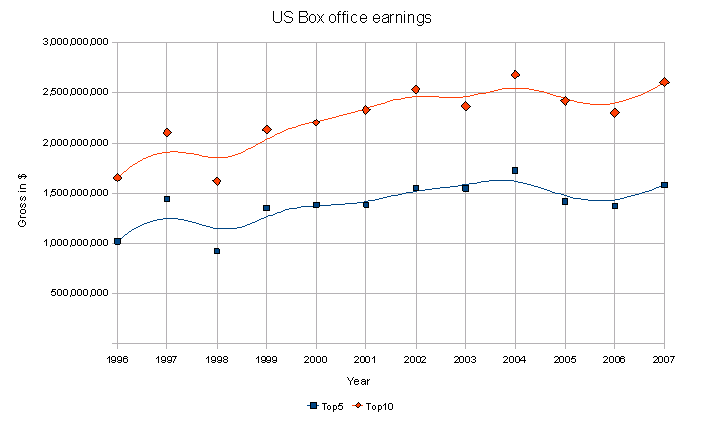
With average growth throughout the time period, it would seem that claims of cinema piracy hurting box office figures (leading to cinemas issuing night vision goggles to staff, and teenagers being charged with crimes for recording 20-second clips) are unfounded. When certain p2p protocol lifespans are marked on the graph, for comparison, the MPAA claims are pretty much shattered.
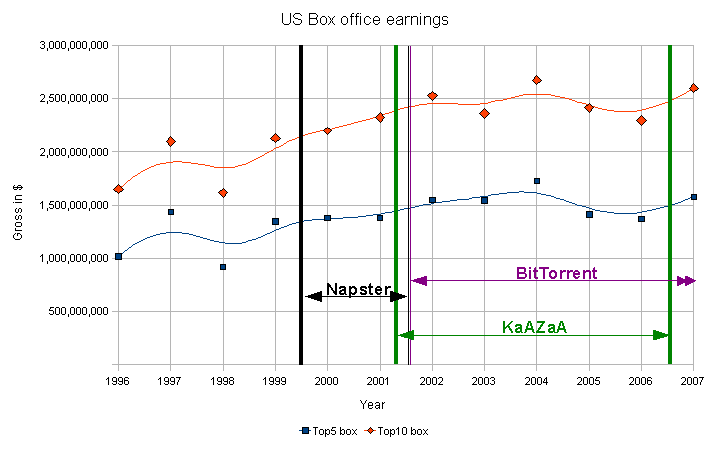
click to enlarge

Mr. Norton is also aware that he will have to prove he is not just making things up. The US Pirate Party, who is publishing the study, has stated that all data used in the study will be available when the full study will published at the end of July. He does have a comment for the MPAA however. “Prove your claims, or shut up about them.”


Previously: Download Torrents Remotely with Mininova Bookmarks

Next: Victims of WiFi Theft Not Responsible For Illegal Uploads

94 Responses

1 Jul 09, 2008 at 00:06 by www.eZee.se

Finally some really good news today!!!!!!… still feeling sick with the news of that bastard cop (against TPB) going free…

2 Jul 09, 2008 at 00:19 by Copafield

Nice

3 Jul 09, 2008 at 00:23 by Anonymous

Owned

4 Jul 09, 2008 at 00:23 by Dave.

With those kind of revenues, you can see how easily the industry can buy politicians and legislation.

5 Jul 09, 2008 at 00:27 by Anonymous

Consistent revenue isn’t good enough for these people. Growing revenue isn’t even good enough for these people. They want their revenue to grow even more – if their revenue isn’t growing as much as they want, they must be loosing money (even if they actually aren’t).

If your industry is actually in trouble (and you aren’t being stupid by paying actors 20 million dollars per picture) then I might have sympathy for you. However, you would have to be nice – your attempts to further bring fascism to the internet is not nice to us.

6 Jul 09, 2008 at 00:31 by Anonymous

I’m interested in the dip between 2004-2006

7 Jul 09, 2008 at 00:33 by Dre

Awesome. I would certainly agree that the MPAA isn’t losing money based on this data.

I’d only be concerned with the leap that Napster/KaZaA/BitTorrent were increasing profits, which would be pretty tough to prove. It wouldn’t be a bad assumption though if we knew when aXXo started uploading (Anyone know?). If he started in mid-2005, then I’d be pretty confident that BitTorrent, etc. is having a major beneficial effect on the movie industry.

8 Jul 09, 2008 at 00:46 by lowdirt

Now if this info could get into the hands of the actual artists and they could begin to understand piracy is not their worst enemy, then maybe there might be a shift in the tide… albeit a very slow one. This is a great preliminary step though (proving the MPAA is essentially lying at every corner).

Tell your friends, tell your neighbors! The Pirate Party is in town baby!

9 Jul 09, 2008 at 00:50 by Anonymous

@6 yeah it’s strange… then again only the top 10movies were studied

10 Jul 09, 2008 at 00:58 by Closer

Take a closer look at the graph, look at where the actual little dots are for each year. Thats actuley the earnings for that year (Which fluctuate as you will notice). The line is to show you its general increase, basically so you can see that its growing and not just fluctuating up and down.

11 Jul 09, 2008 at 01:18 by jos

Well you should also check out what kind of movies were released in these years. If you check at IMDB top 250 http://www.imdb.com/chart/top.

You will notice that there are several movies in 2004 being noticed in the IMDB top 250.

54. 8.4 Eternal Sunshine of the Spotless Mind (end march 2004 released)
69. 8.4 Untergang, Der (end february 2005 released)
82. 8.3 Hotel Rwanda (end december 2004 released)
126. 8.2 Million Dollar Baby (end december 2004 released)
145. 8.1 The Incredibles (begin november 2004 released)
164. 8.1 Crash (begin may 2005 released)
183. 8.0 Kill Bill: Vol. 2 (half april 2004 released)
242. 7.9 Shaun of the Dead (end september 2004 released)

In comparison to 2005:

79. 8.3 Sin City (begin april 2005 released)
102. 8.2 Batman Begins (half june 2005 released)
147. 8.1 V for Vendetta (half march 2005)

In comparison to 2006:

43. 8.5 The Departed (end october 2006 released)
51. 8.4 Leben der Anderen, Das (released in 2007)
59. 8.4 Laberinto del fauno, El (end december 2006 released)
85. 8.3 The Prestige (end october 2006 released)
156. 8.1 Children of Men (end december 2006 released)
165. 8.1 Letters from Iwo Jima (end december 2006 released)
184. 8.0 Little Miss Sunshine (end july 2006 released)

You can check the box office earnings per movie per year here:

2004 – http://www.boxofficemojo.com/yearly/chart/?yr=2004&p=.htm
2005 – http://www.boxofficemojo.com/yearly/chart/?yr=2005&p=.htm
2006 – http://www.boxofficemojo.com/yearly/chart/?yr=2006&p=.htm

So I think we can conclude that in 2004 a lot of good movies made it to the screen, while in 2005 it were less. There were also good ones in 2006, but they were coming at the end which means a lot of people saw them in the next year 2007…

12 Jul 09, 2008 at 01:31 by Sorry

I don’t want to spit in this soup, but the relation between the box office earnings and piracy doesn’t tell you much. Yes, the earnings might have increased while piracy increased, but it’s a fact that cinema attendance is in decline and has been for years. The fact that movies make more money these days, is based on the higher ticket prices and inflation. Indy 4 for example marks Spielberg’s biggest box office weekend to date, higher than Jaws, Jurassic Park, E.T. etc. However, if you count the numbers of people who saw it, you’ll get a different picture.

Piracy definitely has an effect on how often people go to the movies, so do flat screen TVs and surround system and annoying teenagers in the movie theater, video on demand, netflix and supposedly GTA4.

Piracy DOES hurt the movie industry, there is no denying that. The question is how much the damage is. And the figure the MPAA gives is utterly ridiculous.

Most times, piracy enables people to watch stuff they would not see in theater in the first place, or buy it on DVD. They’d pick it up at Blockbuster/Netflix. So the loss is marginal.

13 Jul 09, 2008 at 01:41 by jack

“Piracy DOES hurt the movie industry, there is no denying that”

Uh, as evidenced by what exactly. I for one think its a load of crap.

J.

14 Jul 09, 2008 at 01:58 by Edwin

Piracy DOES hurt the movie industry, there is no denying that. The question is how much the damage is.

No it doesn’t. Movie “industry” hurts itself by releasing complete and total bullshit that nobody wants to watch. Same goes to music and games. Quality product will always sell.

PS Turning movies and music into “industry” is what actualy hurts it all imho. It’s form of art, and art cant be “industry”

15 Jul 09, 2008 at 02:19 by $bullshit_name

“I’m interested in the dip between 2004-2006″

Yeah, that is interesting, especially considering the cunning Hearts & Minds PR campaign they had running an all.

16 Jul 09, 2008 at 03:28 by TD123

“Prove your claims, or shut up about them.”

QFT

17 Jul 09, 2008 at 03:32 by Idealist

I think what @14 was saying is that piracy does _have an impact_ on the movie industry. Whether that’s harm or help is subjective and of great debate.

I think it’s great that there is some alternative research being presented here. Unfortunately, the movie industry as it exists now will never accept a benefit to piracy. As for-profit companies, the continued existence of the major studios requires growth–growth in profits, growth in market share, growth in consumer control systems, growth in share-holder value. At best there will be a smattering of industry insiders and small studios that speak up on the side of file-sharing.

If we really want to change the face of the industry, it will require supporting only the studios that are embracing new media. I say that if the existing hollywood mafiaa aren’t willing to share their work, then I’m not interested in it at all! The liberation of creative works held captive by their restrictive copyrights may well be a noble act, but if we build a new industry based on freedom from the ground up, then the writers, directors, actors and crews will follow, and mighty Paramount will crumble in our shadow.

18 Jul 09, 2008 at 03:40 by Idealist

Here’s a starting point, an open-source software animation released on a Creative Commons arbitration license.

http://orange.blender.org/

19 Jul 09, 2008 at 03:58 by EelfinnTy

I don’t think the movie industry is losing much money but if they were wouldn’t it be from dvd sales?

20 Jul 09, 2008 at 04:06 by John Hone

Yawn, screw the MPAA and the RIAA while we are at it. Morons.
http://www.FireMe.To/udi

21 Jul 09, 2008 at 04:09 by Anonymous

> “Here’s a starting point, an open-source software animation released on a Creative Commons arbitration license.”

It was indeed a great starting point, but I believe it was more aimed at showing the power of open source tools (and that it did well).

22 Jul 09, 2008 at 04:17 by chingy

is that money standardized over the years?

because the value of the dollar hasnt been exactly constant…

23 Jul 09, 2008 at 04:37 by enter8

More importantly, why doesn’t the graph take into account how much money was spent on these films? If they continue to spend more and more (and it seems like they are) when that’s taken into account, the graph might take a downward tilt.

Sorry, but if we’re going to get on the MPAA’s case for pulling numbers out of thin air, we need to get our math straight as well. Gross income is meaningless to this discussion.

24 Jul 09, 2008 at 04:48 by Idealist

“I believe it was more aimed at showing the power of open source tools”

Indeed, but this isn’t a battle over just movies or music or software. We really need to look at how our entire digital lives are organized. The open source/gpl software communities share much with the copyleft creative communities, and both need our support as the creative consumers of this new age.

The movies, musicians and software developers we choose to support now will help to create a digital environment in the future that is free and open for all. If we continue to support (to watch, talk about, buy) corporate, proprietary, restrictively-copyrighted products, those companies will continue to pressure our elected representatives to crack down. But if we support those creators that have embraced digital freedoms instead, they will be elevated and help to affect positive changes for our shared digital future while the old guard lose profits, market share and influence.

25 Jul 09, 2008 at 05:05 by ...

People are taking the statistics way too literally..

You can draw statistics any way you want to prove your point, you can account for gross income and profit and tax and expenditures or whatever you can come up with.. it doesn’t matter..

Statistics don’t really prove that much, it doesn’t matter how much these stupid companies make (Even though its completely rubbish the claims they make). Its all about control and power, they release crap and expect you to line up like a mindless robots.

They are outdated, I don’t care for there garbage, and its time for them to go.

I want freedom, not there controlling bull shit, they have made there bed and now they can sleep in it.

26 Jul 09, 2008 at 05:16 by Hah

I love this song lol

http://www.youtube.com/watch?v=xLZpxVI7Pa8

27 Jul 09, 2008 at 05:16 by Ben Jones

Enter8 – I believe that is comming in the full report. We got a look at some of the data, it includes expenditures, inflation adjustments, attendance figures, even ‘time to scene’.

Think of this as a warning shot at the MPAA

28 Jul 09, 2008 at 05:32 by Chris Taylor

You people seem a bit blind to the facts. I can list why the box office stats are down with 5 characters

$9.50

thats the price per ticket in my area. If it were not for one theater having $5 showings during weekdays I would not be going to the movies. I refuse to pay $10 to see a movie. Period.

THATS why there is a decline.

29 Jul 09, 2008 at 06:37 by thanks idealist

Thanks for your post idealist!
Ps.. to the guy who posted the internet privacy link.. I would use TorrentFreedom instead!
http://www.torrentfreedom.com/

30 Jul 09, 2008 at 06:57 by #YLS#

@ 26 – Hah

Nice one, not seen this one before it’s pretty good!

31 Jul 09, 2008 at 07:14 by Peter Pier

You can’t base your intended profits on the oil industry cartel model. That level of ripoff already siphons off more than anyone else can get. You have to settle for a portion of what remains.

The mistaken figure was meant to be 6 hundred dollars rather than 6 billion. We hoped it would be far more, but with solid boycott efforts it may yet be. We won’t rest until you’re in the red, literally.

32 Jul 09, 2008 at 07:26 by Peter Pier

@28 Here it is $10, plus they don’t allow food and drinks in the theater, unless of course it’s bought there at their inflated prices. Can you believe that? I thought it might be nice to go with a group of mates but then realized we’d be wasting a hundred bucks, plus extras.

The only way I’d go is if I did a screen cam for bit torrent, only we’re among the last to get them; also I’d “smuggle” in food.

33 Jul 09, 2008 at 08:35 by Izkata

@28 & 32: My parents and I have gone to 4 movies over this summer so far. I don’t know what the price is, but really: The only reason we went is because my mom has been getting *free* tickets for all of us. Some sort of promotional deal.

34 Jul 09, 2008 at 08:41 by Egil

I believe the only reason of a decline in box office income would be the industry itself. The low prices on dvds is really undermining the value of going to the theater. Her in Norway, one cinema ticket costs 90nok, which google says is 17.7$ at the moment. That means 36 bucks for the two of us, without bus/parking, inflated snack prices and so forth. Why would I choose that when I can get 4 imdb top250 movies delivered in my mailbox for the same amount? 4 excellent movies to own, versus one screening with no
quality assurance at all.

35 Jul 09, 2008 at 08:48 by FetteredSoul

Don’t make the same mistake as the MPAA.

Although I cannot say anything about the upcoming full study from the pirate party, these preliminary findings say absolutely nothing about MPAA’s claims. The MPAA fails at producing credible figures and uses rhetoric to injure those who don’t want to take their bullshit, but the conclusions I’ve been reading here are also misinterpretation of data and the data itself is also unreliable.

I’ll keep it simple and look at 2 important points: 1)the conclusions are wrong 2)we may be making a point FOR the MPAA rather than against.

1) Even if revenues are growing after kazaa/bittorrent (leaving out napster which is mainly about music) appeared, that does not mean it is growing AS MUCH AS IT WOULD WITHOUT p2p. This is a counterfactual: what would have happened if p2p didn’t exist? naturally no one can observe a counterfactual, but there are many ways of estimating what the revenues could have been if p2p didn’t exist, WHICH IS WHAT THE MPAA does (and any serious economic analysis should do). We can’t say that piracy hasn’t hurt the movie industry simply because the revenues kept on growing. We need to see if the actual revenue minus the estimated revenue comes out negative (revenue loss-piracy hurts) or positive (revenue gain-piracy helps). Of course, I believe that the MPAA overestimates the estimated revenue, afterall they don’t publish their methodology. Still, we can’t shatter any claim based on these graphs.
Furthermore, analysing Box-office earnings alone won’t bring us anywhere. The MPAA takes DVD sales, for instance, into account (and no, they don’t count each pirated movie as 1 sale less). The DVD market is the movie industry’s main source of revenue, almost up to 2/3 of it. Movie executives aren’t really that worried about cinemas… it’s the competition of piracy with DVD sales that scares them. And not just movie executives… 40% of DVD sales in the USA are made through Wal-Mart. (these data are from TheEconomist 23rd Feb)
In the end, it might be that piracy actually helps, as I believe. However, there is no conclusive answer yet. And this topic is being heavily discussed… just type “piracy” at econpapers.repec.org to see dozens of academic papers trying to prove the good or bad role of piracy. It will take more than 2 graphs to argue against an immense lobby group.

2) We need to be careful not only about what we say, but also the data we’re basing ourselves on… Take a look at the box office x p2p lifespan graph. Now look only at the section 1996 – 2001 (begining of Kazaa). draw an imaginary line, say from $1,7bi to $2,3bi. Now take the Kazaa+bittorrent lifespan, roughly 2001-2007. draw another imaginary line from $2,3bi to $2,6bi. Which line shows a higher growth rate? Not only is this graph not very helpful, it may also be used AGAINST us, because it shows that, in the presence of piracy, revenues have grown more slowly. Now, no serious, unbiased person would therefore conclude that piracy has effectively hurt the movie industry, for this would be a conclusion as falacious as the one I pointed out above. But well, MPAA doesn’t play fair, does it?

36 Jul 09, 2008 at 09:29 by Anonymous

I used to go to the cinema maybe twice a year before i had internet. What I see now is that I last year went to the cinemas 5-6, same with the year before.

I used to buy dvd’s I heard was good, but they wasn’t always and I felt tricked, probably most by all the commercials. They used to trick me to buy their crap. Now I use my money on what i actually like.

I’ve really a lot of games and DVDs, I usually rather go for open source programs<3 than those that costs money.

Games, I’ve probably bought too many games, so many crap ones too… I recently bought a chipped ps2 so i could download all the good ps2 games i missed because I bought some crap instead. Because the only way I can buy ps2 games now, is most likely used or some new really bad they have left. When I then download PS2 games, i cant see where they would have made any profit on me at all, i wouldnt have bought it anywayz. If I like a game, maybe I buy the next in the same serie to ps3?? who knows, they might earn money on me!

My music collection, I don’t think I ever bought a cd before i started to download some… then i knew what i wanted, if I just kept on liking it more and more over time, it was worth buying. I knew I wouldnt get tired of it after some months. Sure I might download a LOT of music, but would they EVER have made ANY profit on it? Or do they make more on me now?

37 Jul 09, 2008 at 09:31 by Welshie

If the most that this study does is to ’shame’ the MPAA into defending it’s reputation (HAH!) by forcing it into publicly releasing it’s LEK study figures in it’s own defence, then it was worth the US Pirate Party’s time.

Also, it is a good tool to use to make media outlets (those who care), future jurors, etc face up to the fact that there are two sides to this tale… and that one side (MPAA) is not playing by the rules.

In my opinion… good story Ernesto!

38 Jul 09, 2008 at 10:09 by swetard

Well, sweden is shiit anyways ..

Horrible weather and VERY VERY ugly people

39 Jul 09, 2008 at 10:44 by Ventin Gabit

The price of going to the theater where I live hasn’t changed all that much over the past 12 years, and is definitely on the expensive side for the wife and I. A long winter doesn’t help matters either (cost of fuel, heating up the car, scraping the windows, etc). It is actually a bit cheaper to just wait and order movies on DVD/Bluray when they’re released.

Normally we’d rent the ones we wish to see based on genre and reviews, and occasionally buy the ones we feel are worthwhile enough to own. Lately we’ve been downloading high-def movies instead, but still plan on buying the good ones just as we normally would. We’re only resorting to this method because nobody has made a truly proper Bluray player yet, which we’ve had the money saved up for almost two years now. We have a nice home theater and so these kinds of things are important to us, as any movie buff will tell you. Honestly, the only area I can believably see studios losing money is with the really rotten eggs, which downloading helps folks avoid.

Even though we do pay what I feel is a bit of a premium for cable, we still tend to download our favorite TV shows as well, but only because it is more convenient and the quality is better (what can I say, Shaw sucks). In the past I’d normally use our PVR to record shows (stuff like Heroes, Lost, BSG, etc), but having to constantly keep track of show times and recording timers is a real pain. I feel what we’re doing is perfectly fair. I suppose we don’t see the ads, but I’d be skipping them anyways if I was watching shows I’d recorded to my PVR. Besides lacking visual/audio quality (and a dozen other reasons for disliking Shaw), they’ve also begun to use copy protection schemes that cause issues with our PVR, pretty dumb considering. No one in their right mind would put their over-compressed content online, but that is what they seem to be worried about regardless.

As far as music and software goes, I’ll occasionally download an MP3 to see if an album is worth buying, but don’t listen as much as I used to. My preference for applications is open source, and I love donating to the projects that deserve it. I’d rather donate $30 for a great bit of code than pay $20 for something commercial if at all possible. Always makes me feel all warm and fuzzy inside.

If I had to guess, I’d be willing to bet that all of my comments reflect that average joe right now. It’s all about principles and fairness, something I wish more parents would teach to their children. After all they are the future. How they’re treated plays a huge role in the direction society will take, and from the looks of things I would say that the “industry” of art will slowly change for the better given enough time. Too bad the greedy corporate big wigs can’t see the writing on the wall and show that they can be reasonable with both pricing and practices, which is all we so called “pirates” ever wanted in the first place. So sad it had to instead turn into a war, but that’s human behavior for ya; intractable to the bitter end.

40 Jul 09, 2008 at 10:48 by Gijs Molenaar

But the CD business almost died. Being the son of a Dutch specialist record shop owner, I’ve seen the shop shrink and die in less than 5 years. Before, the shop was filled with personel, and it was a respected job, people working there know a lot about music and is was a sort of social meeting place. After, people come there to ask for the title of a CD, or something they could find on the internet and download it theirselfs. Some would even say “f*ck you” for the, still high, prices of CD’s.

In my opinion the high price of CD’s in Holland is one of the biggest factors in this story, but this is the mistake of the big record companies.

What I want to say is that there ARE victims in this war between big media companies and pirates, and these are the small resellers.

I know the world is changing, and I’m downloading a lot myself. I just get this feeling that a old handcraft just died, just like glass blowing or something as simple as a grocery store.

41 Jul 09, 2008 at 11:27 by Fred

OK it doesn’t hurt the box office earnings. The best way to watch a movie is in the cinema.

But how about DVD sales and DVD rentals? I expect that there is some damage done. Any data available about those earnings?

42 Jul 09, 2008 at 11:58 by Cc

the chart is only for US but not outside US . if you do survey outside of US .

less and less retail shop that selling movie/music . not to forget the number of cinema .

also don’t just calc the box office movie only . need to calc yearly movie.

to be frank I doubt any party can come out correct figures.

43 Jul 09, 2008 at 12:30 by rofl

Nice try, but there is way too much data ignored here to come up with any valid conclusions.

Several data must be included to return a valid statistical analysis. Some examples would include, but are definitely not limited to:

1, Catastrophe – New Orleans Hurricane disaster, etc.

2, World Events – 911 and subsequent Homeland security issues. Iraqi war troops abroad, etc.

3, Economy – Housing market burst, price of oil, declination of the dollar, bankruptcies, etc.

4, Family – Divorce rate, census of age groups, etc.

5>, Movie quality, target audience, advent of wide-screen flat panel TVs, sexual promiscuity, price of marijane, ad infinitum.

All of these issues would, in some way, substantially affect the overall MPAA member profits, with or without involving peer sharing.

44 Jul 09, 2008 at 14:21 by Anonymous

Why is everyone wracking their brain over this? The MPAA, just like its music counterpart the RIAA ,is an anti-competitive cartel by the literal definition. We shouldn’t have to feel any need to placate them. In any case, it seems pretty clear that, at least among the higher grossing movies, “piracy” has a marginal affect on their revenues and may even help them. Let’s move forward from those facts.

By the way, there seems to be a lot of semi-apologists for the MPAA on here. Again, why do these people show up on a site called TorrentFreak? Do they think we’re here to make excuses for the cartels and celebrate their hijacking of our laws?

45 Jul 09, 2008 at 16:10 by Anonymous

you must remember that correlation does not equal causation. you can put any 2 sets of numbers on a graph and draw a line, but that doesn’t mean they have anything at all to do with each other. much more detailed and open studies are needed on both the parts of the mpaa and the pirate party. these graphics are less than useless. both sides have failed to show even a correlative relationship. a slightly more useful method might be to compare on basis of individual movies, to study the difference between movies that had high quality pre-release screeners and those that had not even cams till late in their life cycle; or looking at the box office gross week to week, and looking for a significant drop off more than expected declines when a high quality release became available. of course either of these would have to be over a very large sample area and should be grouped by budget(and maybe imdb rating). and this would need to be done over several thousand films to begin to get a representative sample to show any sort of definitive correlation. but true causation is nearly impossible to prove with any sort of statistical analysis, and any claims of such are nothing but an educated guess.

46 Jul 09, 2008 at 16:15 by Anonymous Statistics

Your use of a high-order cubic spline to represent the data is not very valid. I would suggest putting in a linear interpolation. That way you could compare the slope of the line against the average rate-of-growth of the U.S. or world economic growth with the trend-line. It makes a significantly stronger argument.

47 Jul 09, 2008 at 16:32 by zarathustra

“There are lies, damned lies, & statistics.”

=]

48 Jul 09, 2008 at 16:33 by Xplicit

so why are they all complaining

49 Jul 09, 2008 at 16:50 by Anonymous

Maybe a third party to all this piracy stuff should conduct a study. Honestly, the U.S. Pirate Party? Their numbers, as well as the MPAA’s, will mostly likely be looked upon with at least a little bit of scrutiny.

50 Jul 09, 2008 at 16:56 by SomeoneElse

“The best way to watch a movie is in the cinema.”

I have my doubts about this.
The last 3 or 4 times I went to the cinema I left the room with a tremendous head-ache, this was about 2 years ago. I have no idea why this happens but I haven’t gone back there ever since.
I don’t know if the cinemas in the US are different than the ones here in Portugal, but the movies always have lots of “dust” in a picture that is generally very blurred and out of focus.
When I went to see Minority Report everyone in the room left early and asked for their money back because you couldn’t see a thing.

The Cinema is dying. I’m happy with watching DVD movies on my TV set, and I don’t need a huge screen if the only thing I can see in it is a blur.

In my case, pirated movies had nothing to do with it. And I don’t think I’m the only one…

51 Jul 09, 2008 at 17:28 by Anonymous

Good point FetteredSoul, but I don’t think we should really care if their revenue isn’t growing as much as they want. It’s still growing, making movies isn’t dead.

52 Jul 09, 2008 at 17:52 by Melted Metal Web Radio

Just remember this:

A vast number of ‘Unauthorized Downloads’ (UD), over 95%, are those that would never have been sales.

Applied to the record industry, this is a huge promotional increase that has fueled the concert industry (of which labels are starting to take big cuts through 360 deals).

When applied to the movie industry, (UD) begs for new visions in revenue development, which are vast, from product placements to inserted promotional tags- use your imagination, people.

But what is clear here is that (UD) is a scapegoat for media monsters who see an opportunity to set the stage for unimagined revenue streams through legislation, framed as if all the other problems from the past, including bad business practices and a bad world economy, have just disappeared. After nearly 10 years, if (UD) were as deadly to their revenues as they keep screaming, .. they would be dead already.

Bill Wilkins
http://www.meltedmetal.com

53 Jul 09, 2008 at 17:56 by the box office is only a small percent

We all know that the studios dont make the real money in the box office. They make it in dvd sales and merchandising. The question then becomes how hard does piracy hit them there? i fear we will not know the answer to that question, as the studios hold those numbers.

54 Jul 09, 2008 at 18:09 by muuh-gnu

It actually shouldnt matter if the industry is doing good or bad to answer the question whether copying is right or wrong.

If the study showed that the industry was truly doing bad, it still would be moronic to prohibit copying just in order to keep a copy industry living.

This study by the pirate party was imho a huge waste of time. They instead should directly fight for our right to communicate freely and without censorship. They do not “owe” the industry a proof that our copying does not harm them. Our freedom to copy and share information amongst each other must not be revoked even if it _does_ harm an industry branch. (Especially one which can not exist under normal circumstances and needs a massive prohibition law to live.)

I dont care if a movie industry exists at all. I just dont want my basic communication and information exchange rights to be revoked in order to keep an obsolete business model (selling copies of stuff) working. Nobody fucking needs such a business model, we now all have our own copying machines.

55 Jul 09, 2008 at 18:13 by hank407

I only saw one or two posts touch on it: they should do a ticket price / attendance overlay for those charts. Matinee tickets weren’t always 7+ dollars, after all.

I’d also wonder if those statistics (average ticket cost for a given year) are affected by those less expensive movie theaters where you can see a different selection of movies for a dollar or two.

Not that piracy would be a/the cause of less attendance, as there are only 3 people on earth who enjoy dealing with cammed movies (the mpaa, the riaa, and the guy who recorded it thinking “this is gonna be sweet”). :p they could also try to get some idea of the number of cell phone complaints, number of parents taking babies to movies, etc.

Pacino gets shot, a baby cries, and the guy next to me is begging his girlfriend to not flush his apparently dead fish down the toilet. No thanks.

56 Jul 09, 2008 at 18:20 by Guy Anon

CD/DVD/Blueray manufacturing and disposal are major contributors to world pollution. These companies should give up there polluting ways. That being said, any ‘burnt’ CD/DVD/BR disc is no where near the quality and durability of a store bought “mastered” disc. the ‘pirating’ they speak of is a lesser art and at best create low grade sample reproductions that should not be considered equal to the real products. Ultimately, you are comparing apples to oranges.

57 Jul 09, 2008 at 18:33 by Eicos

“I dont care if a movie industry exists at all. I just dont want my basic communication and information exchange rights to be revoked in order to keep an obsolete business model (selling copies of stuff) working. Nobody fucking needs such a business model, we now all have our own copying machines.”

This is an example of the sort of shocking ignorance that makes anti-xxAAers look bad. The very existence of the copying machines that you feel obviate the need to pay for information would not be possible if it were not for a strong system of intellectual property protection. Just because information is intangible and fungible doesn’t mean it doesn’t have value, and it doesn’t mean that it should be free. Destroying the copyright and patent systems would eviscerate the creative economy.

You don’t care if there’s a movie industry? Great. Because if there’s no business model, there sure as hell won’t be any movies.

58 Jul 09, 2008 at 18:56 by T

The movie industry needs a salary cap!

59 Jul 09, 2008 at 19:04 by Anonymous

Excellently said, muuh-gnu. My thoughts exactly. Let an industry try to survive in a natural free market!

> “Just because information is intangible and fungible doesn’t mean it doesn’t have value, and it doesn’t mean that it should be free.”

You can’t own something intangible, though.

> “You don’t care if there’s a movie industry? Great. Because if there’s no business model, there sure as hell won’t be any movies.”

So you believe in having laws to keep industries? If there is no law banning CDs then the vinyl record industry will die. How about that?

60 Jul 09, 2008 at 19:23 by zarathustra

“any ‘burnt’ CD/DVD/BR disc is no where near the quality and durability of a store bought “mastered” disc. the ‘pirating’ they speak of is a lesser art and at best create low grade sample reproductions that should not be considered equal to the real products.”

*cough* bullshit *cough*

Durability maybe, but bit-for-bit duplication of data produces an IDENTICAL copy, not ‘low grade sample reproductions’. How could you possibly arrive at any _other_ conclusion?

Please put brain in gear before poasting further…

HTH
HAND
kthxbai

61 Jul 09, 2008 at 20:00 by Esteban

Owned!

62 Jul 09, 2008 at 20:04 by Daniel

Are we adjusting for inflation on the graphs? I could easily see the MPAA making claims that they are technically losing money if their gains are less than the rate of inflation.

63 Jul 09, 2008 at 20:09 by Rekrul

“Destroying the copyright and patent systems would eviscerate the creative economy.”

True, but the copyright system definitely needs an overhaul. The current term of life of the artist plus 70 years is ridiculous. It may be great for the artist’s kids, but it sucks for everyone else.

Software from the 1980s will be under copyright until long after I’m dead, even though it’s already old enough that you need a virtual machine to run it on.

There are many old movies and TV shows that have never been released on DVD or even VHS, that are illegal to copy because they’re still under copyright, even though the studios that created them obviously see them as worthless.

Copyright shouldn’t be automatic, it should require effort and expense on the part of the rights holder. This would force companies to decide which of their copyrights are truly worth hanging onto and which should be allowed to pass into the public domain.

The corporations should also stop trying to force DRM on everyone. It clearly does virtually nothing to stop piracy and only makes life more difficult for honest users. I’d consider paying for cheap, DRM-free digital copies of films and TV shows, but there’s no way I’m going to pay for a file that only works under limited conditions with certain software.

Having said all that, I think everyone is missing the big picture about this survey. While it’s good news to those of us who think the MPAA and RIAA have way too much power, this survey, in the words of Tommy Lee Jones “they mean precisely… dick.” No mainstream news outlet is going to print this story. No politician is going to go against their corporate masters and give credence to it. The MPAA probably won’t even bother to respond to it, other than maybe to claim that it’s just an attempt by pirates to justify their actions.

I means absolutely nothing to the rest of the world.

64 Jul 09, 2008 at 20:11 by Rekrul

Oops, that should be “It means absolutely nothing to the rest of the world.”, although the first way is pretty much true too. :)

65 Jul 09, 2008 at 20:49 by Bob

So hit movies are hits because of piracy?

What the hell? It’s the other way around. People pirate them because they’re hits.

66 Jul 09, 2008 at 21:13 by Anonymous

you seem to miss the point, usually these movies are hyped, and with em all over the net they get hyped even more! Usually are these movies the most crap :|

67 Jul 09, 2008 at 21:33 by Putin 08

Eicos: “This is an example of the sort of shocking ignorance that makes anti-xxAAers look bad. The very existence of the copying machines that you feel obviate the need to pay for information would not be possible if it were not for a strong system of intellectual property protection. Just because information is intangible and fungible doesn’t mean it doesn’t have value, and it doesn’t mean that it should be free. Destroying the copyright and patent systems would eviscerate the creative economy.

You don’t care if there’s a movie industry? Great. Because if there’s no business model, there sure as hell won’t be any movies.”

Greetings!

I’m afraid to inform you that the post you are replying to is a product of your own imagination. In reality, muuh-gnu didn’t call for the destruction of the copyright and the patent systems.

In addition, the business model in question is the ass-backwards business model of selling pyshical copies to consumers who can make their own fucking copies because they have broadband and a media burner at home. If that business model went bye-bye, it would not infact mean the end of the movie industry.

Finally, muuh-gnu’s top concern was that basic communication and information exchange rights never be revoked in order to artificially prop up and outdated business model. Not that Hollywood can keep crapping out movies.

Three strikes. You’re out.

But don’t cry, my wittle sweetums. It’s not really your fault. You can’t help having Down’s Syndrome.

Just tell your Special Ed. teacher that the Internet is too complicated for you, they’ll understand. And an embarrassing situation like this will never happen again.

68 Jul 09, 2008 at 21:45 by Eicos

“You can’t own something intangible, though.”

You can’t? Well, then I guess I don’t own my bank account, my stocks, my bonds, or my domain names.

“So you believe in having laws to keep industries?”

No, I believe in laws preventing theft. I am a pirate too, and I believe, like Rekrul does, that the copyright system needs a major overhaul. But ultimately, a person who creates content needs to be compensated somehow by the people who consume that content. That should be obvious.

“If there is no law banning CDs then the vinyl record industry will die. How about that?”

This is a foolish analogy. When people switched from vinyl to CDs, the artists making the music on those media still got paid. The only difference was the equipment. If people switch from CDs to illegal torrents, the artists will NOT get paid. Of course, the record companies are greedy and screw their artists, but how are the artists supposed to get paid if they have no legal recourse against freeriders?

69 Jul 09, 2008 at 21:59 by Eicos

@putin 08

I’m not sure why you felt it necessary to accuse me, among other things, of having Down’s syndrome. The only person who should be embarrassed here is you. Now then, shall we get on to the reason you’re completely wrong?

You say, “In addition, the business model in question is the ass-backwards business model of selling pyshical (sic) copies to consumers who can make their own fucking copies because they have broadband and a media burner at home. If that business model went bye-bye, it would not infact (sic) mean the end of the movie industry.”

This is a straw man attack. (You do know what that means, right?) The sale of physical instantiations of art is clearly NOT the business model in question. It’s obvious that only a few cents out of the purchase of a CD or DVD pays for the media and packaging. Most of what you’re paying for is the right to play back, at your leisure, the music or video that’s ON the media. This is why, for the right price, most labels would be just fine with legal, DRM-free downloading.

No, the business model muuh-gnu wants to overturn is the model of charging for content. Here, read it yourself:

“Our freedom to copy and share information amongst each other must not be revoked even if it _does_ harm an industry branch.”

So, according to muuh-gnu, information is fundamentally free, and there must be no legal restrictions on its sharing. Since the recording and movie industries live by accepting money in return for providing content, this legal theory would destroy those industries.

I think “free information” is a nice idea, but the problem is that if information is free, there’s very little incentive for people to develop any products which can exist as information. You can call people retards all you want, but until you address this fundamental weakness in your arguments, nobody will take you seriously.

70 Jul 09, 2008 at 22:28 by Anonymous

@ 68
Shut up, fag.

71 Jul 09, 2008 at 23:18 by Eicos

#70, let’s see you say that to my face. Or even with your name next to it, for that matter. Coward.

72 Jul 10, 2008 at 00:17 by Naw man

@ 40

Glass blowing is still in biz.. what the hell else am I supposed to smoke out of? hah

73 Jul 10, 2008 at 02:04 by Anonymous

> “You can’t? Well, then I guess I don’t own my bank account, my stocks, my bonds, or my domain names.”

How are those not tangible? They’re certainly more tangible than culture.

> “No, I believe in laws preventing theft.”

Copying isn’t theft.

> “But ultimately, a person who creates content needs to be compensated somehow by the people who consume that content. That should be obvious.”

Industries should be left on their own from government intervention to keep them up like this. We don’t need the government to decide what industries should exist and enforce laws that go against the nature of culture to keep them as profitable as they want.

> “This is a foolish analogy. When people switched from vinyl to CDs, the artists making the music on those media still got paid. The only difference was the equipment. If people switch from CDs to illegal torrents, the artists will NOT get paid. Of course, the record companies are greedy and screw their artists, but how are the artists supposed to get paid if they have no legal recourse against freeriders?”

The point was using copyright laws to keep up the music industry.

Why not use laws to keep up the vinyl industry? If we don’t, no vinyl will be produced any more! We need to do it! Think of all the people who make vinyl records! They won’t have a job without it! Just one more exclamation mark! :)

74 Jul 10, 2008 at 02:29 by Izumi-sensei

@57
“estroying the copyright and patent systems would eviscerate the creative economy.”
WRONG. I have an alternate business model. Non-profit file-sharing should be legalized. Copyright should be reduced to 15 years maximum. The deal is that the ordinary people have their own ideas on what culture they see. They should be permitted to express it, but they are forbidden to do so because of copyright. Culture is essentially speech, a basic function of society, and there is no way legalizing file-sharing will ever destroy creativity, because creativity comes from human nature. In addition, this will permit the ordinary human to express themselves about culture through creative art. Moreover, since the ordinary person will be more creative and vocal, the ordinary person will be more equal under this system, which will encourage more human interaction between creator and viewer.

“But ultimately, a person who creates content needs to be compensated somehow by the people who consume that content. That should be obvious.”
The fact is that the viewer of the art also has their own idea about the art, and their ideas count as much as their own. The compensation is that it is seen. For example, when you write a message, the compensation is that people read the message. The same goes for art.

“No, I believe in laws preventing theft.”
Copying a CD for your friend is not theft, or taking a copy of a CD from a friend is not theft. Simply put, the friend who is giving it to you, is willingly giving it to you. Therefore, it is not theft.

“Well, then I guess I don’t own my bank account, my stocks, my bonds, or my domain names.”
You own your own bank account, but what other people do with their own bank account should be their own business. Analogously, people who create their art have the right to do whatever they want with their art, but what other people do with their own copies, like giving it to a friend, should be their own business.

A substantial number of people here think that the creator is the only one who should have a say on what is to be done for art. This is obviously wrong. Other people have their own ideas on what could be done with the art, and their ideas are as creative as the original creator. When one hears some kind of music, one has one’s own idea of it, and one should be able to create an offshoot of it, or do other things with the music that the original creator has not thought up of.

I have set up a simple pledge so that you can help me with this simple idea:
http://www.28chan.org/pledge.php
I am soliciting the readers of TorrentFreak to support and help my cause.

75 Jul 10, 2008 at 04:11 by Eicos

I agree with a few of the things that you say about fair use, but there is still the fundamental problem of compensation. The idea that having your art seen or heard is compensation is laughable. You may not want to accept this, but just as some people are better at baseball than others, some people are better artists than others. And just as we pay for the privilege of watching the best baseball players compete in sports events, we pay for the privilege of experiencing the works of the great artists. If we, as a society, want to have great art, we have to be willing to pay great artists enough so that they can make art full time. If we’re not willing to pay them to make art, they’ll spend most of their time doing something else that we ARE willing to pay them for, such as being a doctor or a janitor or something. And I think that’s a waste of talent.

76 Jul 10, 2008 at 04:46 by Joseph McCarthy

Fact is, I’ll download and watch a lot of movies that I’d NEVER EVER pay a cent to see, not even as a rental.

77 Jul 10, 2008 at 05:22 by JN

Can someone send this chart to that stupid Politician in western Canada who is responsible for Bill 61 please!

Or maybe he is still counting his under the table money from the movie industry.

78 Jul 10, 2008 at 06:40 by Mr. Dr. PhD

Wow what an amazing study, this really proves that piracy actually helped the industry!

79 Jul 10, 2008 at 12:38 by I can be anonymous too...

@ Eicos

Many thanks for your views. You make a lot of valid points.

Please don’t let the trolls annoy you :-)

80 Jul 10, 2008 at 12:42 by I can be anonymous too...

@ 70

Are you telling Eicos to shut up, then offering him a cigarrette?

I’m afraid that when you throw insults around, you weaken your position and invalidate your argument.

81 Jul 10, 2008 at 13:21 by Bubba

I’d figure that piracy would have more impact on video sales and rentals than on the box office.

But, for every actor that gets $20 million a picture, there’s probably a thousand that get paid squat and get squat in residuals. Bud Cort, who starred in “Harold And Maude” said in an interview that he got absolutely nothing from video sales, and that his residual check was about $29 a year. Actors are probably afraid to try to change this for fear that they’ll be blacklisted.

Not completely unlike the way that big music companies rip off their artists; some bands don’t get a penny from CD sales once management and distribution have taken their shares. The lucky ones maybe get a whole 5% of the CD retail price.

82 Jul 10, 2008 at 15:19 by AnarchyNow

Death to the record/movie/useless-optical-plastic-disk industry!

83 Jul 10, 2008 at 15:54 by Putin 08

Eicos from Special Ed. :“I’m not sure why you felt it necessary to accuse me, among other things, of having Down’s syndrome.

Oh? You aren’t sure why?

Then I recommend you learn how to read. Or is literacy too advanced for your curriculum? sniff :(

Eicos from Special Ed. : “No, the business model muuh-gnu wants to overturn is the model of charging for content. Here, read it yourself:

“Our freedom to copy and share information amongst each other must not be revoked even if it _does_ harm an industry branch.”

So, according to muuh-gnu, information is fundamentally free, and there must be no legal restrictions on its sharing.”

And you see, dear, this is why you need to notify your Special Ed. teacher ASAP to revoke your computer room privelages. The comment you “read” is wildly different from the comment in reality.

If you weren’t suffering from prenatal braindamage, your response there would be called a strawman. But you are, so let’s just forget all this unpleasentness and get in a great big hug-circle!

Eicos from Special Ed. : “I think “free information” is a nice idea, but the problem is that if information is free, there’s very little incentive for people to develop any products which can exist as information.”

Nine Inch Nails brought attention, but apparently not enough to hammer it into your oversized forehead, to the fact that offering a product for free doesn’t stop people from buying it if they’re given the option. Because even if you give something away for free, there are no shortage of people willing to pay for it.

You act like the economy and artistic creativity would fall in to shambles if copyright was abolished, but copyright has been dead since the moment Napster pushed filesharing into the mainstream.

Information already is free. Welcome to the real world.

And one last thing, Shortbus…

Eicos from Special Ed. : “No, I believe in laws preventing theft. I am a pirate too”

Nice try, but the only people who associate theft with filesharing are either A, MAFIAA sockpuppets, or B, utterly clueless.

You should remember that the next to you pretend to be a “pirate”.

P.S.,
Hay everybody, don’t call Eicos a “fag”. He’ll beat u up IRL :O!! He doesn’t seem too offended when you call him a retard, though. I’m guessing closet-homosexual. It’s ok 2 b gay, Eicos.

84 Jul 10, 2008 at 16:19 by oneplusone

@ #12

They can bitch and moan all they want. Theatres smell, are uncomfortable, noisy, are attended by inconsiderate clods and are unjustifiably expensive. The sounds is way to loud and I have to sit through rushes. I can’t bring my two year old daughter (for the consideration of others paying all that money for a movie). So theatres are a no-starter, for me. On top of all of it, I smoke and can pause the movie at home as needed.

Funny that this issue appears to be as political as some of these artists get. Most, really. Most of these pity-party artists are gutless absentees when issues of political import arise in society. Their precious “careers” are not to be put in jeopardy for the “rest of us”. And I know that’s how they view us- ,as wallets and pocketbooks without our own perspective. You know what’s funny? I find that the less you pay for something, the less it is important to your being. As an example, I bet 50% of the movies I watch, I don’t even finish. Hells yes I’m glad I didn’t give my family’s hard-earned money to some stupid theatre or media giant for those ones.

How many other people on here don’t finish much of what they watch? That would be interesting.

85 Jul 10, 2008 at 16:52 by Jammy Jones

Piss on the MPAA, the RIAA and anyone else who tries to keep it from being free!

JT
http://www.FireMe.To/udi

86 Jul 10, 2008 at 21:08 by Eicos

@Putin 08, when all the gratuitous insults are stripped away, you make so few points that the few sad stragglers aren’t even worth rebutting.

87 Jul 12, 2008 at 06:42 by Izumi-sensei

I am soliciting readers of TorrentFreak.com for support in a pledge to help me in an effort to reform copyright law and hand over power to the common person. I am trying to create an open discussion on what should be done.

Here is the pledge:
http://www.28chan.org/pledge.php

88 Jul 12, 2008 at 11:51 by july 12

IS refreshing to know they are heavily insured

89 Jul 12, 2008 at 14:49 by Crynsos

Really just one word… LOL!

When I read the article and looked closely, I couldn’t see or think of much yet, but with the P2P Networks in the second picture, I looked at it for a second and loled so much…

It’s so dumb, that it’s totally hilarious…

90 Jul 13, 2008 at 09:27 by hyc

“But ultimately, a person who creates content needs to be compensated somehow by the people who consume that content. That should be obvious.”

No, your basic premise is flawed and you’re too brainwashed to even see it. Ideas, the product of creative minds, are not *consumed*. When you conceive of an idea and pass it on to someone else, the idea does not disappear, nor does it diminish. Quite the opposite, it *grows stronger*.

The entire concept of “consumer” is based on the notion of physical resources that can only exist as a single instance. When I build a hammer, physical resources are consumed to produce that hammer. Once allocated to producing the hammer, those resources cannot be used for any other purpose (unless/until the hammer is recycled). It’s based on the scarcity of physical resources. The concept has absolutely no bearing on Ideas or human creativity.

As long as there are living people, there will always be new ideas. There’s no scarcity, and the fact that I share an idea with you doesn’t prevent me from continuing to use the idea myself. When you buy into the notion that intellectual property is sold to the population and consumed, you’re buying into a Big Lie.

The notion that the distribution of ideas must be tightly regulated is yet another Big Lie. If you come up with a revolutionary New Idea and never tell anyone else about it, it has a value of exactly zero. Ideas and intellectual property only become valuable when they are disseminated – the more people you can reach with your idea, the more valuable it becomes.

And of course, once you’ve distributed your idea to a population, it only matters if that population actually appreciates it and assigns a value to it. Ideas have no intrinsic value. Their value can only be judged by their potential impact on society. Ideas that are rejected, ignored, and forgotten, have no value…

The Big Media industries used to actually serve a purpose – by distributing their products, they enabled artists to have their work exposed to a wide audience, and the value of the artist’s work was directly measured by the sales figures. But Big Media has been the tail wagging the dog for a long time now – instead of finding actual talent and simply exposing them to the world, they’ve been hunting for marketable drones that could be easily promoted, regardless of talent. And in the meantime, the Internet has come along to serve their original purpose far better than they ever could.

Wake up already…

91 Jul 13, 2008 at 22:37 by Dr J

So there is a lot to take into account. For the the increasing population in the world which should be giving them more profits, secondly the inflation of the dollar, thirdly the increased cost of special effects. It is obvious that the could be losing money, but patenting art in my opinion is wrong.
I understand that they want money, and I believe that they should have it. But they need to catch up with society. Perhaps there are other ways to make money besides selling the movie. The majority of people downloading pirated materials probably can’t afford them. So by denying piracy you are with holding information from the weaker classes. Is that ethical?
Millions of people put information on youtube which makes them nothing, while making youtube rich. I don’t see them complaining… Artists are giving out music for free these days and asking for donations. The world has changed the government will soon have to change it’s ways to keep up.
Try figuring out how over populated the world will be in 100 years. We should double soon…. Do you realize what this means?! Have you ever started with the number 1 then added it with 1. Then add that together. EX 1+1=2 2+2=4 4+4=8 8+8=16 and so forth. Now go figure out what the world population was in 1990, then compare it with what it is today… Then estimate for the future. Then figure out how many problems we’ll have unless we have re-imagine our world.
The end is near, are you ready?

92 Jul 15, 2008 at 15:38 by Eicos

hyc, you bring up some interesting points, to which I make the following response:

It’s true that the traditional sense of the word “consume” can’t be applied to ideas, since they can theoretically be “replicated” without loss of form or power. Nonetheless, most of those who listen to music are still consumers; it’s just that the product they consume is not a good, but a service.

After all, the “great forum of ideas” model of music is a fantasy. Most people are not great musicians, or indeed, even capable of playing an instrument. Nor do most of them have any opinions or knowledge concerning music that would be of any value to the rest of the world. Still, for various reasons, they enjoy listening to music. But if they cannot produce it themselves, how can the public experience music? Well, it just so happens that there are excellent musicians who will produce and record music expressly for the enjoyment of others. This is a service, and because there are relatively few musicians who have only so many hours per day, it is /scarce./

This is why musicians should be paid. Most music is not a “big idea,” but a form of entertainment. We’re not paying for an idea, but for an experience. And it’s not hard to see that if we decide that musicians should not be paid, that there will be much less of that experience to be had; if musicians are not paid for their music, they will either have fewer hours and less energy with which to produce their music, or give it up entirely.

Now, this is where my own certainty on the subject ends. I would be the first to say that the current system is broken. Before the internet, the labels provided a useful service by exploiting economies of scale to efficiently aggregate advertising and distribution under one roof. They were still screwing their artists, but the artists needed the labels too. But today, neither advertising nor distribution is beyond the reach of a determined individual with a few hundred dollars to spend. And many consumers are rightly wondering why they have to subsidize the payrolls of the rapacious legions of lawyers and administrators when the record labels no longer serve a useful function. Moreover, by spending vast sums of money on lobbying and suing file sharers for extortionate sums, the labels are producing market distortions which have negative effects on artists, consumers, and citizens alike.

I think there is an argument to be made that one should not support the record labels. We are still left, however, with the moral imperative of compensating musicians for the time they spend producing something that we enjoy. And since most people do not have any form of opinion or knowledge which would be useful to the musicians, this compensation will still have to take the form of money. The question of how to accomplish this is a difficult one, but I believe that the market is already in the process of solving it.

Now that the internet makes advertising and distribution available to individual artists for a tiny fraction of the previous cost, any company whose business model relies on providing those services at higher-than-internet economic cost will either have to change their model, or fail. The savings of internet-provided ads and distribution will eventually be passed along to the consumer, resulting in substantially lower prices. And once music sales are transacted on a forum directly controlled by and associated with the originating artist, the behavioral effects of personal interaction will come into play; consumers will be much less likely to take their music for free when piracy stops letting one thumbing one’s nose at an evil corporatocracy, and instead means directly stiffing the artists.

The result will be a musical and artistic revolution in the long term. In the short term, however, since the artists are paid indirectly through record labels, we are each inexorably faced with the choice of whether to sacrifice the needs of the artists in the interest of hastening the demise of the labels. I think we have to support the artists somehow, but I’m not sure how to do it.

93 Aug 08, 2008 at 23:24 by prophet

That’s what happens when wrong people do the study and millions think the researcher did his job.

Anyone who’s in the biz around the europe will see a different pattern.
Only an idiot will take top 5 or top 10 movies of the year to do the chart.

The pattern known in some european countries is showing that with piracy people tend to go far less to cinemas. They become more picky about what they actually pay for. So they narrow their cinema visits to maybe two or three movies a year (talking about average). So that means that top5 or top10 movies might start doing even more or at least the same as previous years.
But that also means that all those “mid range” films are getting hurt badly, which is a sad thing, as it’s in that category that you can find best movies of the year.

Why else would many yearly box offices go down even in years when average ticket price went up?

It’s an idiotic research by a person that has no experience in movie distribution.

When you see the true yearly data for every country, then you can start talking about piracy and how much change it made.

Of course, there can’t be much more piracy in 2008 than it was in 2007. Almost anyone interested is already pirating as much as he wants. So piracy is no longer lowering box office, it just keeps it low(er).

94 Aug 08, 2008 at 23:45 by prophet

to dr.j

Denying download of films is denying information to weaker class?
Do you honestly believe only poor people download?
What do we do with those that have more than enough money, but they chose to spend it on something else?

Also, do you believe that being without money entitles you to have everything?
Do you go to your nearest Ferrari owner and ask him to lend you the car because you can’t afford it?

There’s no problem in changing society into communism, but shouldn’t we tell that to the authors of copy right before they start making movies?

You might see that a number of smart people will quickly change their jobs.

Responses are closed

All remaining responses will continue to be archived. Use the TorrentFreak forums if you want to discuss something.