Earlier this year, adult entertainment company FlavaWorks sued the operators and hundreds of users of private torrent tracker Gay-Torrents.org.
The lawsuit had an immediate effect, as the tracker went offline shortly after. In an amended complaint, FlavaWorks later narrowed its list of targeted users from 325 to 39.
Several of the site’s administrators and most of the targeted members are still listed as anonymous John Does. To change that, FlavaWorks asked the court for permission to subpoena their email providers. In an October 14 order, U.S. District Judge John Robert Blakey granted this request in part.
Subpoenas Target Google, Yahoo, Microsoft
The order allows FlavaWorks to subpoena Google, Yahoo, Microsoft, AT&T, Cloudflare and Newfold Digital. Each subpoena is limited to the email addresses or domains of defendants linked to that provider.
The targeted services are asked to hand over the subscriber’s name, mailing address and phone number, as well as any secondary, recovery or two-factor authentication email addresses. FlavaWorks can also request the most recent IP address that was used to access each account, covering the period from January 2025 onward.
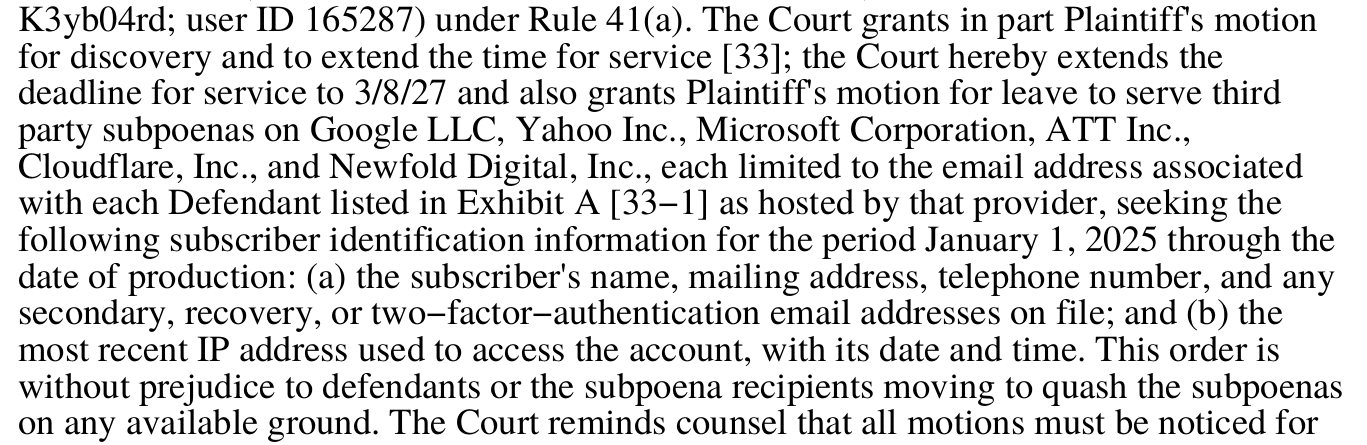
The judge didn’t give FlavaWorks carte blanche. The company also asked for the billing names and addresses on file with the email providers, and for a subpoena to payment processor Stripe to identify the people behind a Bulgarian company linked to the site. The order includes neither.
An IP Address Is Not a Person
Subpoenas targeting email providers are not common in torrent-related lawsuits. Rightsholders typically collect IP addresses from torrent swarms and ask Internet providers to identify the account holders. FlavaWorks says it has IP address data for the defendants too, but it chose to go after their email accounts instead, bypassing the more common ISP route.
As justification, FlavaWorks mentions an argument that’s usually reserved for defendants, stating that an IP address is not a person.
“But an IP address identifies an Internet subscription, not a person: it resolves to whoever pays the bill for a household, an office, a university network, or a shared carrier-grade address pool, and it can be masked by a VPN,” FlavaWorks writes.

An email address, the company argues, is personal to the account holder, which should help to identify the defendants.
According to the exhibit filed with the motion, 22 defendants are linked to Gmail addresses, nine to Yahoo, three to Hotmail and one to an AT&T address. Two others use private domains, registered through Cloudflare and Bluehost, a Newfold Digital company.
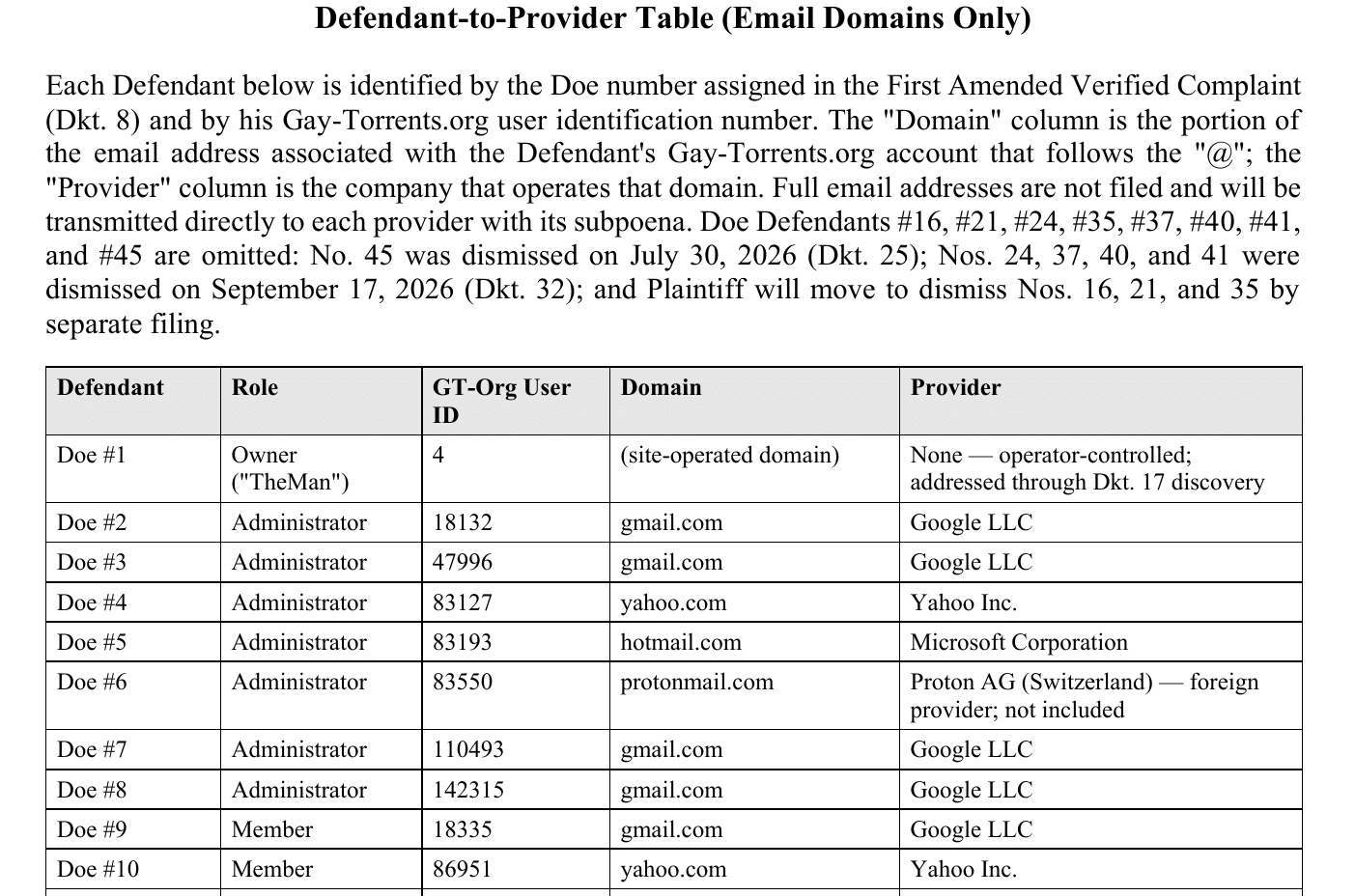
This list of targets isn’t limited to regular members. Several of the site’s administrators are on it as well, identified by Gmail, Yahoo and Hotmail addresses. One other administrator, who used a ProtonMail address, was left out, as the Swiss company is beyond the reach of a U.S. subpoena.
Tracker Users Can Still Object
The new order doesn’t mean that the data will be handed over right away. It explicitly allows the defendants and the providers to move to quash the subpoenas.
Google, for example, has pushed back before. In February, we reported that the company raised First Amendment concerns over a similar FlavaWorks subpoena targeting users of another private tracker.
However, in a July filing, FlavaWorks said that Google produced subscriber data in that case in April. Whether that covered all the targeted Gmail accounts is not mentioned. FlavaWorks adds that the tech giant handed over the same type of information in an earlier case, without objection.
Insider Knowledge?
For FlavaWorks, the subpoenas are meant to confirm its existing suspicions. The member defendants in this case were selected because the email address on their tracker account matched an account on one of FlavaWorks’ own sites.
In a September status report, the company said that its own records already point to a probable identity for many of them. It doesn’t want to name anyone publicly, however, before the email providers confirm who is behind each account.
How FlavaWorks obtained the email addresses in the first place is still a mystery. On an invite-only tracker, this information is typically only visible to staff. The court filings don’t offer a direct answer but cite the company’s own records and “investigation” without going into detail.
The September status report, which we haven’t seen reported anywhere, shows that FlavaWorks has help, presumably from an insider.
“Plaintiff has also obtained the cooperation of an individual with direct knowledge of the Site’s operation,” it reads.

The report doesn’t say when this cooperation started, or whether this person is the source of the email addresses. That said, FlavaWorks expects that this cooperation can help identify the operators, as well as other users who shared its works or funded the site.
Some defendants are already settling. FlavaWorks notes that several members resolved the claims before they were named. Additionally, in its separate RICO lawsuit against 75 members, one John Doe agreed to pay an undisclosed settlement amount in installments.
For now, the account holders and the subpoenaed companies can still ask the court to quash the subpoenas, but the docket shows no movement on that front yet.
—
A copy of Judge Blakey’s order is available here (pdf). FlavaWorks’ renewed motion for expedited discovery, with the defendant-to-provider table, can be found here (pdf), and the September status report is available here (pdf). FlavaWorks’ July discovery motion, which mentions Google’s earlier productions, can be found here (pdf).