 Last month, DNS resolver Quad9 announced that it would leave France, after losing a legal battle against beIN Sports.
The Paris court imposed a penalty of €1,000 a day, which ran until November 14, when the blocking order expired at the end of the WTA tennis season. Quad9’s exit, however, went ahead as planned.
Service Unavailable
From this morning, Paris time, French users of the Swiss foundation’s DNS resolver no longer get answers. We confirmed this through probes in France shortly after 09:00.

Quad9 told us that it answers queries from France with a refusal. The response includes extended DNS error code 18, which is labeled “Prohibited” under DNS standards, as well as a short note pointing to the legal situation in France.
Most people will never see these details, as web browsers don’t display them. For regular users, DNS lookups through Quad9 simply stop working.
The Internet doesn’t have physical borders, so Quad9 relies on a GeoIP database to decide who is in France. The foundation believes that data is good, but notes that it will be imperfect. Some users outside France will be refused, and some French users will slip through.
VPN use will also impact its blocking. A French user connected to a VPN server in Helsinki will still get answers, while a user in Kenya who connects through a French VPN server is refused. People who believe they are blocked by mistake can contact Quad9’s support team, which will then adjust its list.
The foundation has also posted a notice on its status page, titled “Quad9 No Longer Serving French Users as of November 24, 2026.”
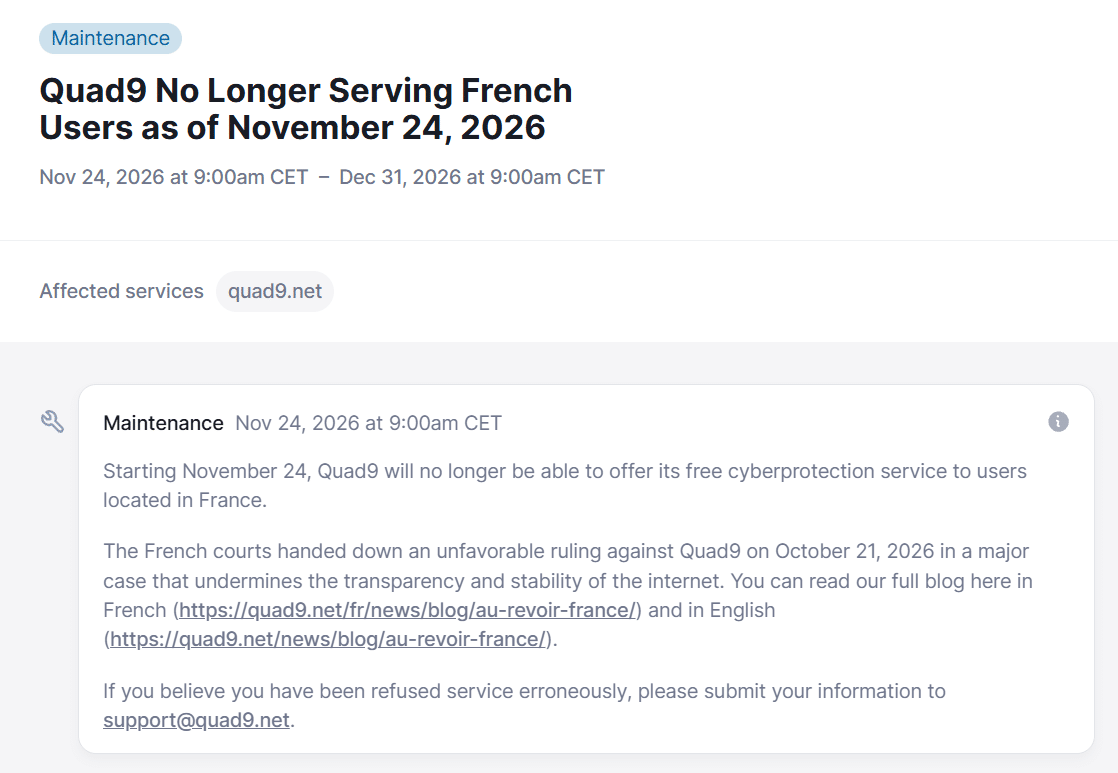
While the tennis order may have expired, beIN’s case was never Quad9’s only concern. The foundation previously said that it can’t survive the penalties that may follow from roughly 20 other pending blocking cases in France.
Quad9 sees leaving France as the least bad option it had.
No Censorship Tool
The exit means that French users who never watched a pirated match lose their resolver, while an imperfect block of the listed domains would have hit far fewer people. We asked why the foundation prefers this option nonetheless, which touches on the core values of its operation.
“Because Quad9’s mission is to protect users from harm, not to guard private companies from outcomes they do not want,” Todd says. “We do not wish to be complicit in building the tools of censorship.”
Quad9 sees DNS filtering as a distraction in any case, as it does nothing to stop the source of the pirate streams.
Quad9 calculates that the penalty could reach €24,000. There is no official demand for payment yet, the foundation told us, and court delays mean it may be some time before one arrives.
Partly Unblocked
Earlier this month, we took a closer look at the blocklist behind beIN’s order, which had grown to 118 domains. After the order expired, we checked all of them again on Monday, through a French VPN server.
Most of the blocks are gone, which shows that blocks do get lifted after an order expires, at least at Google and NordVPN
Google’s DNS resolver now blocks 22 of the 118 domains, down from 91 on October 28. NordVPN’s resolver blocks 20, down from 89, while Cloudflare’s 1.1.1.1 still blocks none.
| Reported to Lumen | Domains | Blocked (Oct 28) | Blocked (Nov 23) |
|---|---|---|---|
| May 13 (court order) | 6 | 6 | 6 |
| June 15 | 22 | 22 | 8 |
| September 21 | 30 | 30 | 3 |
| October 16 | 30 | 30 | 2 |
| October 26 | 30 | 3 | 3 |
| Total | 118 | 91 | 22 |
The six domains in the original (now expired) court order are all still blocked. Google’s error message links to a notice that was filed on behalf of beIN Sports in June, under the case number of the tennis order (RG 26/02207).
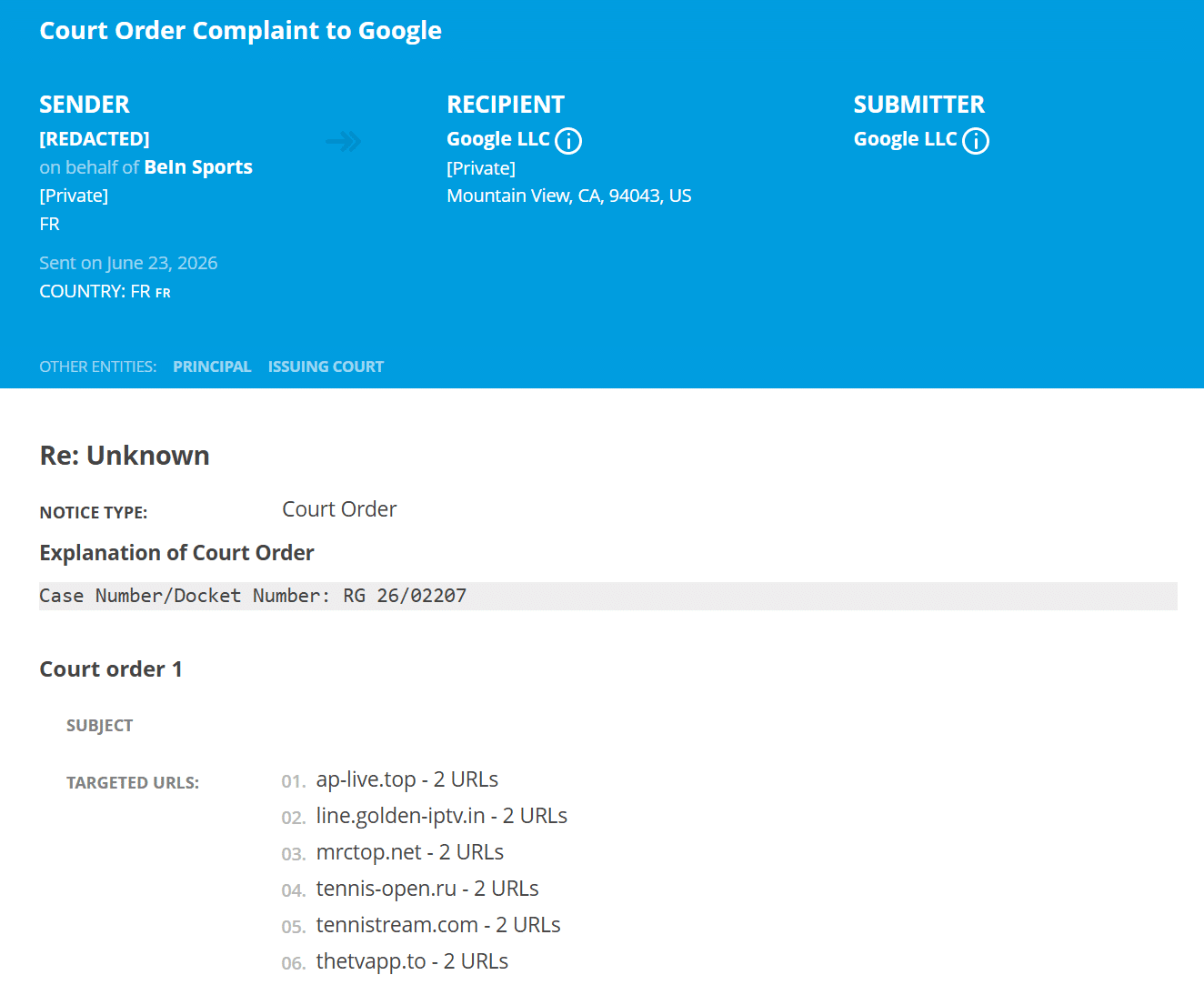
None of the remaining Google blocks refer to the Arcom notices that added the later batches to the tennis order. The other 16 domains point to different notices. The two we checked were filed on behalf of Arcom under other court orders, one of them on November 13, the day before the tennis order expired.
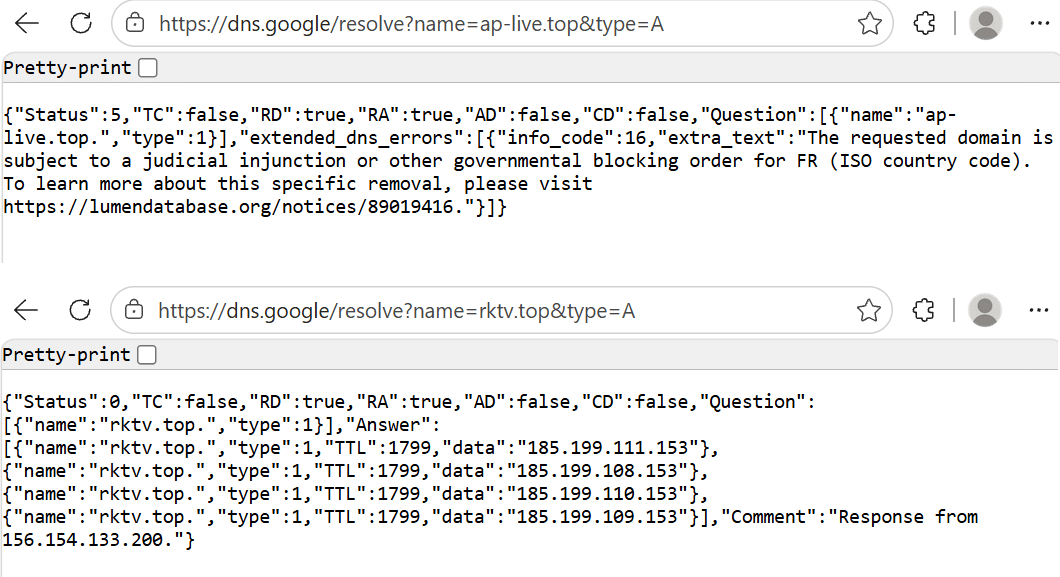
Our two research domains clearly show the split. Google now resolves rktv.top, which was added in the June batch. ap-live.top, one of the six domains in the court order, is still refused.
“The requested domain is subject to a judicial injunction or other governmental blocking order for FR,” Google’s response reads.
Why Google still applies beIN’s notice to the six domains in the original order is unclear.
ISPs Go Their Own Way
French ISPs don’t follow the same schedule. Earlier this month, Bouygues Telecom and Free redirected rktv.top to offrelegalesports.fr, a page that links visitors to licensed sports broadcasts. SFR’s business provider Completel did the same.
When we tested the ISP resolvers on Monday, these redirects were gone.
Orange, however, blocks ap-live.top on most of the resolvers we tested, answering with 127.0.0.1 or reporting that the domain doesn’t exist. One Orange resolver also still blocks rktv.top.
The other ISP resolvers we tested are inconsistent. Most answer normally for both domains, but some still block ap-live.top, and one gave no answer at all.
For now, our research domain ap-live.top remains blocked by Google and several French ISP resolvers, a month after we registered it. Arcom did not respond when we asked whether a new owner can get a listed domain removed.
A Comeback?
The pirate domains that made up most of the list, meanwhile, haven’t gone anywhere. The 74 domains that pointed to two Hong Kong IP addresses last month now point to two addresses in a different range, with the exact same split of 13 and 61 domains.
This suggests that, aside from a move to a new server, little has changed for most of the domains.
Quad9 also wants to make a comeback in France, but only if it doesn’t have to filter the DNS on behalf of rightsholders.
“Yes, Quad9 hopes to return to France. That is our highest wish in this case,” Todd says, pointing to the demand it still sees for its service in the country.
That potential return depends on the French court, and potentially policymakers, accepting that recursive DNS is the wrong place to intervene, the foundation notes.
“We hope to re-activate the services available to French users as soon as the risk of doing so does not compromise the integrity of Quad9’s mission, the risk to Quad9 as a law-abiding organization, or present a threat to the rest of the world,” Todd concludes.
—
A copy of the Paris Judicial Court’s October 21 ruling (RG 26/11882) is available here (pdf).