 Blocking foreign pirate sites at the ISP level has been off the table in the United States since the SOPA bill was shelved in 2012.
That changed in January last year, when Rep. Zoe Lofgren introduced the Foreign Anti-Digital Piracy Act (FADPA).
This proposal set the blocking wheels in motion and a last summer, Senators launched the Block BEARD draft. Meanwhile, Rep. Darrell Issa, who chairs the House IP subcommittee, continued working on a draft of his own blocking bill, the American Copyright Protection Act (ACPA).
Issa’s bill was being discussed among stakeholders but was not formally introduced in the U.S. House of Representatives, until now.
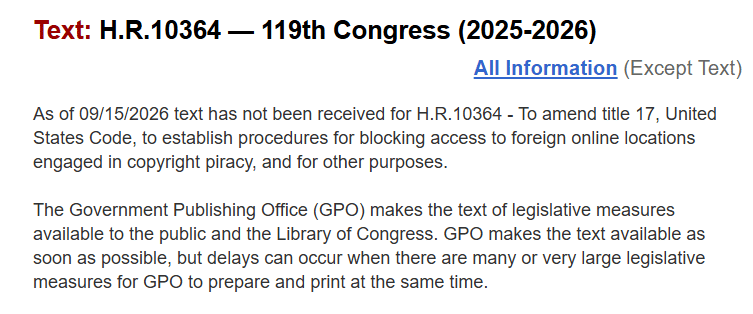
Congressional records show that Issa introduced H.R. 10364, describing it as a bill “to establish procedures for blocking access to foreign online locations engaged in copyright piracy, and for other purposes.” There is no name listed, but Issa previously used the “American Copyright Protection Act” title.
A Site Blocking Bill Without Text
At the time of writing, the text is not online yet. Congress.gov notes that the Government Publishing Office has not yet received it, and Issa’s office has not issued a press release. TorrentFreak contacted Issa’s office for a comment and a copy of the text, but we didn’t immediately hear back.
That leaves the 2025 discussion draft, of which we had previously reviewed a copy, as the best indication of what the bill might be. That blocking framework would let copyright holders obtain court orders, requiring both ISPs and DNS resolvers to block foreign pirate sites.

Unlike the other blocking proposals, Issa’s early draft stipulated that the Judicial Conference would maintain a roster of designated judges to hear all blocking cases, while the Copyright Office would publish a list of active orders.
Issa’s proposal also uniquely targeted overblocking. The draft included a provision stating that a third party whose site was wrongly blocked as the result of a rightsholder’s error could claim up to $250,000 in compensation.
Whether any of these provisions have made it into the recently introduced bill is unknown, we will update this article when the text becomes available.
Competing Site Blocking Bills
The bill doesn’t come as a surprise. On June 30, Issa told The Capitol Forum that his intention was “to introduce it this week before we go on this district work period.” That never happened, however.
Notably, Issa is retiring at the end of this term, which leaves a few months to get anything through the House. While that is not impossible, the bill does face some competition on the Hill.

There are currently three separate site blocking efforts in the US. Earlier this year, TorrentFreak reported that Senator Thom Tillis and Rep. Lofgren were merging FADPA and Block BEARD into a single bicameral bill covering both ISPs and large DNS resolvers.
Lofgren later confirmed she was negotiating a “four corners agreement” with Issa and Senators Blackburn, Coons, Schiff and Tillis.
A source previously described the two efforts as separate, uncoordinated tracks. Whether that changed since is unknown. If ACPA is the House half of a consensus deal, Lofgren’s name should appear among the cosponsors. If not, the House has two blocking bills, with the Senate version as the third.
Opposition
Interestingly, opposition already responded to the bill’s introduction before the text is published online. Specifically, Public Knowledge warns that the bill turns broadband providers into copyright police.
“More importantly, applying blocking orders to global DNS resolvers causes global blocks. This means that one court can cut off access to a website globally, based on a single individual’s filing and an expedited procedure,” says Meredith Rose, Senior Policy Counsel at Public Knowledge.
“Small businesses and nonprofits face the greatest risks for site blocking but have the fewest protections. In Europe, we’ve seen overblocking bring down digital infrastructure for hotels, car mechanics, retail shops, telehealth programs, and even a nunnery.”
Rightsholders have been quieter. The MPA, which gave Issa its Industry Champion Award last year, had not issued a statement when this article was published. We asked the group for a comment but it did not immediately reply.
—
Breaking story, updates may follow.