TorrentFreak

The place where breaking news, BitTorrent and copyright collide

ISP Friendly BitTorrent Tracker Doubles Download Speeds

A new Open Source BitTorrent tracker set to be released in September promises to boost download speeds by up to 150% and decrease the load BitTorrent users put on ISP networks by 20 to 50 percent. Based on the widely used OpenTracker software, the new BitTorrent tracker aims to overcome many of BitTorrent’s current limitations.

peerialism logoSince it was first released by Bram Cohen back in 2001, very few changes have been made to the way BitTorrent works. It was a revolutionary invention and to date it is by far the most effective way to transfer large files online. However, BitTorrent does have its limitations.

On the one hand users sometimes complain about slow download speeds, but most of all, Internet providers are not always happy with the heavy load BitTorrent transfers put on their networks.

The Swedish based company Peerialism hopes to tackle these problems and make BitTorrent future proof. Aside from their issues with GGF, they are currently working on the release of a new Open Source BitTorrent tracker based on the OpenTracker software currently in use at most of the larger public BitTorrent trackers.

Andreas Dahlström, the CTO and founder of the company explained to TorrentFreak that the key to solving BitTorrent’s main problems is to make the tracker location aware, so that peers first try to share files with other peers that are closer to them.

“In standard BitTorrent the tracker chooses a totally random number of peers for you. There are some good reasons for this since random actually gives some nice and robust network properties but in many cases this will force you to download for peers far away from you,” Dahlström said.

“This has two effects: slower download speed and unnecessary network traffic for the ISPs. And since BitTorrent traffic causes so much problems for ISPs many use traffic shaping, causing even slower download speeds,” he explained.

The solution to this problem according to Dahlström is to make the tracker select peers more intelligently, based on their geographical location. The initial tests of this new methodology are very promising, as they result in faster download speeds for BitTorrent users, and less traffic going outside the ISPs network.

“We have built p2p algorithms which actually map the entire Internet. We can use this to let a BitTorrent Tracker assign you to the peers closest to you. The effect for the downloader is 30-150% faster downloads and 20-50% less traffic for the ISPs,” Dahlström told TorrentFreak.

Peerialism localizes local peers
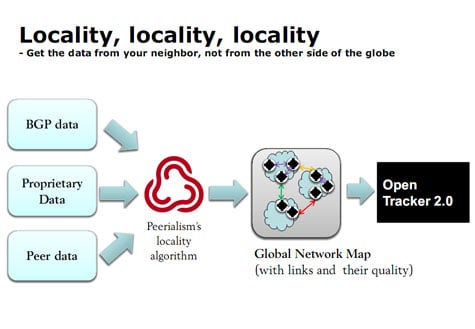
peerialism

This sounds like a classic win-win situation. If it’s implemented by most of the leading BitTorrent trackers, ISPs will have less trouble handling BitTorrent traffic and thus less incentive to slow it down. On the other hand, BitTorrent users will see a boost in their download speeds.

There is a minor drawback to the plan though. The new trackers will use more CPU and memory, which means that more power is required than with the current setup. This means that the people who run the trackers will have to invest in new hardware.

“We work hard to together with Ergeist [the creator of the original OpenTracker software] to minimize the extra load,” Dahlström said. “We do believe the extra resources are well spent compared to the improved download speeds and less ISP traffic.”

If Peerialism can deliver what they are promising, their new tracker will be one of the most significant advancements to BitTorrent in years. Although they are not the first to come up with the idea of location based peer allocation, some might remember P4P, the solution they offer is superior since it requires no changes to the existing BitTorrent clients.

In addition, Peerialism is already working together with the developer behind the most widely used BitTorrent tracker software currently in use by The Pirate Bay, OpenBitTorrent and PublicBitTorrent trackers. Thus, they are as close to the fire as they can be.

The Open Source tracker, currently codenamed OpenTracker 2.0, is set to be released in September. If some of the larger trackers decide to use it we might see a huge drop in Global Internet traffic instantly, along with faster download speeds for most BitTorrent users.


Related Posts

Previous Post | Next Post

  • Anonymous

    Hot shit

  • Anonymous

    Exciting.

  • dtl

    couldn’t the ip localisation be done client side?

    so then dht/pex can utilise this too

  • Cynthia

    Color me skeptical, or even paranoid, but this means that each ISP can shut down BitTorrent “2.0″ traffic even more easily across their network, actually shutting down all local peer-to-peer activity. There needs to be a fallback abroad, IMO.

  • Crammy

    sounds intresting =)

  • vyvyan

    How can everyone miss “proprietary data” mention in image above.

    Is this the backdoor from which MAFIAA will enter the picture and ruin it?

  • Me:D

    @3 dtl: That was also my first thought.

    Why don’ the client get all the peers and then find the peers closest it self?

  • SomePirate

    Good for ISPs … maybe.

    Pretty bad if your private tracker uses this and you want to maintain a good ratio BUT AREN’T located where most other users are. In this case you will get screwed so your ISP can save a few cent. Bye bye foreign trackers for you.

  • ctuluh

    If I lived in the states, I’d rather only be connected with people on the other side of the world; that would make it harder for the copyright orgs to find people within their ‘jurisdiction’

  • Genieguy

    SomePirate got a point…

  • Gargamel

    Or…………… You could stop downloading off crap @ss public sites, and get downloads that already max out your connection every time on good sites.

  • Anonymous

    I think this is going to slow down the distribution of non-english material… May not be a problem for most torrent users but surely will be for everyone interested in non-english audio, video and games. All in all the one making the deal is your local ISP.

  • Popular Tags

    I think this is going to slow down the distribution of non-english material… May not be a problem for most torrent users but surely will be for everyone interested in non-english audio, video and games. All in all the one making the deal is your local ISP.

  • diarRIAA

    And when can the RIAA/MPAA start sending their legal threats? I’m sure their lawyers are excited to make more money! xD

  • ROFLOLWTF

    Vuze already does this with the Ono plugin. It makes very little real world difference with larger swarms speed wise. Gimmick really. As for ISPs, they’ll never be happy with p2p traffic as long as the industry is breathing down their neck, so this ain’t going to further the cause of filesharing either as congestion is not really what the issue is with ISPs.

  • noname

    Awesome news! Can’t wait for this.

    - http://ddlpro.com/

  • yay

    the opentracker guy is called erdgeist nor ergeist. “erdgeist” is german for “earth ghost”.

    i thought trackers are location aware (at least ip-range-wise) for a long time… its a pretty obvious, although non-trivial solution.

  • Sesquipedalian

    @4&8

    Read more carefully. It is not that you will only connect to nearby peers, it is that these will be the preferred peers. If there aren’t enough nearby peers, the tracker will send you further afield until you get what you need.

  • dandin1

    While vulgarizing complex concepts on an article aimed at general users is fine, I think it’s important to note that their algorithm does not “select peers [...] based on their [b]geographical location.[/b]”
    It selects them based on network topography, which doesn’t mean that they’re close.
    My North American ISP peers with European ISPs. This means they have a “free” direct connection to them. My ISP does not peer with Bell, so my next door neighbour, even if he is 10 meters away from me, is a worst peer than someone on bredbandsbolaget, thousands of kilometers away.

  • http://www.eZee.se www.eZee.se

    Some valid questions raised above, heres one of mine:
    What if the the antipiracy scum start “sharing” corrupted files? since they are next to you, how do you get the original non corrupted files from your friend in far-away-place rather than IFPI–in-a-bukakke (also known as their Christmas party) video?

  • wonderwhy-er

    Sounds interesting.

    Considering tracker is open I doubt it will be much of a problem to disable it if it will turn out to be copyright holders friendly thing.

    BTW I always tough bit-torrent had something like that. For example uTorrent has local peer discovery that checks local network for same torrents. Also we can see IP client side so I wonder why it was not done before on client side… Does not seems as that hard thing to do…

  • Wash

    @ROFLOLWTF (comment 15)

    That’s true, Ono has been around for a while. It doesn’t look like it has been actively updated for a year.

    Azureus 2.5 used to include something else (which I can’t remember the name of). Of course, it required an ISP to set up a sort of anonymous caching server just for this kind of thing, so they of course didn’t care about the tremendous savings they may have gotten.

    I’ll believe it when I see it. Which probably means never.

  • Foo

    Biggest problem I see with this is the negative impact on seedboxes. I’d rather download from a fast, far-away seedbox than a slow, nearby cable/DSL user.

  • jemoer

    @20 http://www.eZee.se
    That can’t be done by the nature of bittorrent because bittorent uses hash tables to identify the files

    here is the wikipedia link
    http://en.wikipedia.org/wiki/Hash_table

  • Anonymous

    The “excessive load” of BitTorrent traffic is nothing more than an excuse used by ISPs to justify their traffic shaping.

    It won’t matter one bit(har har, I maded teh pun) how ISP-friendly Peerialism’s new client is. Even if the load is reduced to zero, they’ll just use some other scapegoat as a justification.

  • antedeluvian

    i never reply, but this thread is yet to fill with idiots, but the clock is ticking.

    this system is great if you synchronous broadband or at least the rest of the country does. unfortunately, all are not blessed.

    for example here in australia where uploads are typically capped at 512kb/s and even counted towards meagre allowances of 20 or 40 GiB per month, this system would suck, though sure to make telstra happy…

  • lol

    So according to this I usually get 2.0-2.5MB/s from a private tracker this is also the max my isp allows but if i use this i should be able to download at 5MB/s…..haha wrong unless your isp let your have double speed this program will NEVER let you double your speeds at best its going to let you download at your isps full speed. the title of this subject is worded wrong there are NO programs that let you download faster than what your isp grant you

  • Hom3r

    Not a new idea. And not as good as it sounds either.

    In a world where everyone has 100mbit connections and all swarms are thousands of peers strong, yes, this would be a great idea.

    But we don’t live in that world. Sure, this will boost individual speeds by a bit and decrease isp load, but, the overall swarm health will suffer in the long run.

  • Facts

    Some interesting facts in Peerialism PDF.

    “[to] Determine, validate, and encourage the adoption of methods for ISPs and P2P software distributors to work together to enable and support consumer service improvements as P2P adoption and resultant traffic evolves while protecting the intellectual property (IP) of participating entities”

    “We thus propose the establishment of a new high level working group, independent or as part of an existing process, to find technical measures that limit unauthorized peer-to-peer trafficking in movies, music and other entertainment content.”

  • Facts

    “Our number one priority clearly is the elimination of copyright infringement and, because DCIA advocates the commercial development of distributed computing (as opposed for example to trying to stop it), our key strategy centers on proliferating legitimate commercial services to displace unauthorized media file sharing currently being conducted by consumers on a massive scale.”

  • Facts

    The largest threat (as usual) might come from the anti-piracy lobby, as they will probably push for content filters or other anti-piracy measures. They haven’t done this so far, but to us this seems to be inevitable.

  • bob the slob

    @ 28, nice research.

  • anonymous

    Terrible idea! I don’t want to only be connected to peers near me – my upload sucks, and so will my neighbor’s!

  • ROFLOLWTF

    @29

    So wait,

    Open Tracker=Peerialism
    Peerialism=antipiracy
    Open Tracker=antipiracy

    Very interesting.

    “our key strategy centers on proliferating legitimate commercial services to displace unauthorized media file sharing”

    They are going to use Open Tracker, with the help of ISPs, to squeeze out other bittorrent trackers. If ISPs block any non Open Tracker p2p, then Open Tracker would be your only option, and as that content is filtered per their copyright mandate, the only torrents you would be able to download would be those using Open Tracker. These torrents would then be spammed to indexing sites so to water down the search results.

  • anon

    thank you internet (y)

  • Bobe-On

    @ Facts:

    Perhaps the industry can “borg” any new technology, but I also guess it can be borgged back if FLOSS.

    The industry seems to operate under a kind of pathological “leveraging” mindset, trying to find ways to leverage (“borg”) anything and everything, destroying and/or assimilating anything in its way.

    “Bakan wrote the book, ‘The Corporation: The Pathological Pursuit of Profit and Power’”
    – Wikipedia

    I think that as long as we have corporations’ modus operandi legally protected entrenched in constitutions (that have less to do with “We, The People”) in the ways that they are in some countries, we’ll have serious social problems stemming from them, their behavior.

    That’s why getting involved in politics seems like a good idea, and probably why pirate parties seem to be popping up like popcorn.

  • Nick

    The legal issues aside, I ran some discrete simulations on this sort of idea a little while ago, and came to the conclusion that you still need at least a couple of geographically random peers.

    The reason is you run the risk of segmenting the swarm, which can prevent certain pieces from entering certain geographical locations. This can lead to the situation where a download can not be completed, despite the fact the availability is well over 1.

    And as mentioned in your article, random peers promotes robustness in the swarm. Local network outages can be catastrophic to the swarm where you experience what I call “piece bias”, in which certain segments of the swarm have a particularly high percentage hit rate on pieces which are considered rare elsewhere in the swarm.

    Additionally, as pieces tend to propagate uniformly away from the seeders, you can actually DECREASE swarm speeds by forcing a poorly connected peer who is closer to the seeder(s) to pass a piece to a well connected peer who is further away.

    Conclusion: The geographic metric is good, but you MUST still have some random peers. The sweet spot is somewhere between a quarter and a half of your connected peers being geographically random.

  • Pingback: Peerialism BitTorrent Software To Have Much Faster Download Speeds

  • sp

    I think the more pressing issue is getting rid of your I.P address showing in your bittorrent client. that way the mafia, riaa can’t log your I.P so they can sue you. no matter what your ISP is going to throttle. So that is the last thing to worry about. All this does is take some load of your ISP but makes it easier for you to get sue.

  • techloid

    Location aware trackers? Sounds good, for countries and/or places that have big data pipes, and good news for the ISPs who are wary of heavy BT traffic.

    @36

    Good call. Even though my peer may be geographically closer to me than someone else, if he/she is stuck with a small pipe, that doesn’t help me much (does it?)

    However, if, as these Peeralism people say, their stuff is ‘intelligent,’ (where’s the intelligence running, client, or server?) it may be able to quickly calculate the speediest option.

    So depending on what you’re downloading, where it is, what pipes its sitting on, Peeralism can then, lightning quick, choose the best route/option.

    Cheers,
    http://www.techloid.com

  • viktor

    how about extending the use of udp?

    “they say” it can greatly decrease cpu load on trackers…

    utorrent2 is right around the corner, so it could be a good enhancement on all sides

  • qwerty

    thank’s fact! open tracker: antipiracy side

  • Anonymous

    BAD IDEA!!! DO NOT WANT!!!

  • Voice of History

    A while back I worked at an university project with a similar idea, except that, instead of a single tracker, it used a multi-layered multi tracker architecture, in which trackers would track other trackers recursively at the various net levels, until you were pointed to your desired, as close as possible peer. We did think about using the Peerialism route. However, such approach is absolutely impossible to be used in open Networks such as the Internet. Indeed, such a thing would require you to run a Full BGP router with extremely frequent route actualization times, otherwise the effect is lost. With this much added traffic, you wouldn’t need just a “costier server”, but instead a very, VERY expensive server + infraestructure just for that.

    Even if they conquer that hurdle, there is still the whole “find the closest neighbor” problem, which is, efficiently, akin to the NP problem of the Traveling Salesman. If they found a way to solve that in linear, computable time, their math geniuses must be for much, MUCH more than simply “150% fast torrents”, but instead by starting a world wide computing revolution. Otherwise, The full computational power of the current TPB would be needed, aproximately, to handle just 1 connection in such a big server.

    In the end, we have this: It’s way too expensive to implement in small trackers, way too hard to do it on bigger servers.

    All those P2P technology entreprises are always the same: All sound but no Fury.

  • viktor

    @Voice of History: the fact you failed at solving a problem doesn’t mean others will too

  • PetFoodz.Info

    Voice Of History Quote:

    In the end, we have this: It’s way too expensive to implement in small trackers, way too hard to do it on bigger servers.

    Apart from this problem I don’t want to be connected to a bunch of Canadians who are throttled and have bandwidth caps here at home.. Assuming they are the closest peers.. By having peers all over the place I can at least get some decent speeds..

    I can’t see this type of setup succeeding with so many ISPs using Sandvine boxes..

  • anonymous

    that’s very exciting news

  • PetFoodz.Info

    @37 – Nick..

    Which seems to be approx what utorrent uses even with UDP etc..

  • Kaz

    This doesn’t mean we aren’t even less anonymous does it?

  • Anonymous

    @48

    +1

  • kiwishare

    Being untrackable is far more important than super high speed downloads.Whats the point in fast downloads if they come knocking on your door to sue your ass!.

    Fuck the MPAA,RIAA,NZFACT,PPNZ,RIANZ,APRA and all the rest of those cum sucking shitbag polesmokers!

  • Reventon

    People are right to point out the anti-piracy angle but Peerilism won’t get far with that when their software is open source

  • Pingback: Linkpost | 8.24.2009 - L&C Tech Talk

  • anon

    Bah, this isnt a big was ist das, I’ve done peer priorities based on GeoIP for a tbdev tracker agessss ago….

  • sophiahere

    nice article – http://www.wowgoldteam.com
    WoWGoldTeam can provide your wow gold with reasonable prices,welcome to visit our site and contact us. Let everyone buy wow gold at ease, and gain cheap wow gold.

  • ptsick

    hope it works..
    I love the new tech..
    ^-^

  • Cordelia

    I use a proxy server in North America for all my bittorrent downloads.

    However I am in Europe.

    Currently my speed is not reduced by this precaution and it saved me from threatening letters.

    Peerialism would be confused by this setup though – but it’s probably quite common these days.

    The anti-filesharing statements in Peerialisms documentation (see comment by Fact) is a big concern also.

  • Andreas Dahlström, Peerialism

    Just wanted to clarify some parts in response to the comments:
    1. Open Tracker 2.0 will be 100% open source and free for anyone to use. If anyone is worried we put some nasty code into Open Tracker 2.0 they can just look at the source code
    2. We want Open Tracker 2.0 to be a show case of what Peerialism can do and hope both the community and the ISPs will appreciate it.
    3. We want you comments and help to make Open Tracker 2.0 suite the community so please send continue to post comments here. If the community doesn’t like our work it will be in vain so we’ve listening closely to what you’re saying
    4. In the article a number of things are simplified not to confuse the not so tech sawy user, but as some of the comments point out there’s a lot more to make this a stable P2P network than just looking at your closest neighbors (for instance we give each Bittorrent a _mix_ of local and random peers to ensure both better download speeds and a robust network)
    5. Open Tracker 2.0 will be as secure as Erdgeist’s original code. Some comment suggested DHT-based Tracker to solve privacy issues, but as far as we can see, DHTs only helps the owner of the _Tracker_ not the end users. So we decided to stick with the current server based approach.
    6. Many comments suggested client based approaches, and while that is a possibility we think a Tracker based is much better since then we only need to change code at one place and not in every Bittorrent client.
    7. We’ve been running Open Tracker 2.0 in both our simulators and our test bed with up to 12.000 Bittorrent clients to ensure we can actually do what we intend. So far it looks good and we’ll publish more info as we approach our release date.

    Please ask me more questions if you want.

    /Andreas

  • Andreas Dahlström, Peerialism

    @40

    UDP is usually better for P2P solutions but it requires client side modifications and either manually firewall configurations or pretty advanced NAT-traversal algorithms. We at Peerialism use UDP for our streaming and storage solution but then we write the clients too, so in this case we though modifying the Tracker was the easiest way to go.

  • AnarchyNow

    We don’t want your shit, we want 100% anonymous encrypted internet, bittorrent is diyng and making it easier for the global worse than nazi mafiaa won’t help and yes it’s better to do geoloc client-side than tracker-side

  • Cordelia

    @Andreas Dahlström (57)

    Good response. Could you also explain please:

    1) What if somebody is using a VPN tunnel, proxy server or SSH in ANOTHER COUNTRY to protect their privacy? This is getting very common due to the anti-filesharing sentiments.

    2) What about the statements that you want to reduce the “illegal sharing of copyrighted material”. Etc, etc. A serious technology developer would be interested in the technology and what it can do for users! Not in serving the interests of international copyright holders. Can you explain why your company makes such statements in their documentation?

  • Andreas Dahlström, Peerialism

    @29
    What PDF is that? Can it be something from a research project with have been a part of? Because I don’t recognize it at all (nor the actual text nor the ideas) and I should :-)

  • tji099

    “promises to boost download speeds by up to 150%”

    a bit misleading, because it’s not really what it will do.

    It would be more accurate to say that the speeds will increase because of *read article*…, you WILL NOT gain faster speed than what your ISP provide you with.

  • Andreas Dahlström, Peerialism

    @60:
    1. In that case it will anyhow be faster since your VPN end-point actually can be considered as any Bittorrent client and thus will get better download speeds. However, it will of course as usual be a bit slower than with VPN and

    2. That is just a big misunderstand, the text quoted in @29 I just found out was from the mission statement of P4P which we have nothing to do with :-) Even though P4P from a _technical_ point of view is similar to what we want to do, which is probably the reason why we where confused with it.

  • Daniel Holmqvist

    Antipiracy stuff is secret leaked deal with Peerialism and IFPI, MPAA, RIAA… = MAFIAA

    Deal is MAFIAA don’t sue Peerialism if they add antipiracy stuff in their new Open Source BitTorrent tracker.

    This is only way to work and make sure MAFIAA don’t sue Peerialism to court and demand millions of euros money for copyright violations. Or helping peoples break copyright laws. Thats why it is only choice. Win-Win situation for all. I hope all understand P2P developers are forced to work with MAFIAA to avoid any legal issues.

  • *Cordelia*

    @Andreas
    I’ve seen this information too; just when the GGF purchase of TPB was announced. I got very suspicious towards your company after reading this.

    I did not do a lot of digging around, just clicking a few links. I read Swedish though, and it is possible the information was in Swedish, can’t remember.

    It sounds like Hans Pandeya has been spreading some rather misleading information relating to the purchase and his “business plan”. Perhaps this “information” was part of this little exercise?

    It sounds like you’ve got a great company with interesting innovative ideas, so nobody wants to believe that you will sell out to the copyright lobby.

  • Andreas Dahlström, Peerialism

    (corrected)
    @60:
    1. In that case it will anyhow be faster since your VPN end-point actually can be considered as any Bittorrent client and thus will get better download speeds. However, it will of course as usual be a bit slower than with VPN but that’s outside what we try to solve here.

    2. That is just a big misunderstand, the text quoted in @29 I just found out was from the mission statement of P4P which we have nothing to do with :-) Even though P4P from a _technical_ point of view is similar to what we want to do, which is probably the reason why we where confused with

  • Arnaud Legout, INRIA

    @62

    right.

    I can’t speak for Peerialism guys,
    but I can give you a reason for the
    speed up.

    We have shown in http://hal.inria.fr/inria-00343822/en/

    that, as locality reduces
    congestion on some specific congestion links (probably inter-ISP links), it results in
    lower download completion time for peers.

    If you don’t have congestion, you
    probably don’t save anything.
    Guys who worked on Ono have shown this
    order of magnitude saving using the Ono plugin. Note that what they do is somewhat different from the solution propose by peerialism,
    but both solutions try to keep
    traffic reasonably local. Admittedly, we can discuss
    for years what is reasonable and probably not a single ISP will agree.

  • Daniel Holmqvist

    Best way to fool public is lie and deny all antipiracy deals. Is what exactly Andreas Dahlström is doing. Im very dissapoint. You should be open about deal and say it all.

    “Like yes we made deal with antipiracy organizations to avoid legal issues and sues from them.” Lying and denying is nasty way to treat community. It is same what GGF is also doing.

    I wrote article about that secret deal between Peerialism and copyright organizations in Swedish media internet and newspaper. To reveal this secret.

  • Cordelia

    So what Peerialism is capable of doing is something that a Vuze plugin can already do (in a slightly different fashion). Namely choose the geographically closest/most efficient peers.

    Only they are proposing to do it an an ISP level instead of in the BT client to achieve more noticeable results in traffic reduction. Presumably at a cost to the ISP.

    Doesn’t that put A LOT of private user information and decisions into the hands of the ISP?

  • Daniel Holmqvist

    I have leaked pdf file about deal with Peerialism and copyright organizations. Only problem is I got legal threat from IFPI. My articles was removed from internet and newspaper article was censored from newspaper because pressure of IFPI.

    I don’t see much difference in Peerialism and GGF, because both lie and not telling truth to public. Most of GGF money is from copyright organizations and IFPI and their “friends” are planning buy GGF.

    Lets say MAFIAA will buy GGF after TPB deal. Then they will get also Peerialism. It should be obvious for all then that Peerialism can not help peoples to make copyright crimes or get interfere. So Peerialism only choice from begining was to work with MAFIAA to avoid any legal issues.

  • Daniel Holmqvist

    So no more lies please Andreas Dahlström, Peerialism. Don’t deny and lie. Community peoples are not stupid. You might can fool them once but not twice.

    How Peerialism will avoid legal issues? It is very obvious that Peerialism can not do what they do without acception from MAFIAA such a ifpi, mpaa, riaa….

    Peerialism without any deals with MAFIAA would end up with court very fast. Their new software develop would end fast and be closed. Then forced to pay MAFIAA in court and maybe even get jail time.

    So only way to survive Peerialism was forced to make deal with devil. It is so simple. I hope community will think about what I said.

  • Andreas Dahlström, Peerialism

    @65:
    We were contracted by GGF to build a some new specific technologies for the Pirate Bay. We have a short history with GGF and entered the deal with them since we trusted two of their board members (Johan Sellström and Magnus Bergman) but whom have now they left GGF. We have been very surprised by all the controversy surrounding GGF and have demanded many answers from Hans Pandeya, so far we’ve got none.

    Anyhow, we decided to try to contribute to the general P2P development community by releasing some of our network aware technologies as open source together with Open Tracker.

  • ma1ici0us

    so it does an AS number lookup and then gives preference to those peers that are within the same AS. Someone should have implemented this far sooner.

  • CaptainArrr

    The best thing to do technically, IMO, would be to do the GEO localization on the client’s side, together with a ping of these closest IPs availlable. The closest and with the lowest latency IPs would be those designated for the connection.

    This would guarrantee not only higher download and upload speeds for all the clients, but also lower overall internet traffic and bandwidth usage, and no change at all for the existing trackers and their hardware, because the extra CPU load would be handled by the clients and not the tracker’s servers, or peerialism.

    Plus, no data would be sent to Peerialism. I think that the weakest spot of their technology (for us) is that we’d have to connect to peerialism’s servers, if I correctly understood how they plan to make their idea work.

    If their servers go down, no more downloads. Not to mention they’d be able to log anything that goes through their algorithm on their servers! Their solution is definitely unsustainable for the P2P world. For a question of efficience and privacy.

  • Andreas Dahlström, Peerialism

    @74:
    Well, latency correlates to some extent to bandwidth but is not good enough based on our research. But this is anyhow handled by the current Bittorrent protocol, what we want to do is to make the peer selection process more effective (less trial-and-error as it is today).

    In Open Tracker 2.0 there is no involvement of our servers, it’s just the Open Tracker and a datafile with network link info. So Open Tracker 2.0 wont depend on any of our servers and we wont deploy any, that’s up to you and anyone else who wants to use the software :-)

  • Hom3r

    I would just like to add that, in addition to the problems associated with the technology, I personally don’t like the idea of the tracker injecting/changing/messing with the data in anyway. It would be much more efficient to do that client side; and better in the sense the user can control it.

  • gigel

    I think here we have a classical trap. U get faster connection, better technical properties, but on the other side u get could get caught easier and at the same time a whole local swarm can be targeted and raided by anti-pirate outfits. This is a an old PR tactic. They get u a technically improved product, but on the other side u loose more and more of your freedoms. Its the same thing with the new versions of Windows or the new internet 2 network proposed by large commercial telecom corporations. In the end its what u want for yourself. A better techincal product or better anonimity and more freedom. Although it would be nice to have it all, there is always a catch.

  • Martin Sjögren

    One thing I don’t get in this story is why so many reasonable people choose to get involved with GGF in the first place. Where are your people judging skills Johan Sellström, Magnus Bergman, Andreas Dahlström and TBP-founders??

    Wasnt it obvious that Hans Pandeya is one of those persons who just keep on making promises and when questioned makes even more lies and promises. I thought one learned to recognise people like that in high school and after that it isnt too difficult to avoid them.

  • NDyA

    To all people who think that Open Tracker 2.0 will have anty-piracy mesures involved:
    As said in article this software will be OpenSource – anybody will be able to modify it freerly and use it without any licensing fees. If anyhow there will be any “controversial” functions, the community can disable those and produce a new tracker software that will be both secure and more efficient.
    All claims that Peerlialism is contributing this software, because of anti-piracy group deal to enable easier infrigment tracking, are simply stupid.
    First of, MAFIAA cannot sue Peerlialism for developing software on base that it can be used to share files illegally (if anything like this is even possible =P), because it is not specially designed to do so. This software is not illegal in any means of law (even American one).
    Second of, after releasing software as open source, it can be examined deeply by anyone and if it has the tracking and logging functionality, it can be easily dissabled and redistributed. Peerialism wouldn’t benefit in any way in including such functions in their software.

    To all people who think geoIP algorithm will reduce their download speed due to poor ISP offert in their region or will harm the file avialability:
    The client will only prefer local peers, not choose them above all. If you wouldn’t be able to download file from local peers, you would simply download it from distant peers. The use of algorithm will increase your download speed, if the file is already distributed in your neighbourhood (network one, not geographical necessearly). The download speed is moreless dependant of number of routers that the connection is being made of. Less routers (usually local area) = higher speeds.

    Too all people bragging about not getting higher speeds due to ISP brandwidth limit:
    Your internet connection is used also as a control means to transfer protocols. If you could decrease the amount of control packets, you will gain some brandwidth to get faster download (even 5% could make a difference). Moreover people with higher speeds internet connections could get higher speeds, because in case of BitTorrent they don’t get as much as they could.
    Also if the network of ISP will get less trafic, there won’t be so many errors in packet transmission – this means even less control packets and redownloads of the same file part (you usually don’t see if it’s being redownloaded, because it’s on transfer protocol level – not application level).

  • Anonymoose
  • Anonymous

    Hit & Runners and selective downloaders will love this… whilst torrents will die.

  • Oh Hellz Yeah

    Since almost everyone in my area has a connection with Verizon FiOS, who now only offer speeds ranging from 15mbps down/5mbps up to 50mbps down/25mbps up in my area, I can really see this helping my download speeds. Maybe I’ll even max out my speed of 25mbps/15mbps now.

  • http://www.eZee.se www.eZee.se

    Just one direct question to Mr.Andreas:

    Q) Are you or your company working with any anti piracy organization (like IFPI) with regards (in ANY way) to this software?

  • Em

    Just because one peer is close to me… eg same country, different ISP… it doesn’t assure I will get the data faster. Sometimes downloading from a US based peer works better than from my neighbor which is on a competing ISP.

  • Andreas Dahlström, Peerialism

    @83:

    No. This is only an improvement of the Open Tracker.

  • Ninja

    It should be done by the client. I don’t want to have people near me sending me stuff. I have serious problems with speed in local trackers or torrents with too many neighbors of mine. However, the ping times between me and those guys is excellent…

    I seriously don’t want this to get popular.

    Instead of messing with the trackers, mess with the clients to help optimize the traffic. Not that I would download a client from a company related to the industry that is actually suing people before asking why and working with them.

  • WTF

    that is good.

  • OneOfThePeople

    How is it, that corporations always claim they can do things better than an open source society? (arrogance?)

    The prime/only motivation of a corporation is always (and has to be, by definition) to gain money, market-share, defeat others etc. by all means necessary (advertising some minor advantages for the users as a big thing for example, higher download speeds?!?)

    So IPS win, users win, what does Peerialism win?

    sry, I don’t trust Peerialism, GGF (any privately owned firm trying to invade community driven efforts for that matter) further than I can throw them…

  • taklamakan

    Interesting to say that Peerialism works hard with erdgeist on this subject. If you really want to know what erdgeist thinks about the idea, here is your pointer: http://erdgeist.org/peerialism.txt

    Blogpost in the opentracker blog will follow.

  • John davis

    Holy Smokes dude, could be my new best friend! LOL

    RT
    http://www.web-tools.us.tc

  • Voice of History

    @44
    It’s a common computation problem. I am not saying it is impossible, just that a solution, should it exist, would find many applications other than simply improving tracking speeds.

    However, I honestly believe that an multi-tracker platform running at each ISP would be the best soultion for both ISPs (a lot less external traffic = reduced costs. BT was responsible for about 50% traffic, right?) and consumers (reduced latency, improved speeds, special plans where you get cheaper traffic rates when P2Ping inside the network). But that is a kinda distant Utopia…

    Finally, there are some nice aproximations for finding the best peer other than the IP geolocalization one, such as latency comparation (would need client cooperation) or grouping Peers by ASN (easily done, and pretty effective too). But true location-aware tracking is a lot different…

    I do believe that the new Open Tracker will be better, but not “150% faster”

  • Anonymous

    Indeed. The client can easily perform an AS lookup and prefer a number of users within the same AS.
    Absolutely no need to do anything sophisticated on the tracker-side. Au contraire. This is exactly the wrong way to do it. And please… don’t call it OpenTracker 2.0 if it’s not open (but just open as in “open source”). That’s just stealing merits from other people who worked hard on a nicely performing piece of software. But it seems – regarding your concept – you apparently need any ornament you can find to decorate your “product” with :) that’s pathetic.
    good luck. aparently it was enough to please your NATO friends.

  • viktor

    @all, whining about anonymity:

    you are already trackable and you have always been. just click on peers tab in utorrent and tah-dah, you “tracked” a lot of people, you nazi!!!!

    bittorrent is NOT ANONYMOUS and has NEVER been.

  • dandin1

    @peerialism.txt I’ve just begun reading, but based on those numbers tpb’s trackers require a minimum of an entire GigE link at non-peak? Crrrrazy.

  • Terminator

    Holy Shit !
    This is certainly good news.
    FOSS FTW !!

  • LifeScientology

    This is good news :-)

    Look, ISPs are between the fronts, since they share interests with both sides.

    Rights holders try vehemently to pull them to their side. How will the P2P community prevent this?

    We have to make some compromises with possible allies (ISP, content CREATORS) and drive the technology forward :-)

  • Andreas Dahlström, Peerialism

    @92 and others:
    You’re touching a very interesting subject: can open source community driven project co-exist with company driven open source projects? We do think so, for us the name Peerialism doesn’t just mean P2P in a technical sense but also in a human sense. We believe community driven open source is a good example of peerialism, and wikipedia another one. We envision a future where companies and communities such as the torrent world live side by side and help each other where possible. We as companies can bring some things like big simulators, test beds and developments resources. On the other side amazing things have been done by the open source community. We hope to bring the best of the worlds together.

    Someone asked why we’re doing this or what Peerialism gains from it and the simple answer is that we want to show that our technology really can make a difference and also learn from big, real world implementations.

    Regarding the effectiveness of our software we are think the effects will be around the announced numbers but it’s actually hard to know before being tested big scale. This has to our knowledge never been done so far anywhere in the world. We intend to make real life big scale experiments later and evaluate (we’ll keep you posted).

    The name “Open Tracker 2.0″ it’s just our internal project name, and it has not been approved by Erdgeist (but we will ask him to). We consider the current Open Tracker the best tracker software in the world – that’s why we wanted it a base for our version. And of course tons of cred goes to Erdgeist :-)

    But back to the main question: if we make this new Tracker version and we can prove it really makes Bittorrent better: will the torrent community use it? If not, why? And can we change anything to make it more appealing?

  • Pingback: BitTorrent Tracker ???????? ???????????? 150% ??????????? 50% | ???????? ????????? ??????????????? ????????????????? ????? ?????????

  • Harold Feit, Depthstrike Entertainment

    “if we make this new Tracker version and we can prove it really makes Bittorrent better”
    Without the co-operation of ISPs, it can’t.

    There are a only a small handful of ISPs in the world that actually have any benefit at all for locality-based preferencing, and they get it for one of two reasons.
    1> Different bandwidth transfer quotas for domestic vs international traffic
    2> Different connection speeds for domestic vs international traffic.

    In North America, neither of the above two scenarios exist.

    I am aware of maybe 15 ISPs worldwide that actually fall into the above two categories that would actually benefit from this.

    If more ISPs would cave a little and give us more bandwidth for ISP-Domestic traffic then maybe we would see this have more than just a minor increase on speeds (or, more likely, a major decrease)

    In lab conditions, I won’t dispute the possibility of such massive improvements in speeds, but real world conditions are, unfortunately, far enough from lab conditions to not see things work the way you guys are hoping.

  • Pingback: VOIP Telephone – How to Save Money with More Features | Business Telephone System

  • LifeScientology

    @Peerialism and Erdgeist: Thanks a lot for working on this and good luck!

  • OneOfThePeople

    Andreas: “We envision a future where companies and communities such as the torrent world live side by side”
    sry, seems your background is PR or advertisement, see next point…

    Andreas: “…what Peerialism gains from it and the simple answer is that we want to show that our technology really can make a difference and also learn from big, real world implementations.”

    wow, that’s selfless!
    How naive do you think we are, seriously?

    you “making a difference” won’t pay the bills, would it? and doesn’t make any sense company-wise!

    So how are you planning to pay your employees?

    your connection with mil, NATO and the interests involved (as someone else mentioned) would be another point we might be interested in …

  • Pingback: How to Configure Router? | Business BroadBand

  • who

    the title is very misleading.
    ISP Friendly >>> true
    Doubles Download Speeds >>> false

    okay, let’s play a game.
    i have a 8mbit/512kbit adsl and i have a limit of ~60KiB/sec upload. using 4 upload slots:
    will i have 60KiB/sec upload speed (15KiB/sec/slot) to any part of the world? yes.

    now i have a 20mbit/20mbit fiber and 2.5MiB/sec upload limit. using 40 upload slots:
    will i have 2.5MiB/sec upload speed (64KiB/sec/slot) to any part of the world? yes. (unless the swarm is extremely healthy and full of seedboxes/fibers)

    nothing can help boost bittorrent speeds except for uTP (which will only help on dsls) or getting a better connection.

  • Rhawk187

    Is it just me, or does this sound a lot like what the P4P stuff was supposed to do?

  • sonic
  • Anon

    Something about “make the tracker location aware” bothers me. Not sure if i want my geographical location out there for anyone with some skills to utilize such info.

  • 2

    Hey anon 103, that info is already out there using databases that connect ips to geographic data (or simple reverse DNS)

  • Anonym

    It’s not going to be less secure, your location is already as trackable as your IP is public.

    I can see some major problems with this in regards to improving speeds, as already outlines by others. Aren’t the various ISPs the main reason for slow download speeds?

  • idonthaveaname

    This is all I have to say:
    My ISP sure as hell doesn’t have enough bandwidth to let everyone actually use their full connection speed at once, and I imagine it’s the same for virtually everyone here.

    I’m not interested in what this does to the speed of my torrents, I’m interested in what it could do for the responsiveness of all my other traffic if/when the overseas tubes are decongested.

  • NDyA

    @100: As I said before – you might actually gain something if you connect to local peers first. If the traffic goes through less routers, less errors are generated (some always occur, but it’s more likely if there are more routers on the way). If you are able do decrease the amount of errors by half, you will get some bandwidth for normal download (like 1-2%). It might not be noticeable, but in long term might make a difference.

  • Pingback: Vincent (vinnl) 's status on Monday, 24-Aug-09 21:51:27 UTC - Identi.ca

  • Pingback: The Benefits of Using an ADSL Line | Business BroadBand

  • Pingback: BitTorrent Tracker ???????? ???????????? 150% ??????????? 50% | ???????? ????????? ??????????????? ????????????????? ????? ?????????

  • Pingback: One Speed, Two Speed, All Speed, No Speed: DSL Internet And Its Mutations | Business BroadBand

  • Pingback: links for 2009-08-24 at DeStructUred Blog

  • Pingback: IMOOH.COM

  • Sophistry

    First let me say:

    99 Aug 24, 2009 at 19:52 by OneOfThePeople

    Brilliant.
    I was hoping someone would mention it.

    Note, yes this technology is Open Source. But it is a complete and utter sham.
    Andreas Dahlström, Peerialism is attempted something quite different here. Peerialism is not interested in torrent, file-sharing, people, community, blahblahblah. No.
    Peerialism is simply a new software development model.
    Use the open source community to debug your own software, then re-package, but some un-needed useless features into it, and VIOLA ! you have a new proprietary product, thanks to Open Source.

  • bewbiegirl

    If u re interested in cougars and young men , if u want to make friends with cougars and young men, if u want to develop a long-term relationship or marriage with young men and cougars, u can sigh up free the ** kisscougar.com ** to browse the people who meet your requirements. No cheat here because the people here upload their true inf. and pcs…… be patient to fill your profile …must be older than 22years old

  • 4nd

    @Sophistry

    Use the open source community to debug your own software, then re-package, but some un-needed useless features into it, and VIOLA ! you have a new proprietary product, thanks to Open Source.

    This is why the GNU’s General Public License is nice. Under this license, it is copyright infringement to distribute proprietary software built from GPL’d software without including the source code (which basically eliminates the point of making it proprietary).

    To the developers of this software: GPL it, please. Free software is far better than simply “open source” software.

  • erdgeist.org/peerialism.txt

    Looking at the core of the problem I’ve been talking to bittorrent
    client authors about introducing filtering features. They say that the
    most important time saver for them would be to not connect to seeders as
    a seeder. There’s also a common understanding that – let me quote an
    rtorrent developer – “bittorrent is not latency-sensitive. only
    throughput should be relevant. and the proverbial swedish seed is always
    faster than my neighbor”.

    So while your proximity biasing approach might ease the load on ISPs
    peering costs, the consensus is that throughput depends on many factors
    like the amount of bandwidth your connected peers are willing to
    dedicate to you, the congestion level of your peers and so on.

    An approach I now chose with the no-seeders-for-seeders problem is based
    on the observation that 200 peers in a tracker reply almost always is
    enough to get enough leechers when trying to seed. However the client
    doesn’t know who is – until it connects. The tracker OTOH does know.

    Instead of implementing a filter on the tracker side – that might run
    into the same problems as your proposal does – I chose to just provide
    the missing information to the clients (in form of a bit field) and let
    them chose what to do.

    Now for you there’s several ways to move on. You can throw money on the
    problem and just buy a cluster huge enough to handle the load – when I
    fixed the multithreading problems in the underlying IO-lib, more cores
    will also help.

    You could also resort to doing what I do with the seeders flag: just
    return random peers but pass the information to the client (4bit
    “distance” info will increase reply by 100 bytes max.) and let clients
    decide whom to connect to. This results in 200 lookups per announce max
    and reduces complexity to O(1) again.

    You could also chose a more subtle approach by re-rolling the dice in
    each sliding window positions: If the first choice’s distance is above a
    certain threshold, you try m others and then chose the closest of the
    peers. This still gives you O(1*m). Plus you can fine tune the threshold
    and amount of re-tries.

    For day to day use on our _open_ opentracker installations however this
    biasing code feels a little like betraying our peers. Outlandish peers
    suddenly will experience degradations in their p2p quality. Applying
    some magic filtering code to exclude certain peers from replies feels
    like a wrong thing to do on an open tracker. OTOH client authors say
    that any pre-filtering on the tracker is void after they connect to the
    first peer and receive more peers via PEX and DHT.

    Of course I understand that your interest is to provide a drop-in
    solution that works without fixing the clients. It might just not be as
    easy is it looks if you rely on existing client software.

  • Pingback: Nieuwe Bittorrent tracker ontlast providers | ISPam.nl

  • Pingback: [Torrent Freak] ISP Friendly BitTorrent Tracker Doubles Download Speeds | ThreeGeeks.org

  • Pingback: Una nuova tecnologia migliora la velocità e le prestazioni di BitTorrent - Commenta la tecnologia, la telefonia, i software

  • Anonymous

    @111 sooo true..

  • Annoyed

    Traffic shaping by ISP’s sucks big time

  • UnitedPirates

    @Andreas Dahlström, Peerialism

    Nice work thank you. More speed and more versions about your software is needed to improve speed and remove bugs.

  • Pingback: The Technology Blog: ISP Friendly BitTorrent Tracker Doubles Download Speeds

  • Pingback: makin's posterous - Home

  • Pingback: Links 25/08/2009: CentOS 4.8, UK Concedes to MAFIAA | Boycott Novell

  • MHammett

    Am I a Torrent user? On occasion.

    Am I an ISP? Yes.

    Most if not all of the ISPs aren’t around to bork you in the bum. There are immense financial and technical reasons why P2P is throttled. Some are more aggressive, but something that benefits both sides is a good thing.

  • MHammett

    I don’t know the protocol, but I’m sure that it will still work with clients across the world, it’ll just prefer those closer to you.

    Very few devices can do true geo, which isn’t what they’re trying to do… since geo has minimal bearing on network performance. Most existing geo methods don’t get much better than what country you’re in.

    A Comcast user in Chicago probably has a better connection to a Comcast user in Seattle than the AT&T user in Chicago.

    People, you will never be anonymous on the Internet, so give it up. It’s impossible. Think of a letter. Someone mails it to your house, you get caught. You give them your friend’s address and he hands it to you. Your friend gets caught. How many friends do you think it’ll take before none will let you have letters mailed to their house? I’m not saying that privacy is a bad thing, but it is an impossibility when you are receiving something… unless you’re /dev/null.

    It also requires 0 ISP involvement.

  • Pingback: Nouveau protocole BitTorrent : de meilleures vitesses en vue « Journal du Pirate

  • Pingback: ISP Friendly BitTorrent Tracker Doubles Download Speeds | Ethiopian News

  • Pingback: Bittorrent downloads may get faster - Internet - City-Data Forum

  • Anti-stupidity

    Stop with the crap, this will be effective if there are a lot of seeders, but every time, every torrent begin with only one, so there is nothing revolution that i see, more over you can do this with GeoIP database and a few lines. I would say hype to the sky for no reason. Mapping the internet, to find the closest peer????? This is like re-inventing the wheel.

  • zoom

    I have invites to Demonoid, Waffles, BitMeTv, RevTT, SDBits, Bit-HDTV, HD-bits.ro, Torrent-damage, and STMusic. If you are interested in joining one of these sites, email me at: teflon701@gmail.com

  • pingo

    In the article a number of things are simplified not to confuse the not so tech sawy user, but as some of the comments point out there’s a lot more to make this a stable P2P network than just looking at your closest neighbors (for instance we give each Bittorrent a _mix_ of local and random peers to ensure both better download speeds and a robust network)
    http://www.softwarefreedown.com

  • BTGuard - BitTorrent Anonymously

NewsBits

Even more news...

  • Pirate Bay Founder Gottfrid Svartholm on Freedom of Speech

    Freedom of speech is a highly valued commodity, but should people be allowed to say whatever...

  • Blu-ray Anti-Piracy Tech Stops Discs and Promotes Purchases

    An anti-piracy system present in all official Blu-ray players since 2012 has received a fresh update...

  • Foxtel Breeds Pirates by Locking Up Game of Thrones

    One of the main reasons why people turn to piracy is the lack of legal alternatives....

  • UK Student Admits Breaching Sony Copyrights With Leak of PS3 SDK

    Last year an Internet user known as El Nomeo leaked version 3.70 of Sony’s Playstation3 SDK...

  • Pirates Can Be Identified Despite Sharing IP Addresses, ISP Claims

    Carrier-Grade Network Address Translation is a network mechanism through which many Internet subscribers can share the...

MostDiscussed

Below are TorrentFreak's most discussed articles of the past month. Join the discussion if you like.

CopyQuote

Left Quote

“The Pirate Bay has been one of the most important movements in Sweden for freedom of speech, working against corruption and censorship.

Peter Sunde Left Quote

PopularArticles

A selection of some TorrentFreak's classics dug up from our archives.