Not every provider accepted this. For example, OpenDNS suspended its service in France in response to the first blocking order.
Quad9 stayed in France. The Swiss non-profit foundation said that it had to block the targeted sites for all users worldwide to remain in compliance, and announced that it would appeal. Meanwhile, the blocking orders kept coming.
In May, the Paris Judicial Court required Google, DNS4EU operator Whalebone and Quad9 to block pirate streams of WTA tennis matches for users in France. This order was requested by beIN Sports and initially listed six domains. According to Quad9, 52 more were added in two later updates, bringing the total to 58.
Now, Quad9 is not blocking any of the domains. In fact, the foundation informed TorrentFreak that it never has. That is a conscious decision, and one that may come at a price.
beIN Returns for Penalties
beIN wanted financial penalties from the start. When it requested the blocking order, the broadcaster asked the court to add a penalty of €2,000 per day for every domain Quad9 failed to block. Quad9 was singled out specifically and the other DNS resolvers didn’t face the same request.
The court declined beIN’s penalty request, explaining that nothing indicated at that point that the foundation intends to resist (“entende résister”) the order. If problems arose later, the parties could return, the court wrote.
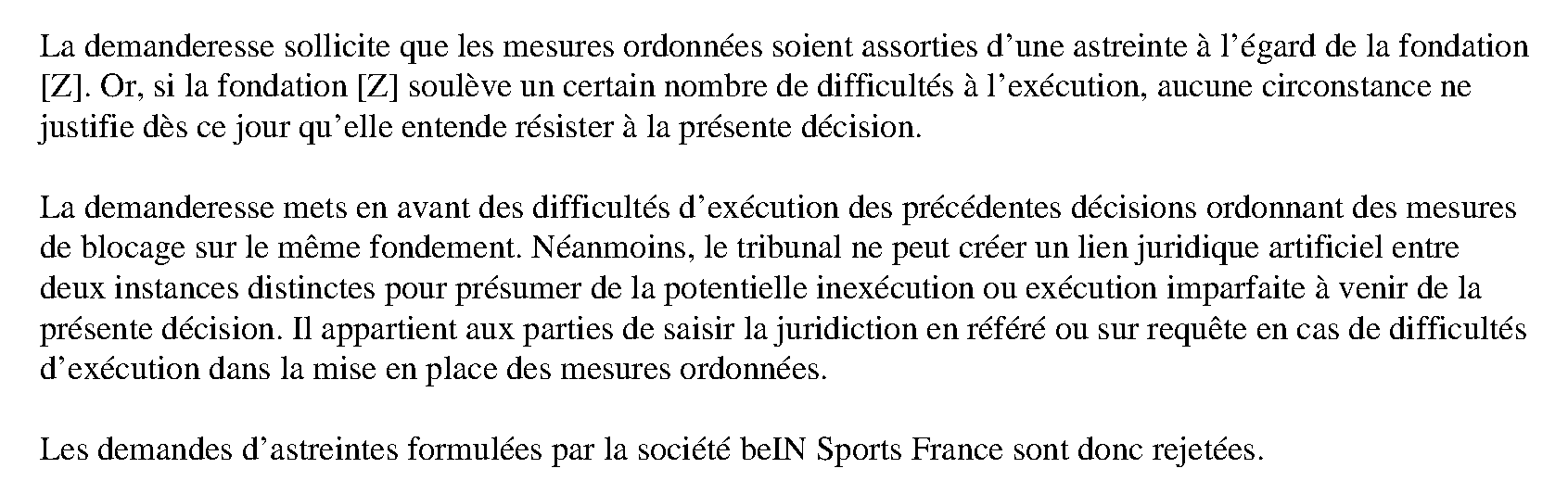
That is what beIN has done indeed. Quad9 informed TorrentFreak that the broadcaster went back to the Paris court to request penalties. According to Quad9, beIN now seeks €10,000 per domain, per day, which adds up to €580,000 per day for the 58 domains on the list.
The case was heard before the Paris court last Thursday and a decision is expected to follow in three weeks. The potential penalties would apply from the moment the order comes in and run in the millions of euros per week.
There are no public notes of the hearing that we know of, but Quad9 explained in detail why it is not blocking any of the domain names, despite facing the potentially bankrupting fines.
The DNS Blocking Problem
Technically Quad9 can block the domain names and avoid further pressure. However, the foundation says that it can’t limit the pirate site blocks to users in France, which is what the court order requires.
The DNS resolver doesn’t collect user data. This means that it would have to rely on third-party databases that link IP addresses to locations to pinpoint users. That’s a problem, Quad9 argues, because these databases are incomplete or inaccurate.
“There is no legally useful way for us to define a French user,” Quad9 tells us.
The foundation has learned this the hard way. In Germany, where Sony Music took the DNS resolver to court and, according to Quad9, judges found that its attempt to limit a block to German users was not good enough. Quad9 eventually won the case on appeal, but that finding was never overturned.
Convincing the Paris court will not be straightforward either. In the May order, the court noted that the defendants failed to show that limiting the blocks to French territory would be costly or technically impossible.
Alternatively, Quad9 can block the domain names globally, as it said it would in 2024. It also did so in Germany in 2023, under the threat of penalties. When asked why it isn’t doing the same now, the foundation explained that the German block was a temporary measure while the case played out. It added that conditions in Germany were different, and that it approaches each case on its own terms.
“We remain entirely confident in our core argument: DNS recursive resolvers are the wrong place to counter the problem of online piracy, and will result in significantly worse outcomes for the citizens of France,” Quad9 says.
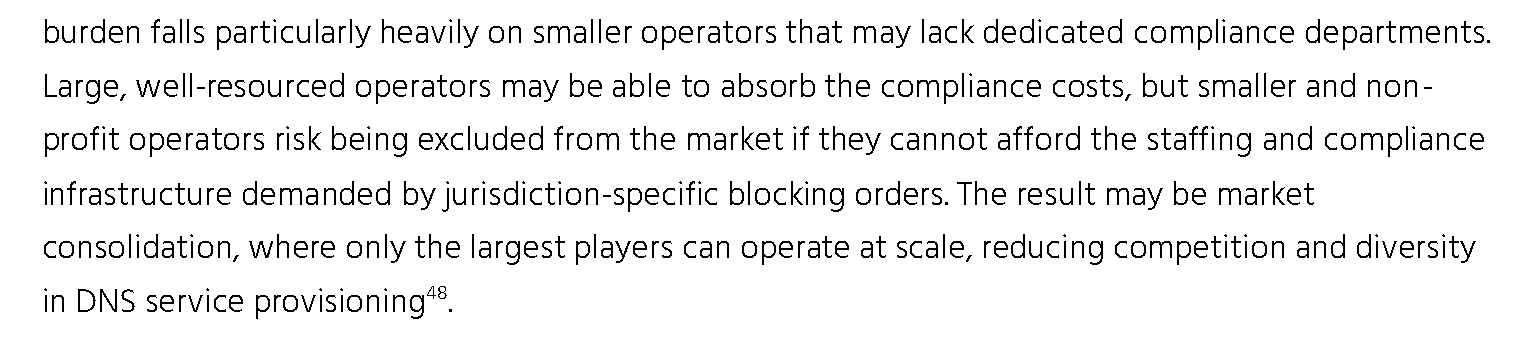
Quad9 is not the only party that raises these concerns. Earlier this year, a report published by the Internet Society warned that smaller DNS operators pay the highest price for blocking orders.
“Large, well-resourced operators may be able to absorb the compliance costs, but smaller and non-profit operators risk being excluded from the market if they cannot afford the staffing and compliance infrastructure demanded by jurisdiction-specific blocking orders,” the report reads.
Leaving France?
If the court grants beIN’s request, Quad9 will have to take action to avoid millions of euros in fines per week. The foundation told us that it essentially has three options left then.
Quad9 can implement a block for French users only, which it says would be inaccurate and still leave it open to fines. Alternatively, it can block the domains globally which, according to Quad9, would essentially extend French jurisdiction across the world.
The final option is to stop serving users it believes are in France altogether, as OpenDNS did in 2024. How accurate that measure is remains to be seen as well.
Quad9 says it has yet to discuss these options with its Foundation Council, noting that it must remain law-abiding without putting its own existence at risk.
“Additionally, we are required by Swiss law to abide by our founding principles of privacy, security, and stability of the internet and how those principles are applied to our user community in a consistent and predictable manner in all areas,” Quad9 notes.
‘Recklessly Dangerous’
The decision isn’t getting any easier now that France prepares to expand its blocking measures. In July, the French Parliament adopted a law that allows new domains to be added automatically during live broadcasts, with regulator ARCOM reviewing them after the fact.
Quad9 sees this as a dangerous development, on top of an already quite concerning blocking requirement.
“An unfettered, unencumbered and delegated power given to an unspecified list of commercial parties to block any content they desire seems to us recklessly dangerous, un-necessary, and counter-productive,” it tells us.
The foundation believes that this will drive people to use less secure systems in unknown jurisdictions. At the same time, the costs associated with continued real-time updates would likely rule out any meaningful vetting, Quad9 adds.
“Dynamic injection of false answers weaponizes the DNS against end users,” the foundation says. “This blocking method will be proven to be ineffective, wasteful, and will not achieve the goal of removing the content which remains as reachable as ever.”
For now, the next step in this blocking saga is up to the Paris court. A decision on the penalties is expected to come in later this month and Quad9 will likely announce its response shortly after.
—
A copy of the May 13 order (RG 26/02207) is available here (pdf). We reached out to beIN Sports for a comment, but the company informed us that it will not comment on the ongoing procedure.