 Last month, we reported that defense attorneys representing prominent torrent trackers told a federal judge that the case may have been filed by an impostor.
After they revealed their findings, Judge Andrea R. Wood put the case on a sanctions track and scheduled an in-person hearing. Since then, the case has taken some surprising turns yet again.
First, defense attorneys Erin Russell and Haley Finch asked the court to hold the plaintiff in contempt for misrepresenting his identity, falsely claiming copyright ownership, and filing under a mail-drop address.
The ‘Real’ Matthew Schneider Appears
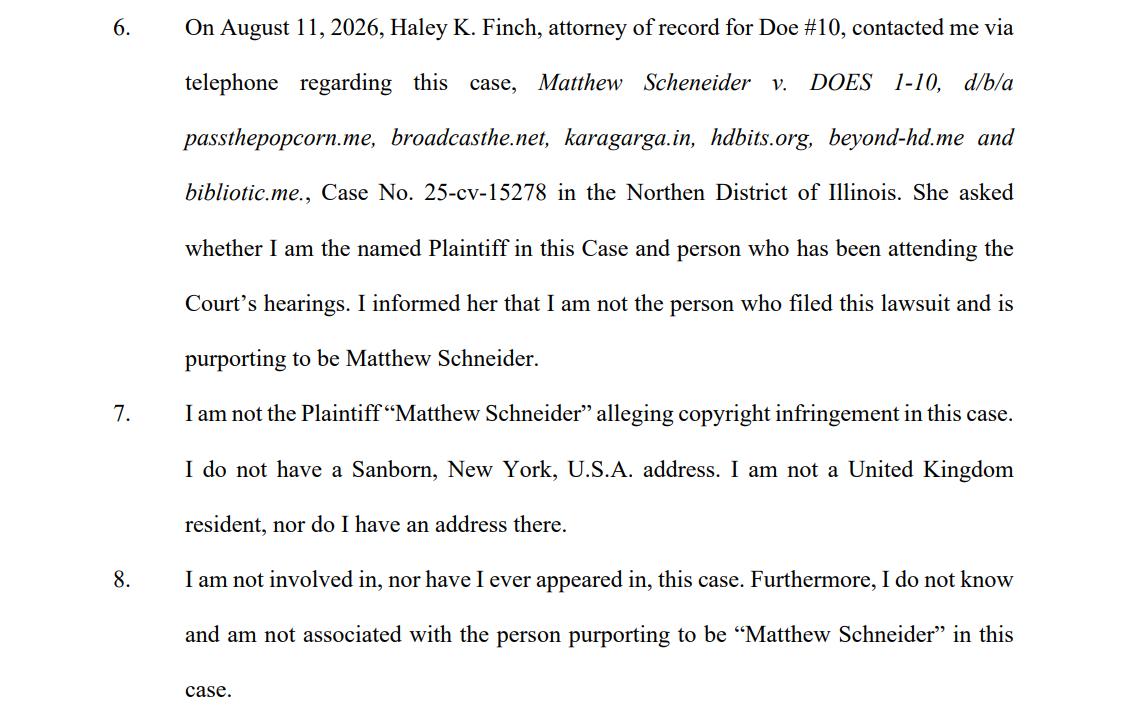
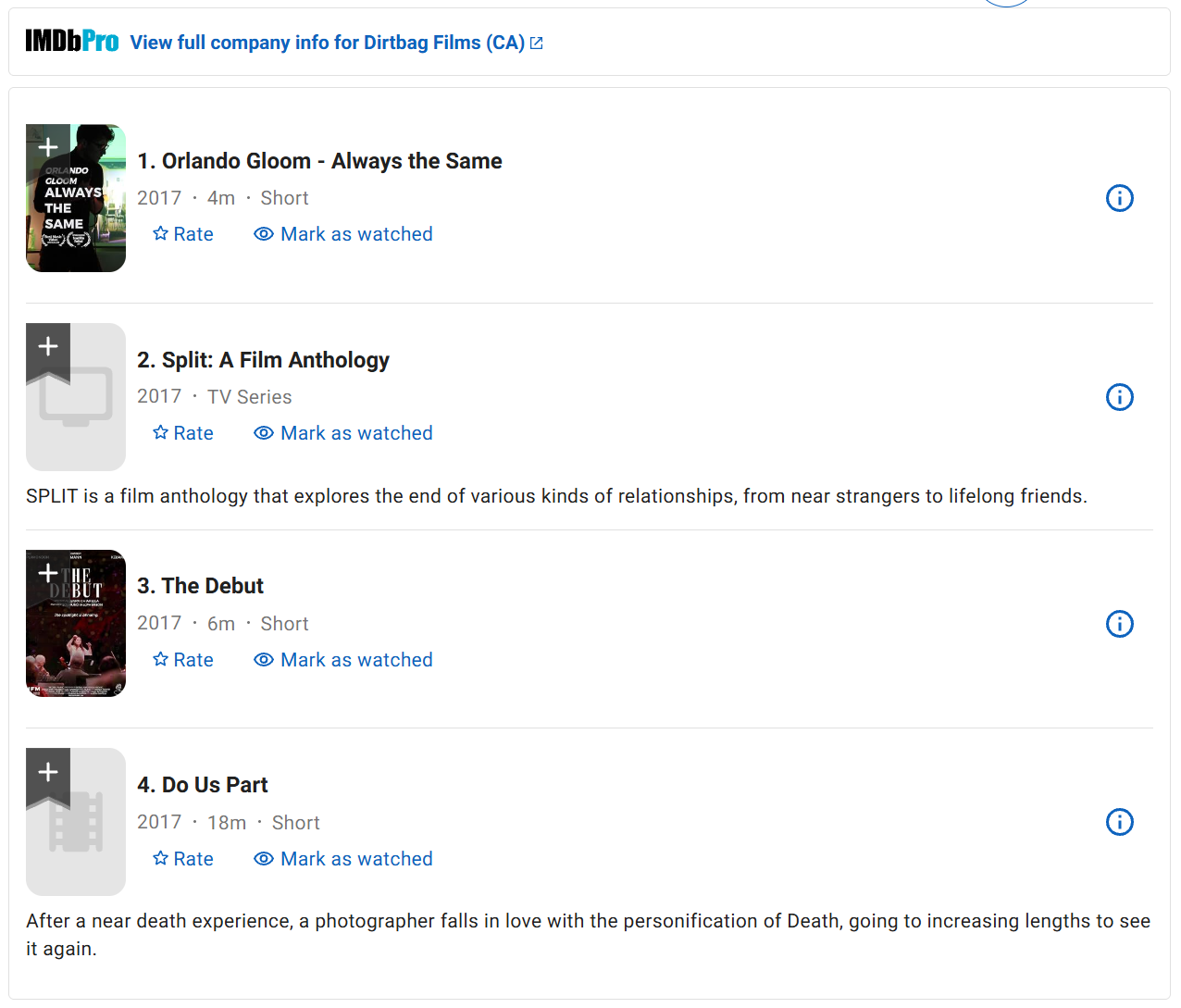
Representing “John Doe” tracker operators, they submitted a declaration from Matthew A. Schneider of Ottawa, Ontario. He is the filmmaker on the IMDb credits for the three films cited in the complaint: “Split: A Film Anthology,” “Do Us Part,” and “Orlando Gloom, Always the Same.”
Under oath, the Canadian clarifies that he indeed created these films with school friends, but that he is not the person that appeared in the lawsuit.
“I am not involved in, nor have I ever appeared in, this case. Furthermore, I do not know and am not associated with the person purporting to be “Matthew Schneider” in this case,” the declaration reads.
The films were created under the high-school filmmaking group “Dirtbag Films,” which also included Solmund MacPherson. He also filed a sworn declaration, confirming that they never sold the rights to the films, and that he didn’t recognize the “matthew.schneider94” email that was on every filing in the federal lawsuit.
MacPherson also tracked down a copy of “Do Us Part.” The real Schneider appears on screen in a speaking role. This should help the judge to compare his voice to the defendant’s. The same is true for an Instagram post, with a photo of the Canadian Schneider, who has since left filmmaking.
A Different Matthew Schneider
Presented with the new evidence, the plaintiff did not give up. On the contrary, in a response filed in court late last week he argued there are two Matthew Schneiders.
The plaintiff writes that he “consistently identified himself in this action as Matthew Schneider, an independent filmmaker and creative professional from the United Kingdom.” He never claimed to be the Canadian and never mentioned Dirtbag Films.
“The existence of another person with the same or similar name is not evidence of impersonation,” he wrote.
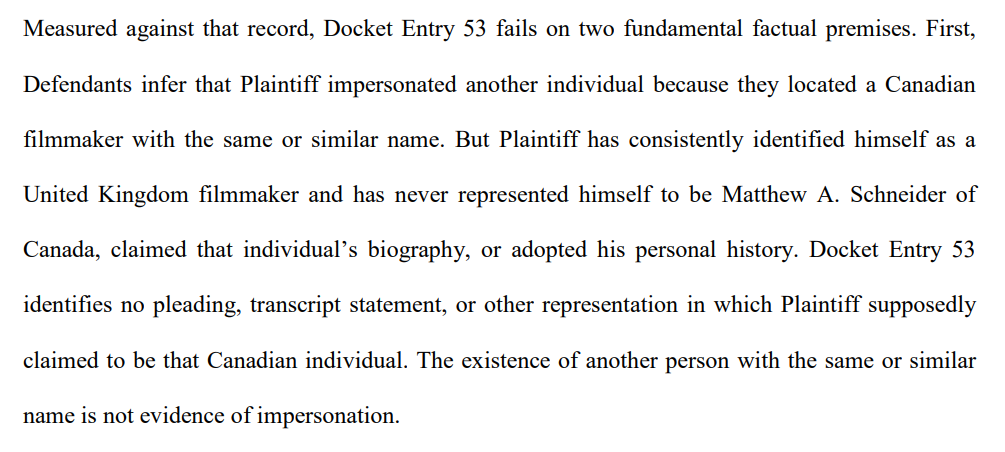
The identical names are not the only coincidence, it appears. The self-described UK filmmaker claims to have independently created films with the exact same titles as the Canadian Dirtbag Films productions.
Identical Film Titles
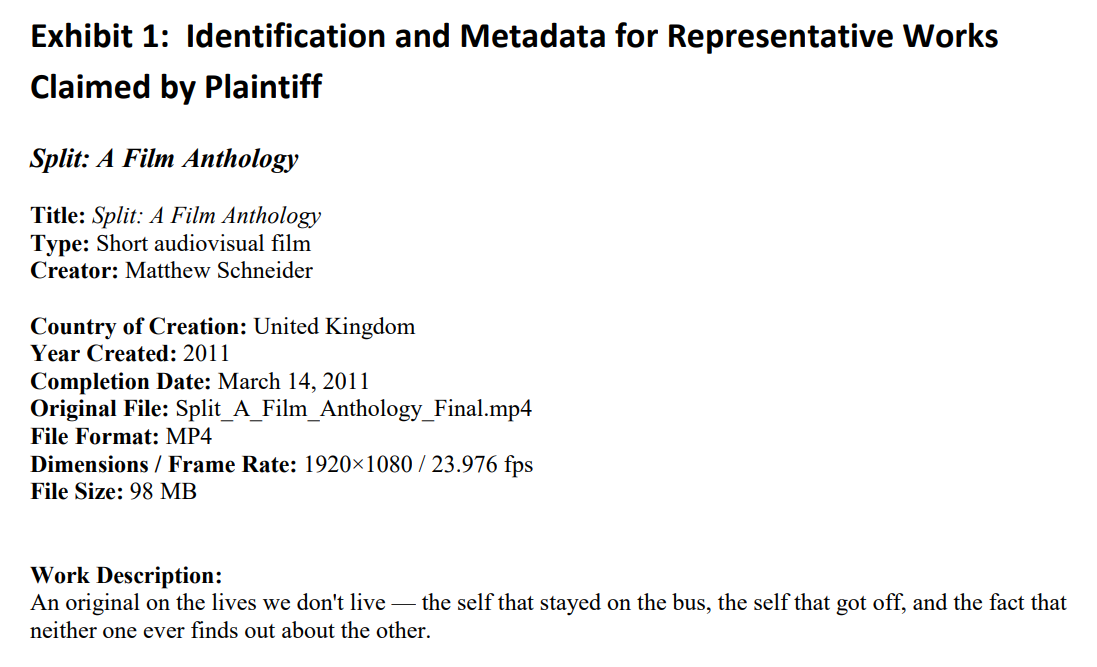
As evidence, he filed an exhibit with metadata for his own alleged versions of the three films, all created in the UK. The dates he lists are 2011 for “Split: A Film Anthology,” 2012 for “Do Us Part,” and 2012 for “Orlando Gloom, Always the Same.”
That puts his versions five to six years before the Dirtbag films, which were created in Canada in 2017. He argues he could not have copied works that “did not yet exist.”
The exhibit lists the films’ filenames, resolutions, and frame rates. However, there are no copyright office registration numbers, no cast members, no crew, no stills, and no IMDb listings.
The chances of two filmmakers with the same name creating three movies with exactly the same titles are slim. Particularly since one title includes “Orlando Gloom,” the name of the musician for whom Dirtbag made the associated music video.
A Procedural Counterattack
The person litigating as Matthew Schneider also went on the offensive. In his response, he accuses defense attorneys Russell and Finch of improper ex parte contact with Judge Wood, pointing to the call defense counsel made to chambers before the August hearing.
Russell described that call as an extraordinary step at the time. The plaintiff now argues that it violated the ban on one-sided communications with a judge, citing the ABA’s professional conduct rules and a Seventh Circuit ruling that allows courts to sanction such contact.
The plaintiff wants the court to disclose the dates and substance of the communications, and to disregard anything that was said outside his presence. He also asks the court to consider sanctions against defense counsel.
In addition, he notes that both declarants and attorney Finch have ties to the same Winnipeg high school, suggesting that the declarations should not be treated as independent corroboration without further explanation.
Whether the pre-hearing call was improper, or a legitimate and justified alert to a potential fraud on the court, is a question Judge Wood will have to answer.
Questions Remain
The response also defends only three of the ten works listed in the complaint. The five other short films and two literary works, which the defense says have no verified creator, are not mentioned.
Later this week all parties are scheduled to attend the first in-person hearing in this case. This is expected to shed further light on the case.
For now, the attorneys representing the torrent tracker operators don’t believe the plaintiff is who he claims to be. If true, that raises the question what this person’s motivation is.
The alleged impostor is clearly interested in uncovering the identities of the tracker operators, but none of the subpoenaed companies, including Reddit, GoDaddy, Cloudflare, PayPal, Stripe, Namecheap, and X Corp, have produced any records. All productions were placed on hold by the court in May and remain frozen.
—
Update: The person litigating as Matthew Schneider has filed a notice of voluntary dismissal. The pending motion for a rule to show cause remains unresolved, however, and the planned hearing remains on the calendar.
—
The defense motion for a rule to show cause is available here (pdf). The plaintiff’s response can be found here (pdf).