 In the summer of 2022, Austrian Internet providers were ordered to block a list of pirate site domains, as well as several IP addresses that belonged to Cloudflare.
These IP address blocks didn’t just target pirate sites. Through shared addresses, thousands of unrelated websites became inaccessible as well.
That incident is highlighted as a key example in a paper presented at an Internet policy research conference in Washington DC this September. In the paper, researchers from Stanford University and Cloudflare examine whether IP addresses are a good tool to identify the websites and people behind them.
Their answer is negative. As an example, they point out that the Austrian ISPs had effectively been ordered to block Cloudflare addresses that hosted both pirate sites and legitimate ones.
“Unfortunately, the IP addresses belonged to Cloudflare, a large content distribution network, and the policy resulted in citizens losing access to thousands of unrelated websites,” the researchers write.
Cloudflare’s own operations were affected by these blocks, and the research has a link to the company as well. The paper discloses that one of the four authors works for Cloudflare and another worked there previously. The data for the research is also partly from Cloudflare’s traffic logs.
Millions of Domains, One Address
To see how common IP sharing has become, the researchers analyzed a decade of DNS records for .com, .net and .org domain names. In addition, they ran their own DNS queries for the most popular domains on the web.
The researchers found that, as of February 2025, only 0.2% of the .com, .net and .org domains had a unique IP address. Even among the top million most popular domains, only 9% used an IP address exclusively.
At the other end of the spectrum, a handful of IP addresses serve millions of domains. The ten IP addresses that host the most live domain names, operated by Squarespace, Amazon, Google Cloud and Wix, serve more than 80 million domains combined.

Large CDN services, Cloudflare included, distribute their customers over more IPs, but these addresses are still heavily shared.
“In contrast, Amazon, Cloudflare, and Google Cloud (all of which provide CDN services) consistently host thousands of domains under a single IP address,” the researchers note, adding that their calculations do not even take subdomains into account.
The researchers found that, over the past decade, IP sharing has only become more prevalent. In 2015, 0.9% of the IP addresses in the dataset accounted for 80% of domains. By 2024, the same share of domains was concentrated on just 0.2% of the addresses.
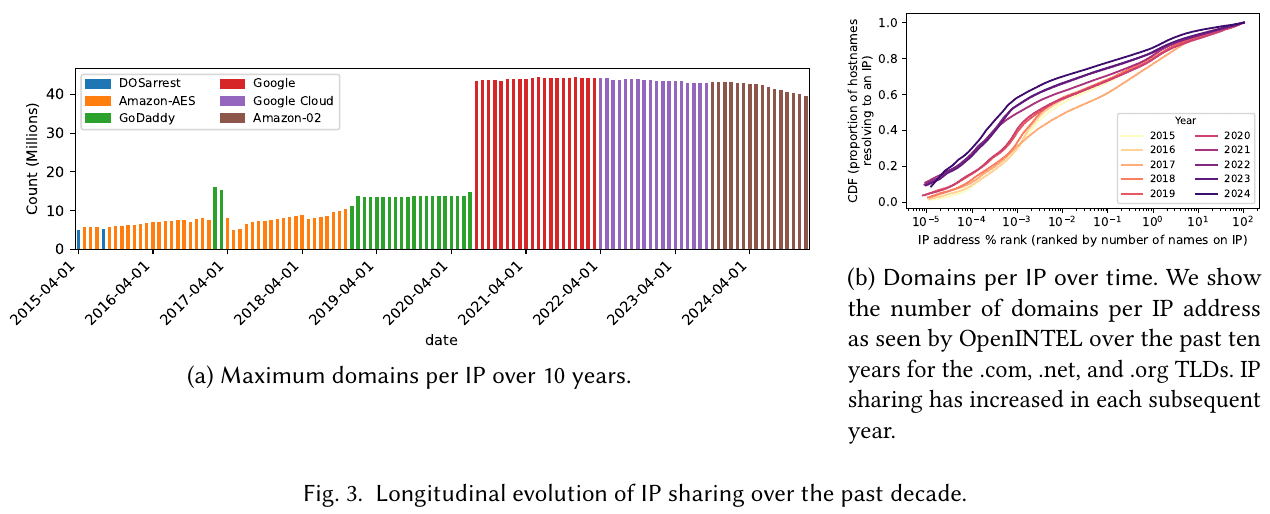
“If history is a predictor of the future, we can expect IP addresses to continue to lose their role as a service identifier,” the paper reads.
An IP Address Is Not a Person
All websites on the web need an IP address, but one server can host many sites on a single address. When a browser connects, it tells the server which site it wants through a field called the Server Name Indication (SNI). An IP address is therefore not a unique identifier.
The paper compares an IP address to a street address, which also says little about a single person.
“Grounded in our analysis, we argue that IP addresses should be regarded as the online equivalents of street addresses. They are necessarily public so that they can be found, but little else is known about them. Looking at a street address does not reveal the number of suites, business, or people who use it, nor its purpose; IP addresses share the same form,” they write.
According to the researchers, this means that blocking implementations at the IP address level can often block much more than intended.
Collateral Damage in Europe
Overblocking incidents have surfaced regularly over the past years. In Spain, for example, football league LaLiga obtained a court order that requires ISPs to block IP addresses used by pirate streams. Since early last year, the blocks applied during matches have regularly included Cloudflare addresses.
Earlier this month, these blocks even made Movistar’s own support forum unreachable.
Research from the Open Observatory of Network Interference (OONI), which the paper cites, found that more than 550,000 of the 9.2 million domains it tested were blocked at some point during LaLiga broadcasts between January and June this year. That research was partly sponsored by Cloudflare.
LaLiga has questioned OONI’s methodology. Last year, the league told TorrentFreak that its blocking is “focused, precise, and without collateral impact on legitimate services.”
According to the paper, the collateral damage of IP blocking is real and it has triggered a shift toward blocking by domain name instead. However, this isn’t perfect either as technologies such as Encrypted Client Hello (ECH) hide that name from Internet providers. LaLiga’s own court case cited ECH as a hurdle for domain blocking.
Whether ECH will keep blocking efforts at the IP level relevant remains an open question, the researchers note, but their paper shows that blocking is not always straightforward.
U.S. Bills Leave the Method Open
The same questions are now relevant in the United States too. In September, two competing bills were introduced in Congress that would allow rightsholders to obtain court orders requiring Internet providers to block foreign pirate sites.
These bills don’t rule out IP blocking. The DEFEND IP Act leaves the technical measures to providers, but judges must weigh whether blocking “would not interfere with access to material at other online locations” that doesn’t infringe.

If legitimate sites are blocked anyway, their operators can ask the court to modify the order. The bill doesn’t offer them any compensation, however. Rep. Issa’s competing American Copyright Protection Act offers up to $250,000 if the rightsholder caused the error.
The paper doesn’t mention the U.S. site blocking proposals. However, it does conclude that blocking policies involve a difficult balancing act.
“Overall, we argue that the community needs to deliberate on how we balance the need for privacy, and the legal mandates to take down services, while at the same time preventing collateral damage,” the researchers write.
—
A copy of the paper, “On IP Addresses as Identifiers of Internet Users and Services,” is available on SSRN and here (pdf).